
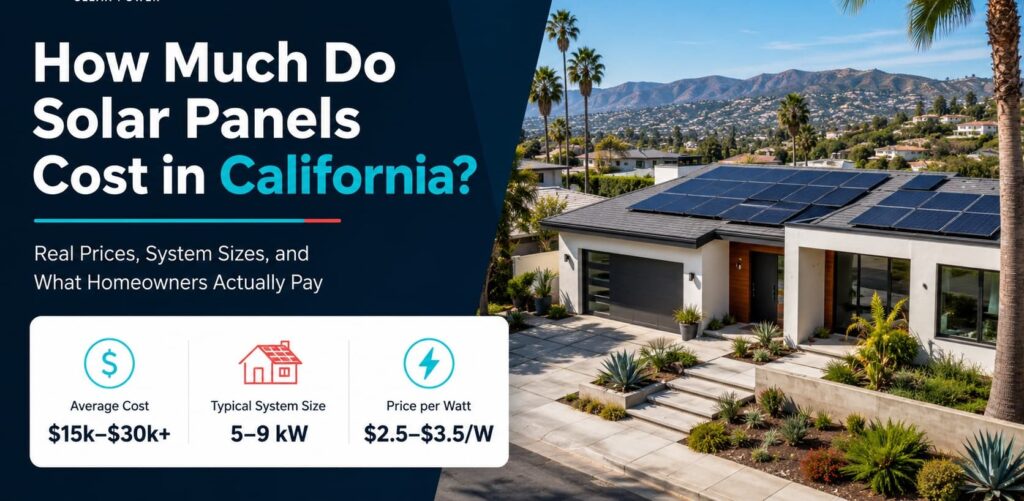
Quick answer: As of 2026, solar panels in California cost about $2.40 to $3.25 per watt installed, so a typical 5kW system runs roughly $12,000 to $16,250 and a 10kW system about $24,000 to $32,500. These are real out-of-pocket prices, because the 30 percent federal residential tax credit expired on December 31, 2025. It no longer applies to purchased systems. Even without it, California solar still pays back in about 5 to 7 years, because the state has the highest electricity rates in the continental US and year-round sun. This guide breaks down current prices by system size, the incentives that still exist, and how to get the best value.
Key takeaways
- California solar costs about $2.40 to $3.25 per watt installed in 2026, slightly below the national average
- The 30 percent federal tax credit (Section 25D) expired December 31, 2025. Purchased systems in 2026 receive no federal credit
- Leases and PPAs can still capture the separate commercial 48E credit and pass it through as lower payments, the only remaining route to federal solar money
- California’s real remaining incentives: SGIP battery rebates, the property tax exclusion (through January 1, 2027), and municipal utility net metering
- Payback still runs 5 to 7 years on the strength of California’s electricity rates alone
Current cost of solar panels in California
Direct answer: the average installed price is $2.40 to $3.25 per watt in 2026, and what you pay scales with system size. The table below shows real 2026 pricing with no federal credit applied, because that credit no longer exists for purchased systems.
California solar system cost by size, 2026 (purchased, no federal credit)
| System size | Installed cost range | Best fit |
|---|---|---|
| 5 kW | $12,000 – $16,250 | Smaller or efficient home |
| 6 kW | $14,400 – $19,500 | Average home, moderate AC |
| 7 kW | $16,800 – $22,750 | Larger home |
| 8 kW | $19,200 – $26,000 | Daily AC, some electric load |
| 10 kW | $24,000 – $32,500 | Big home, pool or EV |
| 12 kW | $28,800 – $39,000 | Very large or high-usage home |
Prices reflect the current California installed range and include equipment, labor, permitting, and interconnection. The federal Section 25D residential credit expired December 31, 2025 (Congressional Research Service); any pricing that shows an “after 30% credit” column for a 2026 purchase is out of date.
What solar costs per watt in 2026
- California average: $2.40 to $3.25 per watt
- National average: $2.70 to $3.60 per watt
California’s prices sit slightly below the national average, thanks to a competitive installer market and mature permitting. Per-watt pricing is the most honest way to compare quotes, since it normalizes for system size. If you want the cost expressed by roof area instead, our solar panel cost per square foot guide covers that math.
What happened to the 30% tax credit?
Direct answer: it is gone for purchased systems. The Residential Clean Energy Credit, Section 25D, paid 30 percent of a solar purchase back at tax time. Congress repealed it in the One Big Beautiful Bill Act, and it expired for any system installed after December 31, 2025.
There is one nuance worth money: the credit follows the installation date, not the filing date. If your system was installed and running in 2025, you can still claim the 30 percent on your 2025 federal return, even if you file in 2026. For anything installed in 2026 or later, there is no residential credit.
The only surviving path to federal solar money is third-party ownership. When a company owns the panels through a lease or PPA, it claims the commercial 48E credit and, in a competitive market, prices that into lower monthly payments. That is now the single reason a lease can beat a purchase for some households. We cover the full picture in our California solar tax credit guide and weigh ownership options in our solar lease vs buy vs PPA guide.
Cost breakdown: where the money goes
Understanding the components helps you compare quotes and spot padding.
| Component | Cost range (typical 6 kW system) | Share of total |
|---|---|---|
| Solar panels | $5,000 – $8,000 | 30-40% |
| Inverter(s) | $1,000 – $2,500 | 10-15% |
| Mounting and racking | $500 – $2,000 | 5-10% |
| Labor and installation | $3,000 – $7,000 | 20-30% |
| Permits and inspection | $500 – $1,000 | 3-5% |
| Electrical, interconnection, misc. | $1,500 – $3,000 | 10-15% |
One cost that can surprise you: if your main electrical panel cannot handle the solar backfeed, a panel upgrade adds $2,500 to $4,500. Ask any installer to confirm whether your panel needs it before you sign.
What incentives California still offers in 2026
The federal credit is gone, but California-specific programs remain. Here is the accurate 2026 picture.
California solar and battery incentives, 2026
| Incentive | What it does | Status |
|---|---|---|
| Federal 48E (via lease/PPA) | Third-party owner claims the credit, prices it into payments | Active through at least 2027 |
| SGIP battery rebate | $150 to $1,100+ per kWh of storage, by tier | Active; general tier waitlisted, income-qualified tiers open |
| Property tax exclusion | Solar’s added home value is excluded from reassessment | Active for systems completed before January 1, 2027 |
| Municipal net metering (LADWP, SMUD, Pasadena) | Full retail credit for exported solar | Active; a major advantage over NEM 3.0 utilities |
| Local and utility rebates | Vary by provider (e.g., SMUD battery program up to $10,000) | Varies |
Details and current amounts in our California solar tax credit guide. SGIP tiers open and close; verify status before installing.
Two of these have deadlines worth acting on. The property tax exclusion sunsets January 1, 2027, so a system completed in 2026 is permanently shielded from reassessment. And SGIP’s income-qualified budgets can genuinely cover most or all of a battery for eligible households.
NEM 3.0 and why your utility matters
Direct answer: since NEM 3.0 took effect, the utility that serves you changes solar economics more than almost anything else. Under NEM 3.0, the investor-owned utilities (PG&E, SCE, SDG&E) pay only a fraction of retail for exported solar, which makes batteries far more valuable so you can use your own power instead of exporting it cheaply. Our NEM 2.0 vs NEM 3.0 explainer covers the mechanics.
Municipal utilities are the exception. LADWP, SMUD, and Pasadena Water and Power still offer traditional retail net metering, which makes solar pay back faster there and a battery optional rather than near-essential. We ran the numbers for two of them in our Granada Hills and Pasadena rate guides.
Long-term savings and payback
Even without the tax credit, the payback math holds because California electricity is so expensive. At the state average of about 35 cents per kWh, an owned system offsets thousands of dollars a year.
- Bill reduction: solar can cut electric bills 70 to 100 percent depending on system size and usage; see our guide to solar savings
- Payback period: about 5 to 7 years for a purchased California system in 2026, faster on municipal utilities with retail net metering
- Home value: owned solar adds roughly 5 to 10 percent to a California home’s value, covered in our home value guide
- System life: quality panels last 25 to 30-plus years, so the two decades after payback are close to free electricity; see how long solar panels last
Regional cost differences across California
Prices vary by market. Los Angeles and the Bay Area tend to run slightly higher on labor and demand, while the Central Valley and Inland Empire often price lower. The bigger regional variable is your utility, not your city, because it determines how much your exported solar is worth.
Tips to get the best value in 2026
- Get 3 to 5 quotes and compare on price per watt, not just total
- Confirm what is included: permitting, interconnection, and a workmanship warranty
- Ask whether your main panel needs an upgrade before you sign
- If you cannot use a purchase, compare a lease or PPA that carries the 48E credit against a solar loan
- Choose a licensed, experienced installer; verify the license on CSLB. NRG Clean Power holds California license #1026168 and has installed statewide for over 30 years
FAQ
How much do solar panels cost in California in 2026?
About $2.40 to $3.25 per watt installed, so roughly $12,000 to $16,250 for a 5kW system and $24,000 to $32,500 for a 10kW system. These are out-of-pocket prices, since the 30 percent federal credit expired at the end of 2025 for purchased systems.
Is there still a 30% solar tax credit in California?
Not for purchased systems. Section 25D expired December 31, 2025. Systems installed during 2025 can still claim it on a 2025 return. In 2026, only leases and PPAs capture federal credit money, through the commercial 48E credit reflected in payments.
What is the average payback period for solar in California?
About 5 to 7 years for a purchased system in 2026, and faster on municipal utilities like LADWP and SMUD that still offer retail net metering. California’s high electricity rates keep payback short even without the federal credit.
Does California have a state solar tax credit?
No. California has no state solar income tax credit. Its incentives are SGIP battery rebates, the property tax exclusion for systems completed before January 1, 2027, and municipal utility net metering.
How much does a solar system cost per watt in California?
$2.40 to $3.25 per watt in 2026, slightly below the national average of $2.70 to $3.60. Per-watt pricing is the best way to compare quotes across different system sizes.
Are solar prices going to drop further?
Panel prices have fallen more than 50 percent since 2010 and have largely stabilized. With the federal credit gone, waiting for small hardware price drops usually costs more in avoided bill savings than it saves, given California’s rates.