
Last updated: July 1, 2026
When your electricity bill is higher than expected, the first number to check is not the dollar total. It is your electricity use in kilowatt-hours, or kWh.
Your bill can increase because of electricity rates, delivery charges, fixed fees, Time-of-Use pricing, weather, or seasonal demand. But your kWh total shows how much electricity your home actually used.
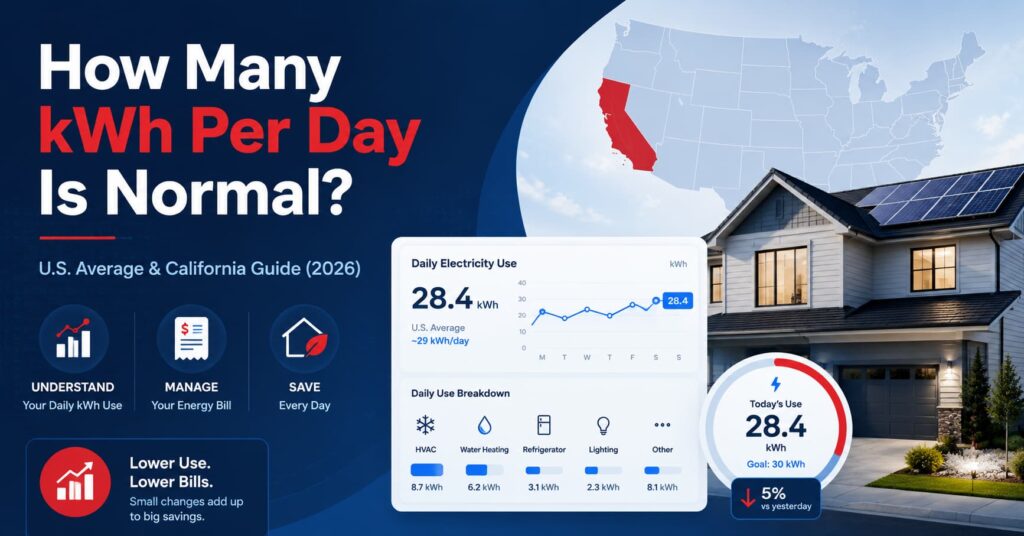
For most U.S. households, around 29 kWh per day remains a useful broad benchmark. However, “normal” depends heavily on your climate, home size, insulation, heating and cooling equipment, electric vehicle charging, pool equipment, household size, and appliance efficiency.
In 2026, the price of electricity matters more than ever. The latest U.S. Energy Information Administration electricity-price data shows that U.S. residential electricity averaged 18.83 cents per kWh in April 2026. California averaged 35.25 cents per kWh, about 87% higher than the national average.
That means two households using the same number of kWh can receive very different bills.
What is normal daily kWh usage for your home?
Select a household profile to see an illustrative daily electricity-use range, compare it with U.S. and California benchmarks, and estimate what that use could cost each month.
Mid-size home, 3–4 people, mixed climate, without major added electric loads.
Based on 870 kWh/month at the U.S. April 2026 average price.
Where does this profile sit?
The blue band is your illustrative daily use range. The red marker is the profile midpoint.
This profile is close to the latest finalized U.S. average. Your actual bill may still differ significantly based on your local electricity rate and when you use electricity.
Quick Answer: What Is Normal Daily kWh Usage?
| Daily Electricity Use | What It Usually Means |
|---|---|
| Under 10 kWh/day | Efficient studio, small apartment, mild climate, little AC use |
| 10–20 kWh/day | Apartment, condo, smaller home, or lower-use household |
| 20–30 kWh/day | Typical smaller single-family home or average household |
| 30–45 kWh/day | Larger home, more occupants, more AC use, electric appliances, or EV charging |
| 45–60+ kWh/day | Large home, electric heating, heavy AC, pool equipment, EV charging, or several major loads |
These are practical ranges, not strict rules.
A household using 15 kWh per day may be completely normal in a mild climate or apartment. A household using 50 kWh per day may also be normal if it has central air conditioning, an EV, a pool, electric water heating, or a large number of occupants.
The best benchmark is always your own usage compared with the same month last year.
The Latest 2026 Electricity Snapshot
The latest official monthly EIA release covers April 2026. It shows that U.S. residential customers purchased 98.3 terawatt-hours of electricity during the month, up about 1% from April 2025. California residential customers purchased 5.55 terawatt-hours during the same month. These figures are statewide and national total sales, not per-home averages. EIA’s April 2026 residential sales table includes the full breakdown by state.
| Metric | Latest Official Figure |
|---|---|
| U.S. residential electricity price, April 2026 | 18.83¢ per kWh |
| California residential electricity price, April 2026 | 35.25¢ per kWh |
| California price premium versus U.S. average | About 87% |
| U.S. residential electricity sold, April 2026 | 98.3 TWh |
| California residential electricity sold, April 2026 | 5.55 TWh |
| U.S. residential sales change from April 2025 | Up about 1% |
A complete 2026 annual “average kWh per household” number is not available yet because EIA publishes annual customer-account averages after the year ends.
The latest complete nationwide per-customer benchmark is approximately 865 kWh per month, or about 28.8 kWh per day. EIA uses residential sales, customer accounts, and revenue to calculate those annual averages. See the EIA’s explanation of average residential electricity bills and household consumption.
What Is a kWh?
A kilowatt-hour is the unit your utility uses to measure electricity.
One kWh equals the energy used by a 1,000-watt appliance running for one hour.
For example:
- A 100-watt light bulb running for 10 hours uses about 1 kWh.
- A 1,500-watt space heater running for two hours uses about 3 kWh.
- A 3,000-watt appliance running for one hour uses about 3 kWh.
Use this formula to estimate appliance usage:
Watts × hours used ÷ 1,000 = kWh used
For example, a 1,500-watt portable heater running for four hours uses:
1,500 × 4 ÷ 1,000 = 6 kWh
The U.S. Department of Energy’s appliance energy-use guide provides more detail on estimating electricity use by appliance wattage and operating time.
How Much Does Daily Electricity Use Cost in 2026?
The table below compares what daily electricity use costs at the latest April 2026 average residential electricity price in the United States and California.
These are simplified electricity-use estimates. Your actual bill may also include delivery charges, fixed monthly charges, taxes, Time-of-Use pricing, fuel adjustments, Community Choice Aggregator charges, and other utility-specific fees.
| Daily Electricity Use | Approximate Monthly Use | U.S. Cost at 18.83¢/kWh | California Cost at 35.25¢/kWh |
|---|---|---|---|
| 10 kWh/day | 300 kWh | About $56 | About $106 |
| 15 kWh/day | 450 kWh | About $85 | About $159 |
| 20 kWh/day | 600 kWh | About $113 | About $212 |
| 25 kWh/day | 750 kWh | About $141 | About $264 |
| 30 kWh/day | 900 kWh | About $169 | About $317 |
| 40 kWh/day | 1,200 kWh | About $226 | About $423 |
| 50 kWh/day | 1,500 kWh | About $282 | About $529 |
This is why daily kWh use alone does not tell the full story.
A California household using 20 kWh per day can pay more than a household in another state using 30 kWh per day.
How to Calculate Your Own Daily kWh Usage
You can find your daily electricity use in less than a minute.
Step 1: Find Your Total kWh on the Bill
Look for the total number of kWh used during the billing period.
For example:
- Electricity used: 750 kWh
- Billing period: 30 days
Step 2: Divide by the Number of Days
750 kWh ÷ 30 days = 25 kWh per day
Your average use is 25 kWh per day.
Always use the exact number of billing days shown on your bill. Some utility billing cycles are 28 days, 30 days, 31 days, or longer.
Step 3: Compare the Same Season
Do not compare a July bill with a February bill and assume something is wrong.
A better comparison is:
- July 2026 versus July 2025
- August 2026 versus August 2025
- Winter usage versus the prior winter
- Summer usage versus the prior summer
This helps separate normal seasonal cooling or heating demand from a real increase in electricity use.
Step 4: Calculate Your Effective Cost per kWh
Use this formula:
Total electric charges ÷ total kWh used = effective cost per kWh
For example:
- Total electric charges: $280
- Electricity used: 750 kWh
$280 ÷ 750 = 37.3¢ per kWh
Your effective cost per kWh can be much higher than the energy-generation rate on your bill because it includes delivery charges, taxes, fixed fees, and other utility costs.
What Uses the Most Electricity in a Home?
Most high electricity bills come from a small number of major loads.
Heating and Cooling
Heating and cooling are often the largest electricity users in a home.
Central air conditioning can add significant daily kWh use during hot weather. Older HVAC systems, duct leaks, poor attic insulation, air leaks, and poor thermostat settings can make the problem worse.
In a hot climate, air conditioning can push a home from 20 kWh per day to 40 kWh per day or more.
Electric Water Heating
Traditional electric resistance water heaters can use a meaningful amount of electricity every day.
Heat pump water heaters generally use less electricity because they move heat rather than generating all heat directly through electric resistance.
EV Charging
An EV can materially change your household electricity use.
For example, an EV that adds 300 kWh per month of home charging increases household electricity use by roughly 10 kWh per day on average.
That does not mean EV ownership is expensive or inefficient. It simply means your home’s electricity use needs to be evaluated differently.
Pools and Spas
Pool pumps, spa pumps, filtration systems, and pool heating equipment can add substantial daily electricity use.
The total depends on pump size, run time, water temperature, weather, and whether the pool uses electric heating.
Clothes Dryers and Electric Cooking
Electric dryers, ovens, ranges, dishwashers, and laundry equipment can have a noticeable impact, especially in larger households.
The ENERGY STAR heat pump dryer guide notes that heat pump dryers can use substantially less electricity than conventional dryer technology.
Older Refrigerators and Freezers
A second refrigerator or freezer in a hot garage can quietly increase electricity use throughout the year.
Older units often run harder during summer. A plug-in electricity monitor can help determine whether an older extra refrigerator or freezer is worth replacing or unplugging.
Why Did My kWh Usage Increase Suddenly?
A sudden rise in daily electricity use usually has a specific cause.
Common reasons include:
- A heat wave increasing AC runtime
- A new EV or more frequent home charging
- A pool pump running longer than expected
- A new electric appliance
- A refrigerator, freezer, water heater, or HVAC system starting to fail
- More people working from home
- A thermostat schedule changing
- An electric vehicle charger set to charge during the day
- A home addition, converted garage, or new appliance load
- A utility estimated-meter read or billing issue
Start by checking your utility account portal.
Look for the date when usage began to increase. A spike every afternoon may point to AC, cooking, EV charging, pool equipment, or another scheduled load. A steady day-and-night increase may point to an appliance running continuously.
California Context: Lower Usage Does Not Always Mean Lower Bills
California is one of the best examples of why electricity use and electricity cost are not the same thing.
California households generally use less electricity than the national average. The latest finalized annual EIA data showed California residential accounts averaging roughly 503 kWh per month, or about 16.8 kWh per day.
But California’s latest April 2026 residential electricity price was 35.25¢ per kWh, compared with 18.83¢ per kWh nationally.
That means a California household can use substantially less electricity than the typical U.S. household and still receive a larger monthly bill.
The California Public Advocates Office reported average residential rates as of March 1, 2026 of approximately:
| Utility | Average Residential Rate |
|---|---|
| Southern California Edison | 33.7¢ per kWh |
| PG&E | 34.5¢ per kWh |
| San Diego Gas & Electric | 45.7¢ per kWh |
These are average residential utility rates, not a quote for every customer or rate plan. The CPUC Public Advocates Office Q1 2026 Electric Rates Report provides the full methodology and utility comparison.
Same Electricity Use, Very Different California Bills
Your utility territory matters as much as your kWh usage.
According to SMUD’s official comparison as of June 1, 2026, a household using exactly 750 kWh per month could see dramatically different bills across California.
| Utility or Service Area | Estimated Monthly Bill at 750 kWh |
|---|---|
| Turlock Irrigation District | $139 |
| SMUD | $149 |
| Roseville Electric | $156 |
| Modesto Irrigation District | $175 |
| LADWP | $217 |
| Southern California Edison | $283 |
| PG&E | $290 |
| San Diego Gas & Electric | $322 |
The same 750 kWh can cost about $149 in SMUD territory or about $322 in SDG&E territory.
You can see the current comparison on SMUD’s utility rate comparison page.
Time-of-Use Rates: Why Two Homes Can Pay Different Bills for the Same kWh
Your kWh total shows how much electricity you used.
Your rate plan determines how much you paid for it.
Many California households are on Time-of-Use plans, where electricity costs more during higher-demand periods and less during off-peak hours.
Two households can use the same 25 kWh per day but receive very different bills.
One household may charge an EV overnight, run appliances later in the evening, and pre-cool the home before peak pricing begins. Another may charge an EV, cook dinner, run central AC, dry clothes, and use pool equipment during more expensive hours.
California homeowners can use the CPUC electric rate comparison tool to compare residential, CARE, and EV rates by ZIP code, city, county, utility, or Community Choice Aggregator territory.
How to Reduce kWh Usage and Lower Your Bill
Focus on Your Largest Loads First
Do not focus on phone chargers and LED bulbs before checking the biggest electricity users in your home.
For most households, the largest opportunities are:
- Heating and cooling
- Water heating
- EV charging
- Pool and spa equipment
- Clothes drying
- Older refrigerators and freezers
- Appliances and electronics that remain on constantly
Improve Cooling Efficiency
Before replacing your AC system, start with the basics:
- Replace HVAC filters regularly
- Seal obvious air leaks
- Improve attic insulation
- Use window shades or solar screens
- Use ceiling fans
- Keep outdoor HVAC equipment clear of debris
- Use a programmable thermostat schedule
- Pre-cool the home before peak pricing periods when practical
Move Flexible Use to Lower-Cost Hours
Flexible electricity loads can include:
- EV charging
- Dishwashers
- Laundry
- Pool pumps
- Water heating
- Battery charging
The goal is not only to reduce kWh. It is to avoid using electricity during your utility’s most expensive hours.
Review Your Rate Plan Every Year
A rate plan that worked before you added an EV, battery, heat pump water heater, solar system, or pool may no longer be the best fit.
Review your annual usage and rate plan at least once per year.
Consider a Home Energy Assessment
A whole-home energy assessment can help identify the biggest electricity loads before you spend money on upgrades.
The Department of Energy’s home energy assessment guide explains how homeowners can identify insulation gaps, air leaks, HVAC issues, appliance loads, and other efficiency opportunities.
California Bill Assistance Programs in 2026
California homeowners and renters should also check whether they qualify for bill assistance.
CARE
The California Alternate Rates for Energy program provides eligible households with a 30% to 35% discount on electric bills through large utilities. Smaller utility providers may offer a 20% discount.
Current income limits are effective June 1, 2026 through May 31, 2027.
| Household Size | CARE Maximum Annual Income |
|---|---|
| 1–2 people | $43,280 |
| 3 people | $54,640 |
| 4 people | $66,000 |
| 5 people | $77,360 |
| 6 people | $88,720 |
FERA
The Family Electric Rate Assistance program provides an 18% discount for eligible PG&E, SCE, and SDG&E households whose income is above CARE limits but within the FERA eligibility range.
| Household Size | FERA Maximum Annual Income |
|---|---|
| 1–2 people | $54,100 |
| 3 people | $68,300 |
| 4 people | $82,500 |
| 5 people | $96,700 |
| 6 people | $110,900 |
The CPUC CARE and FERA program page has complete income limits and enrollment information.
Income-qualified households may also qualify for no-cost insulation, weatherization, refrigerator upgrades, caulking, weatherstripping, and other efficiency measures through the California Energy Savings Assistance Program.
California Climate Credit in 2026
California’s Climate Credit is an automatic utility-bill credit funded through the state’s Cap-and-Invest Program.
Beginning in 2026, electric customers of PG&E, SCE, and SDG&E receive their Climate Credit during August and September, rather than the previous April and October schedule.
The CPUC’s 2026 Climate Credit update explains that the timing change is intended to provide bill relief during higher-use summer months.
The credit can lower a particular month’s bill, but it does not mean household electricity use declined.
How Daily kWh Helps With Solar and Battery Planning
Your daily electricity use is one of the most important starting points for a solar assessment.
But do not size a solar system based on one month of electricity use.
A proper solar and battery evaluation should consider:
- Your last 12 months of electricity use
- Seasonal changes in kWh usage
- Your utility and current rate plan
- Daytime versus evening electricity use
- EV charging habits
- Pool and spa equipment
- Planned electric appliances
- Roof orientation and available solar production
- Battery-storage goals
- Current utility export-compensation rules
Solar can reduce the electricity you buy from the grid. A battery can help shift solar energy produced during the day into higher-cost evening periods.
For California homeowners, this matters most when electricity rates are high, evening usage is significant, or future electricity demand is expected to increase.
For more utility-rate context, see our guide to the average electric bill in California.
Frequently Asked Questions
Is 20 kWh per day high?
Not necessarily.
Twenty kWh per day is below the latest U.S. average of around 29 kWh per day. It can be normal for a small single-family home, condo, apartment, or efficient household.
For California, 20 kWh per day is above the state’s latest finalized annual average, but it can still be normal for a home with moderate AC use, electric appliances, or several occupants.
Is 50 kWh per day a lot?
For many homes, yes. But it can be normal for a large home with central AC, electric heating, EV charging, pool equipment, or heavy summer cooling demand.
At California’s April 2026 statewide average electricity price, 50 kWh per day is about 1,500 kWh per month, or roughly $529 in electricity-use charges before utility-specific fees and bill details.
How many kWh per day does a one-bedroom apartment use?
Many one-bedroom apartments use around 8 to 15 kWh per day.
Actual use depends on climate, AC, electric heating, appliance efficiency, the number of occupants, and whether the apartment includes EV charging or laundry equipment.
Why is my electric bill high if my kWh usage is low?
Your electricity rate may be high.
This is particularly common in California, where bills can include high delivery charges, fixed charges, Time-of-Use pricing, Community Choice Aggregator charges, and utility-specific fees.
How can I see my daily kWh use without doing math?
Log into your utility account portal.
Most major utilities provide daily and hourly usage charts. You can also divide the total kWh on your bill by the number of days in the billing period.
Can solar eliminate my electric bill?
Solar can reduce the electricity-use portion of a bill, but it may not eliminate every fixed charge, delivery-related charge, minimum charge, or non-bypassable utility fee.
Bottom Line
For most U.S. homes, around 29 kWh per day remains a useful benchmark.
But the right question is not simply, “Is my kWh use normal?”
The more useful question is:
Is my electricity use reasonable for my home, climate, utility territory, appliances, and lifestyle?
A 15 kWh-per-day apartment may be completely normal. A 50 kWh-per-day home may also be normal with air conditioning, an EV, a pool, and a larger household.
In 2026, your electricity price matters more than ever. The latest EIA data shows that California’s residential electricity price is nearly double the national average, which is why understanding your usage, rate plan, and largest electricity loads can have a meaningful impact on your bill.
At NRG Clean Power, we help homeowners understand their annual electricity use, utility rates, solar potential, battery needs, and long-term energy costs based on their specific home and usage profile.