

Quick answer: As of October 2026, a typical California homeowner on PG&E, SCE or SDG&E has almost no cash rebate left for solar. The 30% federal credit ended December 31, 2025, and SGIP’s standard battery rebate is closed in all three territories. What remains: the solar property tax exclusion (finish by January 1, 2027), the ACC Plus export adder, income-qualified programs, and municipal utility rebates worth $5,000 to $12,000 in SMUD, Riverside and Pasadena.
Key takeaways
- Your utility now decides your incentives more than any state or federal program does.
- SGIP’s general-market battery rebate ($150/kWh) and Equity Resiliency ($1,000/kWh) are closed statewide.
- The property tax exclusion is the last broad incentive, and it stops covering new systems on January 1, 2027.
- Municipal utilities are where the money moved: Riverside pays $500/kWh for batteries, SMUD about $5,400 per Powerwall 3.
- Low-income households can still reach $3.10/W for solar and $1.10/Wh for storage, though most budgets are waitlisted.
Which California solar incentives are still available in 2026?
Six programs still pay something, but only three reach a standard-income homeowner on PG&E, SCE or SDG&E, and one of those requires leasing. Most incentive pages you will find still list rebates that closed months or years ago, so here is what I tell homeowners first: check your utility before you check any rebate list.
I have never seen California’s incentive map change this fast. In January the federal credit disappeared. By October the state’s main battery rebate had run dry for ordinary households. Meanwhile a handful of city-owned utilities quietly launched the richest battery rebates in the state.
California solar and battery incentives, status as of October 7, 2026
| Incentive | Who qualifies | Value | Status (Oct 7, 2026) |
|---|---|---|---|
| Federal Section 25D credit | Homeowners who buy | 30% (was) | Ended Dec 31, 2025 |
| Federal Section 48E (via lease or PPA) | Third-party-owned systems | Up to 30%, passed through in pricing | Active; must be in service by Dec 31, 2027 |
| SGIP Small Residential Storage | Any PG&E, SCE, SDG&E, SoCalGas home | $0.15/Wh | Closed |
| SGIP Equity Resiliency | Income or medical need + fire or PSPS risk | $1.00/Wh | Closed |
| SGIP Residential Solar and Storage Equity | Low-income homes | $3.10/W solar + $1.10/Wh storage | Waitlist for most; open for some muni customers |
| Property tax exclusion (Section 73) | Every solar owner | Excludes system value from reassessment | Active until Jan 1, 2027 |
| ACC Plus export adder | PG&E and SCE residential | Extra cents per exported kWh, locked 9 years | Shrinking 20% a year; ends for new customers in 2028 |
| DAC-SASH | Low-income homeowners in disadvantaged communities | $3/W, usually a no-cost system | Active, $10M per year |
| Municipal rebates | SMUD, Riverside, Pasadena and others | $500 to $550/kWh batteries; $0.60/W solar in Pasadena | Active |
Sources: CPUC SGIP page, SGIP budget tracker, CPUC Solar in Disadvantaged Communities, Board of Equalization.
Is there still a solar tax credit in California in 2026?
No, not for homeowners who buy. The 30% federal Residential Clean Energy Credit (Section 25D) ended for any system completed after December 31, 2025, and California has no state solar income tax credit.
The federal credit did not vanish completely. It moved to the company side. Under Section 48E, the owner of a leased or PPA system can still claim up to 30%, and in a competitive market part of that value shows up as a lower monthly payment. Leased and PPA projects that start construction after July 4, 2026 must be placed in service by December 31, 2027 to qualify.
What this means for pricing: any 2026 quote for a system you buy should show no federal credit. If a salesperson nets 30% off a purchased system installed this year, walk away. Our full breakdown of the federal credit in 2026 covers carryforwards and the 48E rules, and our lease vs. buy vs. PPA guide runs the cash-flow math both ways.
Can I still get an SGIP battery rebate in 2026?
Only if your household is income-qualified, and even then you will probably join a waitlist. On October 7, 2026, the state’s SGIP tracker showed the general-market Small Residential Storage budget ($0.15/Wh) closed at Step 7 in every territory: PG&E, SCE, SDG&E (run by the Center for Sustainable Energy) and SoCalGas. Equity Resiliency ($1.00/Wh) is closed too.
The CPUC’s own SGIP page now marks those budgets “available through 2025.” The one residential budget still taking money is Residential Solar and Storage Equity, which pays $3.10 per watt of solar and $1.10 per watt-hour of storage for low-income homes. Here is where it stood on the SGIP budget tracker:
- Open: the slice reserved for customers of publicly owned utilities, administered by PG&E (about $5.8 million left) and SCE ($1.0 million).
- Waitlist: the main PG&E and SCE customer slices, plus SDG&E, SoCalGas and LADWP customers.
Put a Tesla Powerwall 3 (13.5 kWh) through those numbers and you see what changed. Under the old general-market rate it earned 13,500 Wh x $0.15 = $2,025. Today a standard-income PG&E customer gets $0 from SGIP. A low-income customer who clears the waitlist gets 13,500 x $1.10 = $14,850 for the same battery, plus $3.10/W on paired solar. SGIP also requires enrollment in a qualifying demand response program within a year of reserving funds.
If you are income-qualified, get on the waitlist now. Budgets reopen when unspent reservations are cancelled. Our solar battery cost guide shows what a battery costs before any rebate.
Does solar raise my property taxes in California?
Not if your system is finished before January 1, 2027. Revenue and Taxation Code Section 73 keeps a solar system out of your home’s reassessment, and the Board of Equalization has confirmed that a system completed before that date stays excluded until the property changes hands. The 2025 cleanup bill, SB 710, kept January 1, 2027 as the date the exclusion stops applying to new systems.
This is now the most valuable incentive most homeowners can still get, and almost nobody is talking about it. Here is the math on a typical NRG install:
- A 7.2 kW system at $3.00/W (the middle of the $2.40 to $3.25/W California range) costs $21,600.
- California’s base property tax rate is 1% of assessed value, so that system would add about $216 a year before local bonds and assessments.
- Prop 13 lets assessed value rise up to 2% a year. Over 20 years, $216 growing 2% a year adds up to about $5,250 in tax you avoid by finishing in 2026.
The catch is the word “completed.” If construction runs past December 31, the BOE treats work added in 2026 that is unfinished on January 1 as assessable. With roughly 12 weeks left, a system you sign for in November is cutting it close. You claim the exclusion with Form BOE-64-SES through your county assessor; our property tax exclusion guide walks through the filing.
Which California utilities still pay solar and battery rebates?
City-owned utilities, and they pay more than SGIP ever paid a standard-income household. Three stand out in 2026, and they are not on the CPUC’s radar because the CPUC does not regulate them.
SMUD (Sacramento). The My Energy Optimizer Partner+ program pays a one-time enrollment incentive equal to the battery’s nameplate kWh x 80% x $500, capped at $10,000 per home across 2 batteries. For a 13.5 kWh Powerwall 3 that is 13.5 x 0.8 x $500 = $5,400. SMUD then pays up to $110 per battery per quarter, about $440 a year, for letting it dispatch your battery during peak events. You must be on SMUD’s Solar and Storage Rate and enroll within 90 days of permission to operate. Details on SMUD’s battery page; local rate context in our Sacramento electricity rates guide.
Riverside Public Utilities. RPU’s new Energy Storage Rebate pays $500/kWh, up to $10,000 per project, for batteries purchased on or after July 1, 2026. Customers in RPU’s SHARE assistance program get $850/kWh, up to $17,000. It covers standalone batteries and batteries added to new or existing solar. A Powerwall 3 earns $6,750 at the standard rate. See our Riverside electricity rates guide.
Pasadena Water and Power. A pilot launched in April 2026 pays $0.60/W for new or expanded rooftop solar ($1.00/W for customers in PWP’s income-qualified programs) and up to $550/kWh for battery storage. PWP is also waiving its plan review and inspection fees for solar and battery projects during the pilot.
Anaheim Public Utilities runs its own battery rebate for customers who pair storage with existing solar, with new amounts effective July 1, 2026. Check Anaheim’s battery page for the current figure.
LADWP no longer pays an upfront solar rebate. Its Solar Incentive Program closed to new applications on December 31, 2018, even though some rebate sites still list it. LADWP’s real incentive is that it never adopted NEM 3.0, so exports still earn close to retail value. Our Los Angeles installer guide explains why that makes solar-only systems pencil there.
What is the ACC Plus adder, and is it still worth anything?
It is a small bonus on top of NEM 3.0 export credits for PG&E and SCE residential customers, and it shrinks every year. The CPUC built it into the Net Billing Tariff as a glide path: customers who interconnect during the tariff’s first 5 years (April 2023 to April 2028) get extra cents per exported kWh, locked for 9 years. SDG&E customers do not get it.
In year one the adder was about 2.2 cents per kWh for PG&E and about 4 cents for SCE non-CARE customers, with higher values for CARE households. It falls 20% for each new annual cohort, so a customer interconnecting in late 2026 locks in roughly half the year-one value. That works out to around 1.1 cents on PG&E and 2 cents on SCE.
To size it honestly: if your system exports 4,000 kWh a year on SCE, 2 cents adds about $80 a year, or roughly $720 over the 9-year lock. That is real money, but it is less than a seventh of what the property tax exclusion is worth on the same system. It should never be the reason you rush. Our NEM 2.0 vs NEM 3.0 explainer covers how export credits work hour by hour.
What solar programs exist for low-income California households?
Four, and they are far richer than anything open to standard-income buyers. The common gate is CARE or FERA eligibility, so start there.
- CARE and FERA bill discounts. CARE cuts electric bills 30% to 35% at the large utilities; FERA cuts them 18% for households up to 250% of the federal poverty guideline. New income limits took effect June 1, 2026 and run through May 31, 2027 (CPUC CARE/FERA page).
- DAC-SASH. For CARE- or FERA-eligible homeowners in disadvantaged communities (the top 25% of census tracts on CalEnviroScreen) served by PG&E, SCE or SDG&E. It pays $3/W, which usually means a no-cost system installed by GRID Alternatives, from a budget of $10 million a year through 2030 (CPUC program page).
- SGIP Residential Solar and Storage Equity. $3.10/W for solar and $1.10/Wh for storage. On a 7.2 kW system with a 13.5 kWh battery, that is $22,320 + $14,850 = $37,170, which in practice covers most or all of the project. Most budgets are waitlisted (see the SGIP section above).
- DAC Green Tariff and Community Solar Green Tariff. For income-qualified renters or homeowners in disadvantaged communities who cannot put panels on their roof: a 20% bill discount from a utility-scale or local solar project.
If you think you qualify, apply for CARE or FERA first. Enrollment is the proof most of these programs ask for.
Are there rebates for the panel upgrade or for sharing my battery with the grid?
The panel upgrade rebate is gone for most single-family homes, and battery grid payments are funded only through the 2026 season.
Main panel upgrades. California’s federally funded HEEHRA program covered up to $4,000 for an electrical panel upgrade for income-qualified households. Single-family HEEHRA rebates were fully reserved statewide on February 24, 2026. The federal 25C home improvement credit, which some homeowners used for panel work, also ended with 2025. If your solar or battery project needs a 200 amp service upgrade, budget for it in full; our EV charger installation guide shows how panel work changes a project’s cost.
Battery grid payments (DSGS). The California Energy Commission’s Demand Side Grid Support program pays battery owners, usually through Tesla, Sunrun or another aggregator, to discharge during grid emergencies. Batteries enrolled in DSGS delivered more than 500 MW to the grid during 2025 events, roughly half of San Francisco’s peak demand. But the CEC has only about $33 million left for the 2026 season, and the Governor’s budget proposed ending the program after 2026. Treat any DSGS income as a bonus, not as part of your payback math. SMUD’s program above is the exception: it is the utility’s own, not state budget money.
How much can I actually get? A worked example by utility
The same project can earn $0 or more than $11,000 upfront depending on who sends your electric bill. Take one common NRG install: a 7.2 kW solar system with one 13.5 kWh Tesla Powerwall 3, for a household that does not qualify for income-based programs.
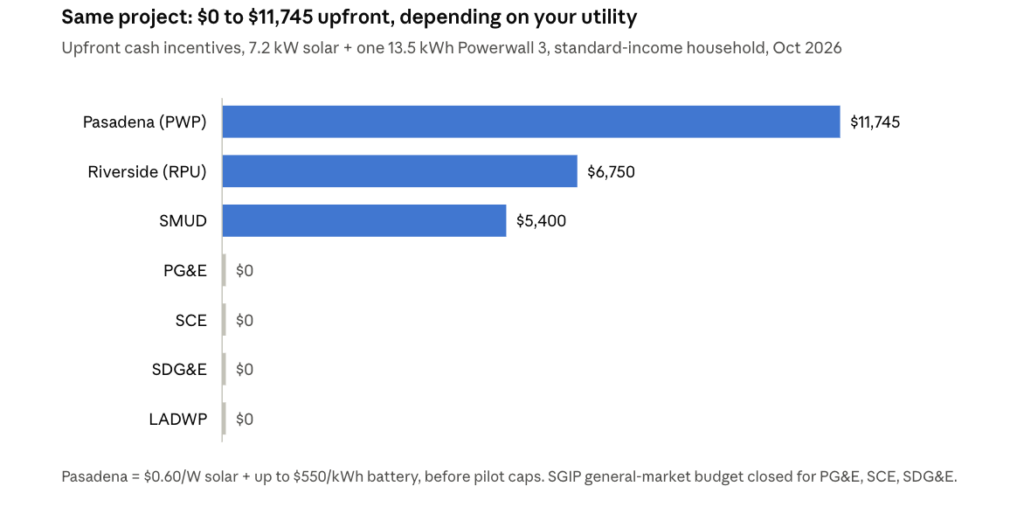
Every investor-owned utility customer gets $0 upfront because SGIP’s general-market budget is closed; the three city utilities pay between $5,400 and $11,745 for the same equipment.
Picture two neighbors on opposite sides of a city line. In Corona on SCE, the homeowner gets no upfront rebate. What they can still capture is the property tax exclusion (about $5,250 over 20 years if finished in 2026) and an ACC Plus adder worth roughly $720 over 9 years. In Riverside on RPU, the same homeowner gets the same property tax benefit plus a $6,750 battery rebate. That is a $6,750 difference for crossing one street.
What changes beyond the upfront check:
| Utility | Export credit | Ongoing battery pay | Income-qualified upside |
|---|---|---|---|
| PG&E | Net Billing (NEM 3.0) + ACC Plus, about 1.1 cents, locked 9 years | None from the utility | SGIP equity (waitlist), DAC-SASH, CARE/FERA |
| SCE | Net Billing (NEM 3.0) + ACC Plus, about 2 cents, locked 9 years | None from the utility | SGIP equity (waitlist), DAC-SASH, CARE/FERA |
| SDG&E | Net Billing (NEM 3.0), no adder | None from the utility | SGIP equity (waitlist), DAC-SASH, CARE/FERA |
| SMUD | Solar and Storage Rate | About $440 a year per battery | Not published for Partner+ |
| Riverside (RPU) | RPU’s own net metering rules | None listed | SHARE customers: $850/kWh, up to $17,000 |
| Pasadena (PWP) | PWP’s own net metering rules | None listed | $1.00/W for solar |
| LADWP | Net metering at near-retail value | None from the utility | SGIP equity via LADWP (waitlist) |
For current rate plans in your area, see our average California electric bill guide and the solar payback period guide.
Which solar incentives have expired but still show up online?
At least five. If a quote or a rebate site counts any of these on a system installed now, the savings estimate is wrong.
| Program | Ended | What to look for instead |
|---|---|---|
| Federal 30% credit (25D) on purchased systems | Dec 31, 2025 | 48E value inside lease or PPA pricing |
| Federal 25C credit (panel and efficiency work) | Dec 31, 2025 | Municipal or income-qualified panel rebates |
| SGIP Small Residential Storage, $0.15/Wh | Closed in all territories (Oct 2026 tracker) | Municipal battery rebates; SGIP equity waitlist if income-qualified |
| HEEHRA single-family rebates, up to $4,000 for panels | Fully reserved Feb 24, 2026 | None statewide today |
| LADWP Solar Incentive Program | Closed Dec 31, 2018 | LADWP net metering at near-retail value |
Frequently asked questions
Does California have a state solar tax credit in 2026? No. California has no state income tax credit for residential solar. The state’s remaining help comes through the property tax exclusion, SGIP equity budgets, DAC-SASH and CARE/FERA.
Is the SGIP battery rebate still available? Not for standard-income households. As of October 7, 2026, SGIP’s general-market residential budget is closed in PG&E, SCE, SDG&E and SoCalGas territory. Low-income households can join the Residential Solar and Storage Equity waitlist at $1.10/Wh for storage.
What is the deadline for the California solar property tax exclusion? Your system must be completed before January 1, 2027. Systems finished by then stay excluded from reassessment until the home is sold or otherwise changes ownership.
Which California utility has the best battery rebate in 2026? Pasadena Water and Power pays the highest rate at standard income (up to $550/kWh, plus $0.60/W on solar). Riverside pays $500/kWh up to $10,000, and SMUD about $5,400 per Powerwall 3 plus about $440 a year.
Can I still get the 30% federal credit through a lease? Indirectly. The leasing company claims the Section 48E credit and may pass part of it to you as a lower payment. The project must be placed in service by December 31, 2027 if construction starts after July 4, 2026.
Do LADWP customers get a solar rebate? No upfront rebate; LADWP closed its Solar Incentive Program in 2018. LADWP customers do keep near-retail net metering, which is worth more over a system’s life than most rebates.
What should I do next?
Find out which incentives your address actually qualifies for before you compare prices. Every NRG quote starts with your utility, your rate plan and the programs still open on the day you sign, and we price purchased systems with no federal credit.
If you want the property tax exclusion, talk to an installer this month; a system has to be finished, not just signed, by December 31. You can get a quote in 2 minutes, browse our solar and battery installation options, or see the areas we serve across California.
Sources
- CPUC: Self-Generation Incentive Program
- SGIP Program Metrics and Incentive Step Tracker (checked October 7, 2026)
- California Board of Equalization: Section 73 guidance
- CPUC: Solar in Disadvantaged Communities
- CPUC: CARE/FERA Program
- SMUD: Battery storage incentives
- Riverside Public Utilities: Energy Storage Rebate Program
- Anaheim Public Utilities: Battery Storage
- LADWP: Solar Incentive Program sunset notice
- TECH Clean California: HEEHRA rebates
- American Public Power Association: Pasadena solar and battery pilot