

Quick answer: Usually not, if your installer knows the alternatives. In California, a 200A panel with a 200A main breaker can take a 40A solar breaker, which supports 7.68 kW of inverter output under the 120% rule. Bigger systems and most batteries exceed that, but a main breaker derate, a supply-side tap, a meter collar or a software power limit can avoid a $5,000+ upgrade and a utility wait.
A lot of the “you need a new panel” quotes homeowners bring us are really “we did not want to design around your panel” quotes. A main panel upgrade is sometimes the right answer. It is rarely the only one.
Key takeaways
- The real limit is your panel’s busbar rating and main breaker, not your home’s square footage or the size of your array.
- A Tesla Powerwall 3 at full power needs a 60A breaker, which is more than a standard 200A/200A panel allows. Software limits (PCS) are how most installs get around it.
- Since January 1, 2026, California inspects to the 2025 California Electrical Code, which adopts the 2023 NEC and its power control and energy management rules.
- PG&E averaged 30 business days of its own time per main panel upgrade from 2023 to 2025, and 42 business days end to end.
How much solar can my main panel handle?
Take your busbar rating, multiply by 1.2, subtract your main breaker: that is the largest solar breaker you can add without an upgrade. Divide that breaker by 1.25 to get the maximum continuous inverter current, then multiply by 240 volts for kW.
That is the 120% rule in NEC 705.12, now part of the 2025 California Electrical Code that took effect January 1, 2026. It also requires the solar breaker to sit at the opposite end of the busbar from the main breaker. Both numbers are printed on the label inside your panel door. They are often different, and that difference is where the hidden capacity lives.
Maximum inverter output by panel rating under the 120% rule (California, 2026)
| Busbar rating | Main breaker | Max solar breaker | Max inverter current | Max inverter output (AC) |
|---|---|---|---|---|
| 100A | 100A | 20A | 16A | 3.84 kW |
| 125A | 100A | 50A | 40A | 9.6 kW |
| 150A | 150A | 30A | 24A | 5.76 kW |
| 200A | 200A | 40A | 32A | 7.68 kW |
| 200A | 175A (derated) | 65A | 52A | 12.48 kW |
| 225A | 200A | 70A | 56A | 13.44 kW |
NRG calculation from NEC 705.12(B)(3)(b) at 240V. Inverter output is AC; the DC array on your roof is typically sized somewhat larger than the inverter.
Two things jump out of that table. First, a 125A busbar behind a 100A main holds more solar than a standard 200A/200A panel. Second, many national guides round a 200A panel to “about 8 kW” and a 100A panel to “about 2.5 kW.” The real figures are 7.68 kW and 3.84 kW. The first number overstates what fits; the second undersells a small panel. Our 120% rule explainer walks through the code text.
How can I avoid a main panel upgrade for solar?
There are six code-approved ways, and a good installer checks all of them before quoting a new panel. Each one fits a different home.
| Option | How it works | When it fits | Watch out for |
|---|---|---|---|
| Main breaker derate | Swap a 200A main for a 175A or 150A one, which frees up 120% rule room on the busbar | Your load calculation shows the home never needs the full 200A | A derate needs a load calc on the permit; an EV charger later can undo it |
| Supply-side (line-side) tap, NEC 705.11 | Solar connects between the meter and the main breaker, so it never touches the busbar | The service equipment has room and listed lugs or taps for it | Many California meter-main combo panels have no practical tap point |
| Software power limit (PCS), NEC 705.13 | The battery or inverter measures current and caps what it sends into the panel | Tesla, Enphase and FranklinWH systems with listed PCS | Some utilities still evaluate the unit at full nameplate (see below) |
| Meter collar | A device between the meter and its socket connects the battery or solar at the meter | Standard 200A plug-in meter sockets approved by your utility | Will not fit a 320A bolt-in meter socket |
| Smart-meter load calculation, NEC 220.87 | Uses 12 months of your actual peak demand x 125% instead of a nameplate estimate | You are adding loads (EV, heat pump) and the panel looks “full” on paper | Not usable once a solar system is on record, per Silicon Valley Clean Energy’s guide |
| Smart panel or energy management, NEC 220.70 | A panel or controller sheds or sequences loads so the total never exceeds a setpoint | Homes electrifying several appliances at once | Ask your building department how it reviews 220.70 |
A few details that matter more than they look:
- PCS settings. Tesla’s Panel Limit defaults to 80A and is typically set to 80% of the panel rating. On a 200A/200A panel, Tesla’s own example uses a 160A Panel Limit (Tesla PCS documentation).
- Meter collars in California. The Tesla Backup Switch is approved by PG&E, SCE and SDG&E. SCE keeps a list of approved meter socket adapters, including FranklinWH’s, which it last revised July 7, 2026. The utility installs or approves the collar; your installer cannot just plug one in. More in our meter collar guide.
- Most homes have far more headroom than their panel suggests. An analysis of smart meter data from more than 22,000 California homes found 86% peaked under 50A and nearly half under 30A (Silicon Valley Clean Energy contractor guide). That is why a derate or a 220.87 calculation so often works.
Our smart electrical panel overview compares the main options.
Does adding a battery mean I need a new panel?
It can, because under NEC 2023 the battery’s inverter counts toward the same busbar limit as your solar. Under NEM 3.0 most California systems now include a battery, so this is where the panel question usually gets decided.
The Tesla Powerwall 3 is the clearest example. It has a built-in solar inverter, and at its default 11.5 kW output it draws 48A and needs a 60A breaker. A standard 200A/200A panel only allows 40A. Tesla lets installers cap the unit’s output to fit:
| Powerwall 3 output setting | Continuous current | Required breaker | Fits a 200A/200A panel on the 120% rule alone? |
|---|---|---|---|
| 11.5 kW (default) | 48A | 60A | No |
| 10 kW | 41.7A | 60A | No |
| 7.6 kW | 31.7A | 40A | Yes |
| 5.8 kW | 24A | 30A | Yes |
Source: Tesla Powerwall 3 design guide. Tesla also states that controlled sources using a Panel Limit can comply through NEC 705.13 without a 120% backfeed calculation.
The tradeoff is real. Dropping to 7.6 kW keeps your panel but caps how fast the battery and solar can discharge into the house. Most homes never notice, but a home that wants to run a central AC and an EV charger on battery during an outage might. That is a design conversation, not a reason to default to a new panel.
One California catch: Tesla lists Pasadena Water and Power among utilities whose interconnection review can evaluate a Powerwall 3 at its full 11.5 kW even when it is limited in software (Tesla documentation). In PWP territory, check that before you plan around a power limit.
EV chargers and heat pumps change the math in the other direction. They add load, not backfeed. If you plan an EV charger within a few years, settle the load calculation with the solar permit. Doing it later can mean the smart-meter method is off the table, because it is not usable once solar is on record. Our EV charger cost guide shows how much the panel changes a charger’s installed cost, and our battery cost guide covers what a battery costs installed.
How much does a main panel upgrade cost in California, and how long does it take?
Plan on $5,000 or more and roughly two months once the utility is involved. Bay Area program data put a panel replacement plus service upgrade at about $6,000 in 2023 (Lawrence Berkeley National Laboratory presentation), and BayREN’s San Mateo study described a typical upgrade as $5,000+. National averages of $2,500 to $4,500 rarely hold here, because California upgrades usually involve the utility, a permit and often a meter-main replacement.
The utility side is now measured. Under the Powering Up Californians Act (SB 410), the CPUC set energization targets in Decision 24-09-020, and utilities now report their performance twice a year. PG&E’s March 2026 report shows:
- 35,839 main panel upgrades energized from applications filed January 2023 through December 2025
- An average of 30 business days of PG&E’s own time per upgrade, and 42 business days end to end
- 90% of 2025 upgrades finished under the CPUC’s maximum target
- If the job needs new service lines instead (Electric Rule 16), the end-to-end average was 313 calendar days
PG&E also notes that the extra SB 410 energization funding expires at the end of 2026. Whether those timelines hold in 2027 is an open question.
Rebates for panel work are mostly gone. California’s HEEHRA program paid up to $4,000 toward a panel upgrade for income-qualified households, but single-family rebates were fully reserved on February 24, 2026. The federal 25C credit ended with 2025. Permit timing is a separate question, covered in our California solar permit guide.
How does an installer decide whether I need a new panel?
A careful installer works down four checks, and only the last “no” ends in a main panel upgrade.
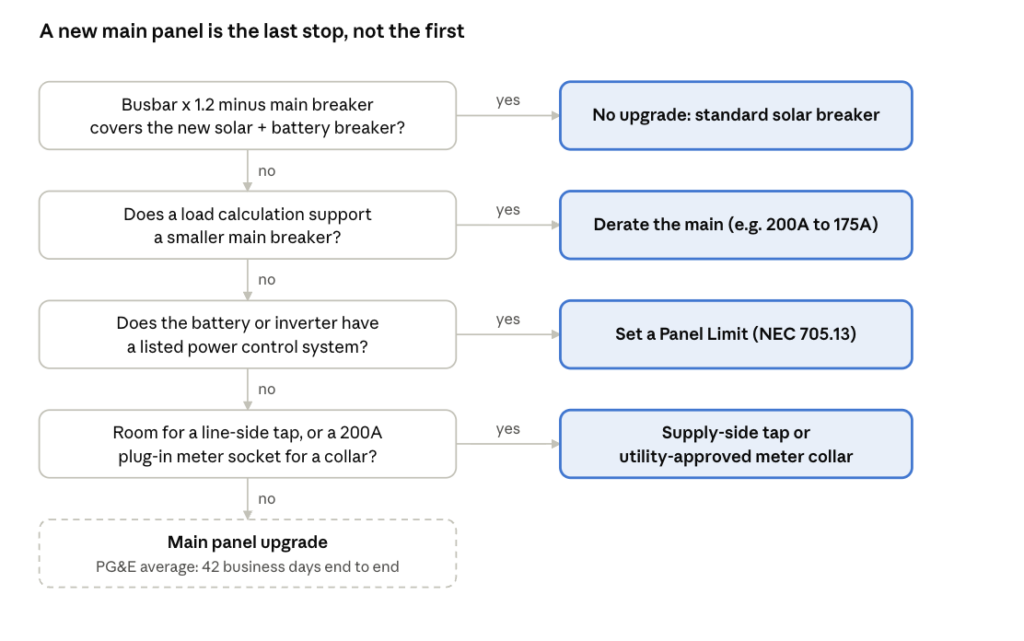
The order matters because each step costs more than the one above it: a breaker and a calculation cost far less than utility work and a new meter-main.
Frequently asked questions
How do I know if my panel can take solar? Open the panel door and find two numbers: the busbar rating on the label and the amp rating printed on the main breaker. Multiply the busbar rating by 1.2 and subtract the main breaker. If the result is 40A or more, a typical 7 kW system usually fits without an upgrade.
Can a 100 amp panel support solar? A 100A panel with a 100A main allows a 20A solar breaker, or about 3.84 kW of inverter output. If the busbar is rated 125A, the same 100A main allows a 50A breaker and about 9.6 kW.
Is a main breaker derate safe? Yes, when a load calculation shows the home’s demand fits the smaller breaker. The breaker still protects the panel; it simply trips at a lower current. It becomes a problem only if you later add large loads without redoing the calculation.
Does a Tesla Powerwall 3 require a main panel upgrade? Not necessarily. At full 11.5 kW output it needs a 60A breaker, more than a 200A/200A panel allows, but a software Panel Limit, a lower power setting, a derate or a line-side tap can each avoid the upgrade.
What is a meter collar, and can I get one on PG&E? A meter collar mounts between your utility meter and its socket so a battery or solar system can connect there instead of in your panel. PG&E, SCE and SDG&E have all approved the Tesla Backup Switch; it needs a standard 200A plug-in meter socket.
How long does PG&E take for a main panel upgrade? From 2023 through 2025, PG&E averaged 30 business days of its own time and 42 business days end to end per main panel upgrade, according to its March 2026 report to the CPUC.
What should I do next?
Send your installer a photo of the panel label and the main breaker before you compare quotes. If a quote includes a main panel upgrade, ask which of the six alternatives above they ruled out, and why.
At NRG we design around your existing panel first and quote an upgrade only when the numbers require it. You can get a quote in 2 minutes, see our solar and battery systems, or find the areas we serve across California.