
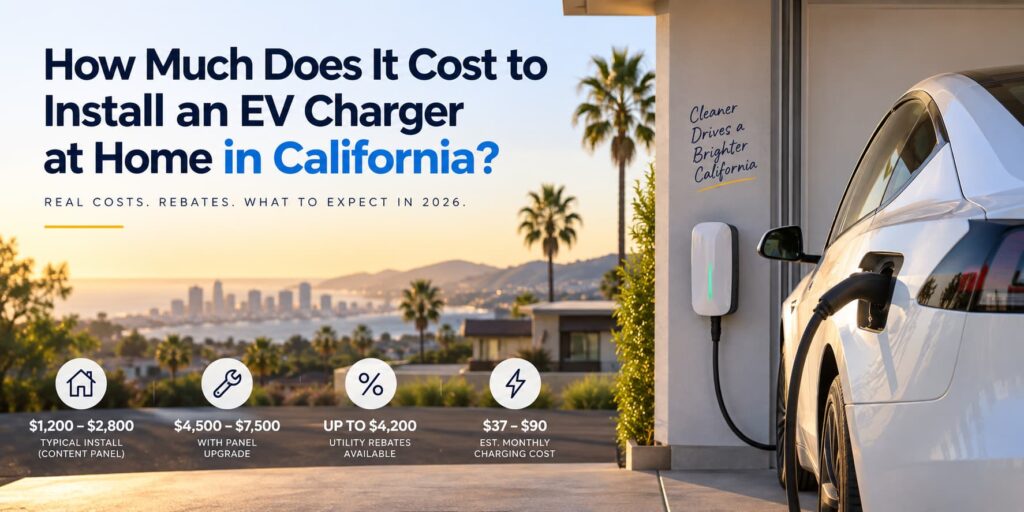
Quick answer: In California in 2026, a hardwired Level 2 (240 V) home EV charger costs $1,200 to $2,800 installed when your electrical panel already has capacity, and $4,500 to $7,500 when it needs a 200 A panel upgrade. The federal 30C tax credit ended for chargers placed in service after June 30, 2026. Utility rebates still cover $600 to $4,200 in PG&E, SCE, LADWP and SMUD territory. On an EV rate plan, home charging then runs about $37 to $90 a month for 12,000 miles a year, versus $160 or more on gasoline.
The charger is the cheapest part of the job. Homeowners in San Jose, LA and San Diego call us with a $600 wallbox in a shopping cart asking what installation costs, and the answer depends almost entirely on two things they have not looked at yet: the amperage stamped on the main breaker in their panel, and how far the garage wall is from that panel. Get those two facts and you can price the job within a few hundred dollars before anyone shows up.
Key takeaways
- A straightforward Level 2 install (200 A panel, charger within 25 feet, garage) runs $1,200 to $2,000 in most California cities, including permit.
- A 100 A panel is the single biggest cost driver. A main panel upgrade adds $2,500 to $4,500, more if the utility has to upgrade the service drop. A load-management device for $300 to $700 often avoids the upgrade entirely.
- The federal 30C credit (30%, up to $1,000) is gone for installs after June 30, 2026. Do not let a quote include it.
- SCE will pay up to $4,200 toward a panel upgrade for income-qualified customers through December 31, 2026; PG&E pays up to $2,000 for a charger project and up to $5,000 with panel work for income-qualified households; LADWP pays up to $1,000; SMUD up to $600. SDG&E currently has no residential charger rebate.
- Timing matters more than the charger. SDG&E’s EV-TOU-5 plan is 13.1 cents per kWh overnight and 80.2 cents from 4 to 9 p.m. as of August 1, 2026.
How much does a Level 2 EV charger cost to install in California?
$1,200 to $2,800 all-in for a typical single-family home with a 200 A panel, and $4,500 to $7,500 if the panel needs replacing. Here is where the money goes.
Table 1. Home EV charger installation cost breakdown, California 2026
| Line item | Typical California cost | Notes |
|---|---|---|
| Level 2 charger hardware (40 to 48 A) | $400 to $900 | Tesla Wall Connector, ChargePoint Home Flex, Emporia, Wallbox; smart chargers needed for most utility rebates |
| Electrician labor and materials, short run | $600 to $1,200 | 50 or 60 A breaker, 6 AWG copper, conduit, 4 to 6 hours at $95 to $150 per hour for a C-10 licensed contractor |
| Long run or exterior mount (40 to 80 ft) | add $500 to $1,500 | Wire at $10 to $20 per foot installed, weatherproof box, possible attic or crawlspace routing |
| Trenching to a detached garage | add $1,500 to $3,500 | Depends on distance and surface; concrete cutting is the expensive version |
| City permit and inspection | $100 to $400 | City of LA (LADBS) residential EV circuit permits typically run $100 to $300; San Diego and San Jose are similar |
| Load management device instead of panel upgrade | $300 to $700 | Energy management system or circuit-sharing device that throttles the charger when the house is under load |
| Main panel upgrade to 200 A | $2,500 to $4,500 | Higher ($5,000 to $7,000) when the utility service drop or meter socket also changes |
Ranges reflect 2026 quotes from licensed California electricians and NRG’s installed-cost benchmarks. Verify any contractor at the CSLB license lookup; EV charging circuits require a C-10 electrical or B general contractor.
What does it cost in my city?
Labor rates and permit fees vary by county, but the scenario matters more than the ZIP code. Use the row that matches your house.
Table 2. Installed cost by scenario, major California metros, 2026
| Scenario | San Jose (PG&E) | Los Angeles (LADWP or SCE) | San Diego (SDG&E) | Fresno / Sacramento |
|---|---|---|---|---|
| A. 200 A panel, charger in garage within 25 ft | $1,400 to $2,100 | $1,300 to $2,000 | $1,300 to $2,000 | $1,200 to $1,800 |
| B. 200 A panel, 50 ft run or exterior mount | $2,000 to $2,900 | $1,900 to $2,800 | $1,900 to $2,800 | $1,700 to $2,500 |
| C. 100 A panel plus load-management device, no upgrade | $2,000 to $3,300 | $1,900 to $3,100 | $1,900 to $3,100 | $1,700 to $2,900 |
| D. 100 A panel, upgrade to 200 A | $5,000 to $7,500 | $4,500 to $7,000 | $4,500 to $7,000 | $4,200 to $6,500 |
| E. Detached garage with trenching | $3,500 to $6,000 | $3,300 to $5,800 | $3,300 to $5,800 | $3,000 to $5,200 |
NRG estimates. Bay Area labor runs 10 to 15% above the state average; Central Valley runs 10% below. Every figure includes hardware, labor, materials and permit and excludes rebates.
[CHART: bar, “Installed cost of a home EV charger by scenario, California 2026 (midpoint)”, x-axis: A short run, B long run, C load management, D panel upgrade, E trenching; y-axis: dollars; series: 1,700, 2,400, 2,600, 6,000, 4,600. Alt text: “Bar chart comparing EV charger installation cost scenarios in California, with a panel upgrade the most expensive at about $6,000”. Takeaway line: “The panel, not the charger, decides whether this is a $1,700 job or a $6,000 job.”]
Do I need a panel upgrade for an EV charger?
Usually not if you have a 200 A panel with two free breaker slots. Often yes if you have a 100 A panel, central AC and an electric range or dryer, and even then a load-management device is frequently the cheaper fix. Here is how an electrician decides.
- Look at the main breaker. The number on the big top breaker is your service size. 200 A is standard on homes built after the mid-1990s. 100 A is common in older LA, San Diego and Bay Area housing stock, and 125 A shows up in 1970s and 80s tracts.
- Run the load calculation. The California Electrical Code (Article 220) adds up square footage, appliances and the new continuous charger load. A 48 A charger needs a 60 A circuit; a 40 A charger needs 50 A. On a 100 A panel with electric heat or a dryer, the calc often fails.
- Downsize the charger before upsizing the panel. A 32 A charger on a 40 A circuit adds about 25 miles of range per hour, which is more than almost any commuter uses overnight. That alone clears many 125 A panels.
- Use a load-management device. An energy management system (or a circuit-sharing device on the dryer or range circuit) pauses charging when the house is drawing heavily. Cost: $300 to $700. It turns a $6,000 job into a $2,500 one, and PG&E’s rebate specifically favors these.
- Upgrade when you are electrifying anyway. If a heat pump, induction range or second EV is coming in the next few years, a 200 A panel is the right call and SCE will fund most of it for eligible customers (Table 3).
How long does an EV charger permit take in California?
Days, not weeks, if the contractor pulls it. AB 1236 (2015) and AB 970 (2021) require California cities and counties to offer a streamlined, expedited permit process for residential EV charging stations and set deadlines for deeming applications complete and approving them. In the City of Los Angeles, LADBS issues most single-charger residential electrical permits through its express process, and inspection follows the install. San Jose, San Diego and most Bay Area cities work the same way. If a contractor tells you no permit is needed for a new 240 V circuit, that is your signal to get another contractor: unpermitted electrical work is an insurance and resale problem later.
What EV charger rebates are available in California in 2026?
The federal credit is gone; utility rebates remain and are the only money on the table for most households. Verify each on publish day and before you buy, because they are first-come, first-served and several changed terms on July 1, 2026.
Table 3. Home EV charger incentives by utility, California, September 2026
| Program | Who qualifies | Amount | Status |
|---|---|---|---|
| Federal 30C Alternative Fuel Refueling Property Credit | Was: homeowners in eligible census tracts | Was: 30% up to $1,000 | Ended for property placed in service after June 30, 2026 (IRS) |
| PG&E Residential EV Charging Rebate | PG&E residential electric customers; income-qualified Rebate Plus at or below 80% AMI | Standard: up to 50% of pre-approved equipment. Rebate Plus: up to $2,000 for a charger project, up to $5,000 with qualifying panel work | Active, pre-approved equipment list, one per household |
| SCE Charge Ready Home | SCE customers installing a Level 2 charger who need a panel upgrade; income-qualified or in a disadvantaged community | Up to $4,200 income-qualified (100% of upgrade); up to $2,100 in DACs | Applications through December 31, 2026; requires a new 200 A panel |
| LADWP residential EV charger rebate | LADWP residential customers | Up to $1,000, plus $500 for Lifeline or EZ-SAVE households, plus $250 for a dedicated EV meter | Active |
| SMUD Charge@Home | SMUD residential customers | Up to $600: $100 charger, $200 load-management device, $500 circuit via SMUD Contractor Network | Active |
| SDG&E | n/a | No active residential Level 2 charger rebate | Check SDG&E EV programs for changes |
Sources: IRS Form 8911 instructions (December 2025); PG&E, SCE, LADWP and SMUD program pages as of September 2026. Amounts and eligibility change without notice; confirm before purchasing equipment.
What will it cost to charge at home once the charger is in?
Between $37 and $90 a month for a 12,000-mile-a-year driver, depending on your utility and whether you are on an EV rate plan. The rate plan is worth more than any rebate. Here is the math for a car that gets 3.5 miles per kWh (Model 3, Ioniq 6, Bolt territory): 12,000 miles is about 3,430 kWh a year, or 286 kWh a month.
Table 4. Monthly home charging cost for 12,000 miles per year by California utility, 2026
| Utility and EV plan | Cheapest charging window | Off-peak price | Monthly cost, 286 kWh | If you charge 4 to 9 p.m. instead |
|---|---|---|---|---|
| PG&E EV2-A | Midnight to 3 p.m. | about 31 cents/kWh | about $89 | about $177 at roughly 62 cents |
| SCE TOU-D-PRIME | 9 p.m. to 8 a.m. (verify) | about 28 to 33 cents/kWh | about $80 to $94 | roughly double |
| SDG&E EV-TOU-5 (Aug 1, 2026 schedule) | Midnight to 6 a.m., plus 10 a.m. to 2 p.m. weekdays and to 2 p.m. weekends | 13.1 cents/kWh | about $37 | about $229 at 80.2 cents |
| SMUD Time-of-Day plus EV credit | Midnight to 6 a.m. | about 11 to 13 cents/kWh | about $31 to $37 | roughly $110 |
| Gasoline, 30 mpg at $5.00/gal | n/a | n/a | about $167 | n/a |
Rates from PG&E, SCE, SDG&E EV-TOU-5 and SMUD published schedules; PG&E and SCE figures are blended per-period approximations and exclude the $24.15 Base Services Charge. Gasoline price sits inside the $4.60 to $6.00 range the CPUC Public Advocates Office uses for EV parity math.
Two things to notice. First, SDG&E has both the cheapest and the most expensive EV electricity in California; a San Diego household that charges at 6 p.m. pays six times what its neighbor pays at 2 a.m. Second, a PG&E household that installs a charger but stays on the default E-TOU-C plan gives back most of the savings. Switching to EV2-A is a phone call or an online form. Full charging math by vehicle: how much it costs to charge an EV and how many kWh a Tesla takes, or run your own numbers in the EV savings calculator.
Should I install the charger with solar?
If you are already considering solar, yes, and do them in the same permit. If you only want the charger, do not let anyone bundle a solar sale into it. The honest case for each:
- Charger only. Cheapest path to $37 to $90 a month fuel. Payback against gasoline is under two years in every scenario in Table 2 except a panel upgrade, which is three to four years.
- Charger plus solar. Under NEM 3.0, exporting solar to the grid at noon earns single-digit cents per kWh. Charging the car with it instead is worth 28 to 31 cents on PG&E or SCE. A smart charger that follows solar production (Tesla Wall Connector with Powerwall, Emporia, Enphase IQ EV Charger) does this automatically. For anyone home during the day, or with a battery, the EV becomes the best use of daytime solar.
- The fixed charge caveat. The $24.15 Base Services Charge applies either way and solar does not remove it. Details in our California fixed charge explainer.
Hardwired charger or NEMA 14-50 outlet?
Hardwired, for most California homes. A plug-in charger on a NEMA 14-50 receptacle saves $200 to $400 up front, but the California Electrical Code requires GFCI protection on a 240 V garage receptacle, and GFCI breakers plus a plug-in EVSE are a known source of nuisance trips and cheap-receptacle overheating at continuous load. A hardwired 48 A unit on a 60 A breaker is faster, cleaner and what most utility rebates assume. The exception is a renter or anyone who moves every few years: the 14-50 outlet stays, the charger goes with you.
Worked example: a 1978 San Jose ranch with a 100 A panel
A San Jose homeowner on PG&E buys a Model Y and wants a Tesla Wall Connector in the attached garage. The panel is 100 A, original, 15 feet from the garage wall, with central AC and a gas range and dryer. The load calculation comes up about 20 A short for a 48 A charger.
Option 1: main panel upgrade to 200 A plus the charger. About $6,200 all-in in Santa Clara County (upgrade $3,800, charger and install $1,900, permits $500). No federal credit. PG&E’s Rebate Plus can cover up to $5,000 of an income-qualified household’s project including panel work; for a household above 80% AMI the standard rebate covers up to half the cost of a pre-approved charger, roughly $250 to $400.
Option 2: the same Wall Connector set to 32 A, with a load-management device on the panel. About $2,600 all-in. Charging at 32 A adds roughly 25 miles of range per hour, so a full overnight window covers 200 miles or more. The household keeps the panel upgrade in reserve for the day they replace the gas furnace.
Either way, they switch to EV2-A and charge midnight to 3 p.m. Fuel cost for 12,000 miles: about $89 a month versus about $167 in gasoline. Option 2 pays for itself in about 33 months on fuel savings alone; option 1 in about 6.5 years, or under 5 with the panel funded for a future heat pump. We recommend option 2 for this house unless electrification is already on the calendar.
FAQ
How much does it cost to install a Tesla home charger in California?
$1,200 to $2,800 installed for a Tesla Wall Connector (hardware about $450 to $500) on a 200 A panel, and $4,500 to $7,500 with a panel upgrade. The Wall Connector is hardwired and delivers up to 48 A, so it needs a 60 A circuit.
How much does it cost to install a Level 2 charger at home?
Nationally $800 to $2,500; in California $1,200 to $2,800 because of higher labor rates and permit costs, plus $2,500 to $4,500 if a panel upgrade is needed.
Is the EV charger tax credit still available in 2026?
No. The federal 30C credit (30% up to $1,000) ended for property placed in service after June 30, 2026. Chargers installed before that date can still be claimed on Form 8911 for the 2026 tax year.
Do I need a permit to install an EV charger in California?
Yes, for any new 240 V circuit. Fees run $100 to $400 depending on the city, and state law requires cities to process residential EV charger permits on an expedited basis.
Can I install an EV charger on a 100 amp panel?
Often yes, using a 32 A charger or a load-management device, and an electrician’s load calculation will confirm it. If the house also has electric heat, an electric range and a dryer, plan on a panel upgrade.
How much does it cost to charge an EV at home in California?
About $37 to $90 a month for 12,000 miles a year on an EV rate plan, depending on the utility. Charging during the 4 to 9 p.m. peak can double or triple that.
What to do next
Send us a photo of your main panel with the door open and the distance from the panel to where the car parks. That is enough for a firm quote on most homes. NRG installs home EV chargers across the Bay Area, Los Angeles, Orange County, San Diego, the Inland Empire, Sacramento and Fresno, with the permit, the rebate paperwork and the rate plan switch handled as part of the job. Get a quote in 2 minutes, and if you are thinking about solar at the same time, say so and we will price both in one permit.