
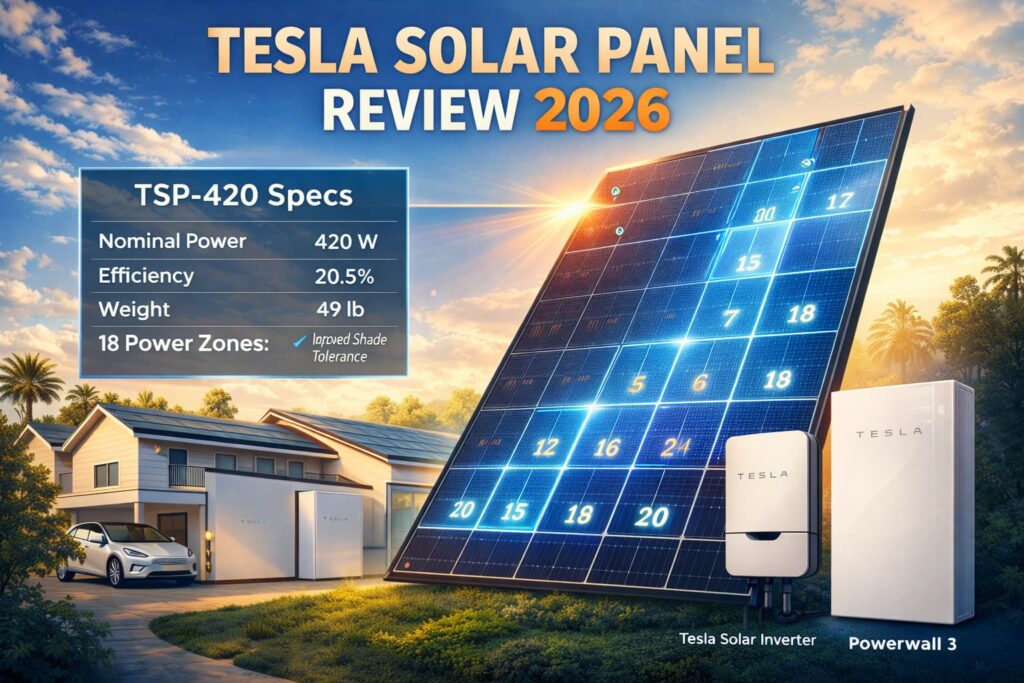
esla is back with its own residential solar modules, the Tesla Solar Panel (TSP series), designed to pair cleanly with Tesla’s inverter + Powerwall stack and to solve real rooftop issues like partial shading, visible racking, and install time. This is a deep, practical review of what Tesla launched, the verified specs, what’s truly different (18 Power Zones), and how it compares to premium alternatives.
What Tesla launched in 2026 (models, positioning, and manufacturing)
Tesla introduced two primary residential module models:
- TSP-415 (415 W)
- TSP-420 (420 W)
Tesla says the modules are assembled at its Buffalo, New York facility (Gigafactory New York), which is scaling to an initial capacity of over 300 MW per year. Tesla frames the launch as completing a vertically integrated “Home Energy Ecosystem” with panels, inverter, battery storage, EV charging, and software in one stack.
The standout feature: 18 “Power Zones” for shade tolerance
The biggest technical differentiator Tesla highlights is 18 independent “Power Zones”. In a conventional residential panel design, a small shadow (from a vent pipe or chimney) can reduce output across a much larger section of the panel or even the string. Tesla’s approach increases granularity so shaded areas affect less of the module’s output.
- What Tesla claims this improves: Better performance under partial shading without relying on rooftop module-level electronics (like optimizers or microinverters).
- Where this matters most: Roofs with lots of “micro-shade” events (plumbing vents, chimneys, dormers, nearby trees).
- Important reality check: This architecture is promising, but broad independent long-term field studies are still limited because the product is new.
Tesla solar panel specs (verified): TSP-415 vs TSP-420
Below are the published specifications reported by pv magazine, including power, efficiency, voltage/current, size, and weight.
| Spec | TSP-415 | TSP-420 |
|---|---|---|
| Nominal Power (Pmax) | 415 W | 420 W |
| Module Efficiency | 20.3% | 20.5% |
| Open Circuit Voltage (Voc) | 40.92 V | 40.95 V |
| Short Circuit Current (Isc) | 12.93 A | 13.03 A |
| Max System Voltage | DC 1000V | DC 1000V |
| Dimensions | 1805 × 1135 × 40 mm | 1805 × 1135 × 40 mm |
| Weight | 22.3 kg (49 lb) | 22.3 kg (49 lb) |
Design and certifications (all-black module + standards)
According to pv magazine, Tesla’s panels feature a black anodized aluminum alloy frame and black backsheet. pv magazine also reports certifications to IEC/UL 61730-1, IEC/UL 61730-2, IEC 61215, and CEC listing.
Mounting and installation: Tesla’s rail-less “Panel Mount” concept
Tesla pairs the modules with a new rail-less mounting approach intended to reduce rooftop hardware and improve appearance. pv magazine reports:
- The mounting system uses the module frame as the structural rail.
- It eliminates traditional rails and visible clamps.
- Tesla claims it is 33% faster to install.
- The mount sits closer to the roof and includes aesthetic front/side skirts.
Compatibility: how “Tesla-native” is this system?
Tesla designed the TSP modules to pair especially well with the Tesla Solar Inverter and Powerwall 3. pv magazine notes that Tesla markets it as a unified ecosystem, but it is not necessarily sold as one inseparable bundle. The key detail is that the panel’s 18-zone behavior is tuned for Tesla’s string-inverter approach. (
Warranty: what Tesla actually promises (2026 warranty PDF)
This is the most important part of the decision for many homeowners. Tesla’s official module warranty states:
- 25-year product warranty (defects in design and materials).
- Performance warranty: At least 98.0% of rated peak power after year 1, then degradation of no more than 0.45% per year for the following 24 years.
- Applies to TSP-405, TSP-410, TSP-415, TSP-420, TSP-425, TSP-430 (as listed in the warranty document).
What that means in plain English: Tesla is committing to relatively low long-term degradation on paper. Always review exclusions and claim requirements in the warranty itself before buying.
Pros and cons (installer-style reality check)
Pros
- Better partial-shade behavior via 18 Power Zones.
- Clean look (all-black styling) with a system designed for minimal visible racking.
- Rail-less mounting concept intended to reduce rooftop clutter and speed install time.
- Strong warranty headline (25-year product + performance).
- Domestic assembly in Buffalo, NY (per Tesla/pv magazine reporting).
- Single-ecosystem experience if you want panels + inverter + Powerwall in one stack.
Cons / unknowns
- Limited long-term field data for this specific new TSP architecture (it is brand new).
- Less flexible if you prefer microinverters or a mixed-brand design.
- Pricing transparency can be lower than distributor-sold modules, depending on how you buy it (Tesla direct vs certified installer).
- Performance advantage under shade still needs more independent third-party validation across many roof types.
How Tesla compares to premium alternatives (quick table)
Tesla’s TSP-420 sits in the premium residential category, but it is not trying to win only on raw watts. It is competing on shade architecture + aesthetics + ecosystem integration. Here is a simple comparison against well-known premium lines (always confirm exact models with your installer):
| Brand / model family | Power range (typical) | Efficiency (typical / max) | Notable strength | Warranty headline |
|---|---|---|---|---|
| Tesla TSP-420 | 420 W | 20.5% | 18 Power Zones, rail-less mounting concept | 25-year product + performance |
| REC Alpha Pure-RX | 450–470 W (460 W common) | Up to 22.6% | High efficiency / power density, premium HJT line | REC 25-year warranty class (see datasheet) |
| Qcells Q.TRON (BLK series) | 415–440 W | High-efficiency N-type lineup (varies) | Strong bankable brand, broad availability | 25-year product + linear performance (varies by series) |
| Maxeon 6 | 425–440 W | Premium tier | Long-term durability positioning | 40-year warranty (on covered models) |
Reference docs: REC Alpha Pure-RX datasheet, Qcells Q.TRON BLK datasheet, Maxeon 6 datasheet
Who should consider Tesla’s new panel?
Tesla’s TSP series is most compelling if:
- Your roof has frequent partial shading from vents, chimneys, dormers, or trees.
- You want a minimalist look with reduced visible racking and clamps.
- You plan to add Powerwall (now or later) and want one ecosystem and one monitoring app.
- You prefer a string-inverter style system but still want improved shade tolerance.
You may prefer another premium panel if:
- Your roof is clean and unshaded and you want maximum watts per square foot (highest efficiency).
- You prefer microinverters by default or want maximum mixed-brand flexibility.
- You are optimizing for broad installer choice and the most commodity-priced module options.
FAQ
Are Tesla’s new solar panels made in the USA?
Tesla says the modules are assembled at its Buffalo, New York facility.
What is special about Tesla’s 18 Power Zones?
Tesla divides the module into 18 independent zones to reduce how much a small shadow reduces total output. This increases granularity compared to common residential architectures and can act “optimizer-like” without rooftop MLPE.
What warranty does Tesla offer?
Tesla’s 2026 warranty provides a 25-year product warranty and performance warranty stating at least 98% output after year 1 and no more than 0.45% annual degradation for years 2–25.
Are the panels available nationwide?
pv magazine reports the new Tesla Solar Panels are available nationwide and distributed through Tesla and its certified installer network.
Resources (primary)
- Tesla introduces U.S.-manufactured solar panels, completing home energy ecosystem (pv magazine USA)
- Tesla Photovoltaic Module Limited Warranty (Effective Feb 20, 2026)
Bottom line
Tesla’s new solar panel is not trying to win only on wattage. The real story is the combination of 18-zone shade architecture, a minimalist mounting approach, and a tighter Tesla ecosystem experience that can appeal to homeowners who want one vendor and cleaner rooftop aesthetics. If your roof has partial shading and you want a Tesla-native system (especially with Powerwall), this is one of the most interesting residential panel launches of 2026.