
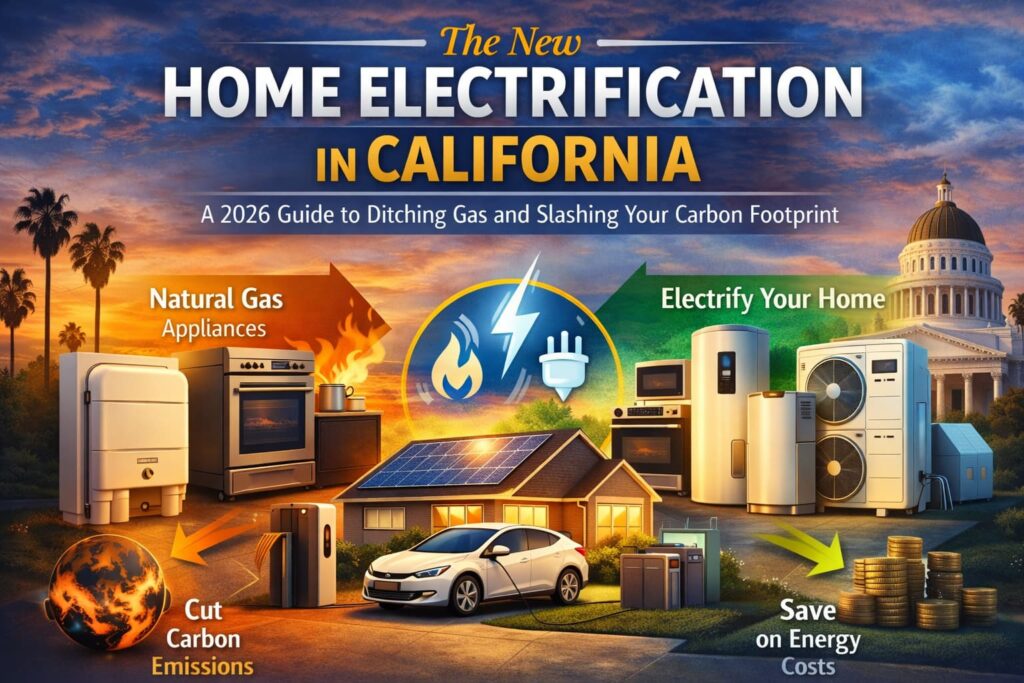
California homeowners are increasingly switching from gas to electric because it can deliver three wins at the same time
- Lower emissions (especially as California’s grid gets cleaner)
- Healthier indoor air (less indoor combustion and fewer NO2 spikes during cooking)
- More control over energy costs when paired with solar and battery storage
State policy is also pushing in the same direction. Starting January 1, 2026, new building permit applications must comply with California’s 2025 Energy Code, which expands heat pump adoption and electric readiness (California Energy Commission)
What “home electrification” actually means
Electrification is simply replacing appliances that burn gas with efficient electric alternatives
The common upgrades
- Gas furnace or AC system → heat pump HVAC (heating and cooling)
- Gas water heater → heat pump water heater (HPWH)
- Gas stove or cooktop → induction cooktop or induction range
- Gas dryer → heat pump dryer or high-efficiency electric dryer
- Gas fireplace or space heater → electric options (when needed)
The goal
A home that runs on electricity for all major end uses, ideally powered by
- Solar panels
- Battery storage (optional but increasingly valuable)
Why California is accelerating electrification in 2026
1) Buildings are a big emissions lever
California notes that buildings play a major role in decarbonization, and cites that buildings currently emit about 25% of the state’s total greenhouse gas emissions (California Energy Commission)
2) Codes are shifting toward heat pumps and electric readiness
The California Energy Commission states the 2025 Energy Code encourages heat pumps for space and water heating and includes electric readiness measures, with compliance for permit applications on or after January 1, 2026 (California Energy Commission)
3) Local air districts are tightening rules on new gas appliances
In the Bay Area, the Air District’s “building appliances” rules set a timeline where new small residential water heaters must meet zero-NOx standards beginning January 1, 2027, and furnaces follow on January 1, 2029 (Bay Area Air District, CARB)
This matters for 2026 because it nudges homeowners to plan upgrades before an emergency replacement forces a rushed decision
The benefits you actually feel at home
Comfort and performance
- Heat pumps deliver both heating and cooling, often with smoother temperature control
- Variable-speed heat pumps can reduce the hot-cold cycling that many furnace systems have
Health and indoor air quality
Gas cooking can elevate indoor nitrogen dioxide (NO2). A Stanford analysis published in late 2025 reported that switching from gas and propane stoves to electric reduces NO2 exposure meaningfully, especially for heavier stove users (Stanford)
Cost stability
Electrification is not only about “saving money today.” It is about reducing your exposure to
- Gas price volatility
- Future gas system cost shifts as fewer customers remain on the gas network
- Peak electricity pricing, which batteries can help manage
Solar synergy
Electrification makes your home a perfect match for solar because you can offset more of your total energy spend with one system
The 2026 electrification roadmap (do this in the right order)
This order is designed to minimize surprises and maximize incentives
Step 1: Get your baseline numbers
Collect these before you buy anything
- Last 12 months of electric bills (kWh and rate plan)
- Last 12 months of gas bills (therms)
- Photos of your main electrical panel (amperage, breaker spaces)
- Appliance list (age, fuel type, size)
- A simple note of comfort issues (hot rooms, cold rooms, humidity)
Step 2: Start with the “big two” gas burners
These usually create the largest emissions and comfort impact
- Space heating (furnace) → heat pump HVAC
- Water heating → heat pump water heater
Why first
- They are the largest gas loads in most California homes
- They unlock many electrification and efficiency benefits immediately
Step 3: Make cooking electric (and better)
- Swap to induction when it fits your budget and wiring
- If you are not ready for a full remodel, consider a portable induction burner as a bridge
Step 4: Finish with dryer and smaller loads
- Heat pump dryer if you want maximum efficiency
- Other minor gas end uses as needed
Step 5: Pair with solar and consider battery storage
- Solar can offset the new electric loads
- Batteries increase self-consumption and reduce peak imports
Costs in California (realistic ranges, plus what drives them)
Costs vary widely by home size, ductwork, electrical readiness, permitting, and region. The goal is to budget with realistic ranges
Heat pump water heater (HPWH)
- Unit cost is commonly in the $1,500 to $3,000 range, with installation varying based on complexity (ENERGY STAR)
What drives cost
- Location (garage vs attic vs closet)
- Condensate drain and venting needs
- Electrical circuit requirements
Heat pump HVAC (space heating and cooling)
- Installed costs vary widely. One 2025 national pricing estimate put an average installed cost around $16,500 with significant range (EnergySage)
What drives cost
- Duct condition (repair or replacement)
- System size and efficiency tier
- Multi-zone needs and home layout
Electrical panel upgrades
Many homes can electrify without a panel upgrade, but older panels or limited capacity can force it
- National estimates show wide ranges, commonly from a few hundred to several thousand depending on amperage and scope (NerdWallet)
Tip
- A smart contractor will explore load management and 120V plug-in options before recommending a costly service upgrade
120V “plug-in” heat pump water heaters (2026 game changer)
A growing product category can run on a standard 120V circuit, potentially avoiding a 240V circuit install in some situations. A NEEA report discusses this emerging class of 120V HPWH products and their performance considerations (NEEA)
Incentives and rebates in 2026 (what is real, and what is “fully reserved”)
This is where homeowners get burned. Programs open, fill up, pause, and relaunch. In 2026, some of the most talked-about California programs are constrained
TECH Clean California
TECH’s public reporting pages show single-family incentives were fully reserved and stopped accepting new reservations after November 2025 in that cycle (TECH Clean California)
HEEHRA (California’s IRA electrification rebates)
The California Energy Commission notes that HEEHRA Phase I launched via TECH Clean California, and as of February 2026, single-family rebates are fully reserved statewide with waitlists and no new income verification at the moment (California Energy Commission)
Federal solar and battery tax credit (25D)
The IRS states the Residential Clean Energy Credit applies to eligible solar and battery storage, with the credit scheduled to begin phasing down in 2033 (IRS)
Important
- Always check current program status before signing a contract
- If a contractor promises a rebate, ask for a written reservation confirmation and program ID
How to plan electrification without blowing up your electrical panel
Electrification does not always mean “replace everything and upgrade to 400 amps.” The smart approach is load planning
The 3 questions to ask before any major purchase
- How many amps is your main service (100A, 125A, 200A)
- How many open breaker spaces do you have
- Which upgrades can use load management or flexible circuits
Common tactics that avoid panel upgrades
- Heat pump water heater first, because it is often easier to wire than a full HVAC conversion
- Induction cooking with a circuit plan (sometimes with a smaller breaker or shared circuit options)
- Smart load management devices to prevent simultaneous peaks
- 120V plug-in HPWH when it fits the home and hot-water needs
Solar for an all-electric home (how to think about sizing)
Electrification increases your electric load. The best time to size solar is before you electrify everything, but after you understand your roadmap
A simple sizing approach
- Start with your current annual electricity use (kWh)
- Add estimated kWh for each new electric load
- Heat pump HVAC
- Heat pump water heater
- EV charging (if applicable)
- Size solar to offset your new annual kWh target, while considering roof constraints and rate plan
Why batteries are increasingly valuable in California
- TOU peak periods can make evening imports expensive
- Batteries let you use more of your solar at night
- Batteries provide outage resilience
A realistic electrification timeline (so you do not get forced into a bad replacement)
If your appliances are still working
- 0 to 2 weeks: plan, bills review, panel assessment
- 2 to 6 weeks: select contractors, finalize scope
- 4 to 12 weeks: install HVAC and water heater (can vary by permitting)
- 1 to 8 weeks: solar design, engineering, and permitting (then installation)
If you are in emergency replacement mode
- Replace with the clean option when possible
- If your panel is a constraint, prioritize a solution that keeps you moving (for example, a compatible HPWH path) and then optimize later
Electrification checklists (copy and use)
Contractor quote checklist
- Itemized equipment model numbers and efficiency ratings
- Electrical scope included or excluded (panel, circuits, permits)
- Ductwork scope and test plan (for HVAC)
- Disposal of old equipment included
- Warranty terms (equipment and labor)
- Clear statement of incentive assumptions and reservation status
Before installation day
- Confirm permit responsibility
- Confirm inspection scheduling
- Confirm electrical shutoff window
- Confirm space requirements (especially for HPWH airflow and drain)
FAQ
Is electrification worth it in coastal California where heating demand is low
Often yes, but the best payback usually comes from replacing old, inefficient equipment and pairing electrification with solar. The roadmap should be tailored to your climate zone and rate plan
Does induction require a full remodel
Not always. Many homes can install an induction range with the right circuit planning. Portable induction can also be a low-cost transition step
Will I lose cooking performance by switching from gas
Most people find induction faster and more controllable once they adjust. It also reduces combustion byproducts in the kitchen, which is one reason it is often recommended as a health-forward upgrade (Stanford)
Do I need a battery for an all-electric home
Not required, but it can significantly improve bill control and resilience, especially on TOU rate plans
Bottom line
Home electrification in California is no longer “a niche trend.” In 2026, codes, air quality rules, and market momentum are all pushing toward heat pumps and electric readiness
The smartest way to electrify is to
- Replace the big gas loads first (HVAC and water heater)
- Plan your panel instead of guessing
- Add solar to offset new loads
- Consider batteries to reduce peak imports and add backup value
Sources
California Energy Commission: 2025 Energy Code compliance starting Jan 1, 2026
https://www.energy.ca.gov/programs-and-topics/programs/building-energy-efficiency-standards/2025-building-energy-efficiency
Bay Area Air District: Building Appliances Rule timeline (2027 water heaters, 2029 furnaces)
https://www.baaqmd.gov/en/community-health/building-appliances-rule-implementation
Stanford: Gas stove NO2 exposure reduction from switching to electric (Dec 2025)
https://news.stanford.edu/stories/2025/12/gas-propane-stoves-nitrogen-dioxide-exposure-health-risks-switching-electric
IRS: Residential Clean Energy Credit (25D) for solar and batteries (updated Jan 2026)
https://www.irs.gov/credits-deductions/residential-clean-energy-credit
ENERGY STAR: Heat pump water heater typical cost range
https://www.energystar.gov/homesavings/redirect/1000180
California Energy Commission: IRA rebate programs and HEEHRA status (Feb 2026)
https://www.energy.ca.gov/programs-and-topics/programs/inflation-reduction-act-residential-energy-rebate-programs
TECH Clean California: incentives status pages
NEEA: 120V plug-in heat pump water heater report (PDF)
https://neea.org/wp-content/uploads/2025/03/Plug-In-Heat-Pump-Water-Heaters-An-Early-Look-to-120-Volt-Products.pdf