

Suggested SEO title: Propel Solar Financing in California: How It Works, Pros, Cons, and What to Ask
Suggested meta description: Learn how Propel solar financing works for California homeowners, how it compares with solar loans and leases, and whether it makes sense under California’s Solar Billing Plan.
Propel Solar Financing in California: Everything Homeowners Need to Know
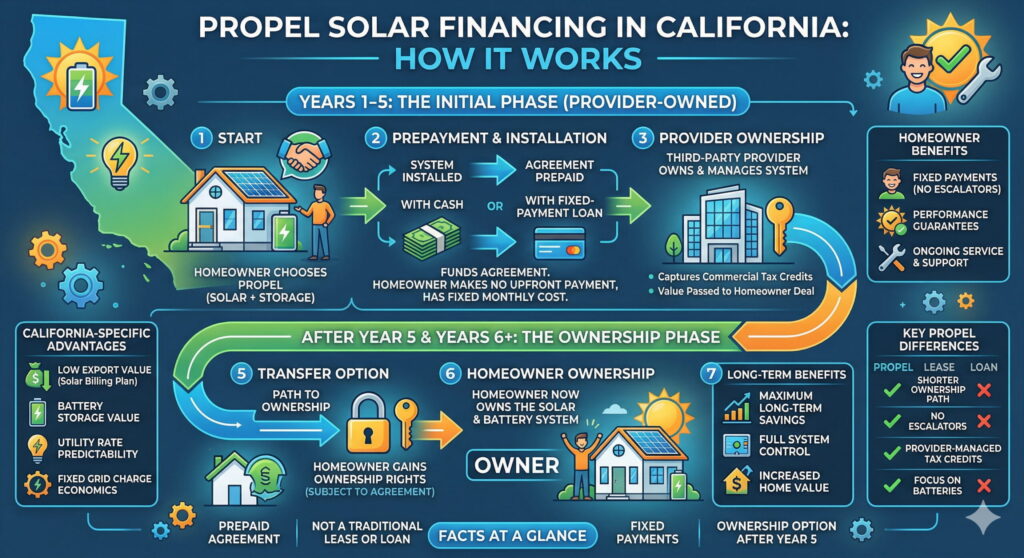
If you are shopping for solar in California in 2026, financing matters more than ever.
The old math has changed.
California no longer rewards daytime exports the way it once did under the Solar Billing Plan. Batteries matter more. Time-of-use rates matter more. And after the end of the homeowner federal solar tax credit for new customer-owned systems, many homeowners are rethinking whether cash and traditional solar loans are still the obvious best choice.
That is exactly why new financing structures like Propel are getting attention.
Propel is not a standard solar loan. It is not a classic lease either. It is a newer structure designed to combine some of the accessibility of third-party ownership with a path to ownership after year five.
For California homeowners, that makes it worth understanding in detail.
This guide breaks down:
- what Propel is
- how it works
- how it differs from a solar loan, lease, or PPA
- why it may be more relevant in California than in many other states
- when it makes sense
- when it probably does not
- what questions you should ask before signing anything
Quick takeaways
- Propel is a prepaid third-party ownership solar and battery financing structure.
- The system is typically owned by the provider at first, not by the homeowner on day one.
- The homeowner can prepay with cash or finance the prepayment with fixed monthly loan payments.
- The structure is designed to capture tax-credit value at the system-owner level and pass value into the homeowner economics.
- Propel is marketed as a financing option with no escalators, no dealer fees, fixed payments, and a path to ownership after five years.
- In California, it is most relevant because of three big realities:
- the end of the residential homeowner federal credit for new customer-owned systems
- lower export compensation under the Solar Billing Plan
- the rising importance of batteries and self-consumption
What is Propel solar financing?
Propel is a new solar and battery financing product launched by SolSource Solutions and TriBeam Financial.
At a high level, here is the concept:
- SolSource acts as the third-party owner of the solar and battery system during the initial term
- the homeowner enters into a lease or energy services agreement
- the required upfront amount is prepaid at installation
- that prepayment can be made with cash or financed through a loan platform
- monthly loan payments are structured to stay fixed
- after year five, the homeowner has the option to obtain ownership rights, subject to the agreement terms
That means Propel is best understood as a hybrid structure.
It is not simply “a lease with monthly payments.”
It is also not a standard “you own the system from day one” solar loan.
Instead, it tries to solve a very specific 2026 problem:
How do you make solar and batteries pencil for homeowners when third-party ownership can still capture tax-credit economics, but many homeowners still want predictability and eventual ownership?
Why Propel matters more in California than in many other states
California is now one of the most complex residential solar markets in the country.
A homeowner here is not just comparing equipment and monthly payment. They are also dealing with:
- the Solar Billing Plan instead of old retail net metering
- very high utility rates
- time-of-use pricing
- a monthly fixed grid charge that solar generally does not eliminate, as explained in The New California Fixed Charge: What It Means for Your Electricity Bill
- stronger economics for batteries than solar-only systems
- frequent homeowner questions around resilience and outage backup
That makes financing structure more important than it used to be.
1) California exports are worth less than they used to be
For new systems, California’s current net billing structure rewards onsite use and storage much more than simply sending excess solar to the grid in the middle of the day, which is why many homeowners are still asking whether solar is worth it in California under the newer rules.
That means:
- battery pairing matters more
- load shifting matters more
- system design matters more
- financing that works well with solar-plus-storage may matter more too
2) Electricity is expensive in California
When grid electricity is expensive, even a financing structure that is not “perfect” on paper can still be compelling if it meaningfully reduces a homeowner’s cost per kWh and improves bill predictability.
That is one reason California homeowners are more willing to compare nontraditional financing structures than they were a few years ago.
3) The direct homeowner tax-credit path changed
For years, one of the biggest arguments for buying solar with cash or a loan was simple:
- you owned the system
- you got the tax credit
- you captured the best long-term return
That calculation is not as straightforward in 2026.
With Propel, the provider structure is designed to preserve tax-credit value through third-party ownership, then build that value into the overall homeowner economics.
4) Batteries are moving from “nice to have” to “strategic” in California
In California, a battery is no longer just about blackout protection. It is also becoming one of the main ways homeowners improve solar economics under current rules, which is why our guide on Solar Battery vs. the Grid has become so relevant.
It can also help homeowners:
- store midday solar instead of exporting it cheaply
- use stored power during expensive evening hours
- reduce grid purchases during peak time-of-use windows
- improve the value of a solar installation under current billing rules
That is important because Propel is being positioned as a solar and battery financing solution, not just a solar-only product.
How Propel works step by step
Here is the plain-English version.
Step 1: The homeowner chooses Propel
Instead of choosing:
- cash purchase
- traditional solar loan
- classic lease
- classic PPA
The homeowner chooses Propel as the financing path.
Step 2: The project is prepaid
The underlying agreement amount is prepaid at installation.
The homeowner can do that in one of two ways:
- cash prepayment
- financed prepayment, where the homeowner uses financing and then makes fixed monthly loan payments
This point is critical.
Propel is not just “pay a lease every month forever.” The structure is centered on a prepaid agreement, often backed by financing.
Step 3: SolSource owns the system initially
During the initial phase, SolSource is the owner of the solar and battery system.
That means the homeowner is not the day-one owner in the same way they would be with a standard solar loan.
Step 4: The system is monitored and supported
The product is marketed with performance support, warranty support, and ongoing system service during the provider-owned phase.
Depending on the installer and contract package, you may also see language around production guarantees, maintenance support, and claims support.
Step 5: Ownership can transfer after year five
A major part of Propel’s pitch is that the homeowner can obtain ownership rights after year five, subject to contract terms.
That is one of the biggest differences between Propel and many traditional leases, which may keep the system third-party owned for 20 to 25 years.
Propel vs a traditional solar lease
Many homeowners hear “third-party ownership” and assume Propel is just another lease.
That is too simplistic.
Here is the practical difference.
| Topic | Traditional solar lease | Propel |
|---|---|---|
| Initial ownership | Third party owns system | Third party owns system initially |
| Homeowner tax-credit path | Provider captures incentive value | Provider captures incentive value |
| Contract style | Long-term monthly lease payment | Prepaid agreement funded by cash or financing |
| Escalators | Common in many legacy leases | Marketed as no escalators |
| Dealer fees | Can exist depending on structure | Marketed as no dealer fees |
| Ownership path | Often none until much later, if ever | Designed for ownership option after year five |
| Best fit | Homeowner prioritizes low entry barrier and simplicity | Homeowner wants predictability plus a shorter path to ownership |
That does not automatically mean Propel is always better.
It just means you should not lump it together with old-school lease products without reading the details.
Propel vs a standard solar loan in California
The better comparison for many California homeowners is actually Propel vs a traditional loan.
| Topic | Standard solar loan | Propel |
|---|---|---|
| Who owns the system at installation? | Homeowner | Provider initially |
| Who handles tax-credit economics? | Homeowner used to, if eligible | Provider structure handles it |
| Payment structure | Loan payment | Loan payment may finance the prepaid agreement |
| Monthly payment risk | Can vary by loan design and dealer fees | Marketed as fixed payments and no escalators |
| Service and monitoring | Depends on installer and warranty | Provider-backed during initial phase |
| Path to ownership | Immediate | After year five |
| Contract complexity | Usually simpler | Usually more documents and more structure |
| Long-term control | Highest from day one | More limited until ownership transfer |
For some homeowners, immediate ownership still wins.
For others, Propel may look more attractive if:
- they do not want to rely on old homeowner tax-credit assumptions
- they want a more predictable all-in structure
- they prefer some service layer during the early years
- they are already planning to pair solar with battery storage
Where Propel may fit especially well in California
Propel may be worth a serious look if you fall into one or more of these groups.
1) You want solar plus battery, not solar-only
California’s current market increasingly rewards homeowners who:
- use more solar onsite
- shift usage into evening hours
- avoid importing expensive peak power
- store daytime production instead of exporting too much of it
A financing product built specifically around solar plus storage can be more relevant than generic solar financing, especially if you are already comparing California solar financing options and trying to understand which structure fits your home best.
2) You want predictable payments
Some homeowners hate the uncertainty that can come from:
- escalators
- teaser monthly pricing
- dealer-fee-heavy loan structures
- tax-credit recast assumptions
Propel is being marketed around predictability.
That does not mean every contract will be perfect. It does mean the product is deliberately positioned against the fee-loaded and escalator-heavy reputation some solar financing products have earned.
3) You missed the best era for direct homeowner tax-credit math
For California homeowners going solar now, the old “just buy it and claim the credit” advice is no longer universal.
That makes products like Propel more relevant than they would have been two or three years ago.
4) You care about eventual ownership
Many homeowners dislike traditional leases for one big reason:
You can be stuck making payments on a system you never really own.
Propel tries to answer that objection by building in a path to ownership after year five.
5) You want a cleaner side-by-side comparison than older lease models
If your alternatives are:
- a lease with escalators
- a loan with dealer fees
- a cash purchase with a large upfront hit
Propel may end up being the most understandable middle-ground option. That is especially true if you are also comparing it against a cash-vs-financing solar decision rather than only looking at lease-style offers.
Where Propel may not be the best choice
This is just as important.
Propel is not automatically the smartest move for every California homeowner.
Propel may be less attractive if:
- you can comfortably pay cash and want maximum long-term savings
- you qualify for a very competitive solar loan with excellent terms and minimal fees
- you strongly prefer owning the system from day one
- you do not want third-party contract complexity
- you may move in the near future and do not want to deal with transfer or buyout logistics
- you are comparing against an unusually well-priced local installer cash deal
For many homeowners with strong cash flow and a long time horizon, direct ownership may still win on lifetime economics.
The California-specific questions that matter most
When evaluating Propel in California, do not stop at the monthly payment.
Ask how the system performs under California’s actual utility and billing structure. In practice, that means looking at your utility, your load profile, and your actual rates, not just sales slides. If you are still trying to benchmark your starting point, it helps to review the average electric bill in California and how much rates vary by utility territory.
Ask these questions:
- How much of my projected solar production will I use onsite?
- How much is expected to be exported to the grid?
- What battery size is being proposed, and why?
- How much evening load can the battery realistically cover?
- What utility rate schedule will I be placed on?
- How much of the projected savings depends on export credits versus self-consumption?
- Does the proposal reflect the Base Services Charge I will still pay as a grid-connected homeowner?
- What assumptions are being used for utility inflation?
- What happens if my usage rises because I add an EV or heat pump?
- What happens if my usage falls and the system ends up oversized?
These questions matter because California savings are increasingly won or lost through:
- system design
- battery sizing
- usage timing
- realistic bill modeling
not just the sticker price of the equipment.
The most important contract questions to ask before signing Propel
This section may save you thousands.
Ask for written answers to all of the following:
Ownership and transfer
- Exactly when can ownership transfer?
- Is ownership transfer automatic, optional, or conditional?
- Is there a buyout formula?
- What document governs the transfer?
- Are there title or filing issues the homeowner should understand?
Payments
- What is the exact monthly payment?
- Is it fixed for the full financing term?
- Are there any dealer fees, origination fees, admin fees, dealer adders, or servicing fees?
- Is there any prepayment penalty?
- Is there a same-as-cash period or recast assumption hidden in the model?
Battery details
- Is the battery included in the ownership transfer?
- Who owns it during years one through five?
- What backup circuits are included?
- Is whole-home backup included, partial-home backup, or no backup design?
- What is the battery warranty after ownership transfers?
Service and performance
- Who monitors the system?
- Who pays if equipment fails in year three?
- What exactly is the performance guarantee?
- How is underperformance measured?
- What remedies are available if production is lower than promised?
Selling the home
- Can the agreement transfer to a buyer?
- What credit or approval standards apply to a buyer?
- Is early buyout allowed before sale?
- What are the costs to transfer or buy out?
Roof and home condition
- What happens if the roof needs replacement in year two or year four?
- Who pays for panel removal and reinstall?
- Are there workmanship warranties on penetrations and roof attachment?
Savings model
- Which utility tariff and rate schedule were assumed?
- Which annual utility inflation rate was used?
- Did the proposal assume a specific amount of export credit that may not materialize?
- Does the model include California’s fixed monthly grid charge?
Red flags to watch for
Not every problem is unique to Propel, but these are the warning signs that should slow you down.
Red flag #1: The rep cannot explain who owns the system and when
If you do not get a crisp answer in one minute, keep digging.
Red flag #2: The proposal focuses only on “your bill goes down”
That is not enough.
You need to understand:
- all monthly obligations
- total five-year outlay
- total financing cost
- when ownership happens
- what value remains after ownership transfer
Red flag #3: Battery value is hand-waved
In California, battery economics should be modeled thoughtfully.
If the rep treats the battery like a generic add-on instead of a core part of your savings strategy, the design may not be optimized.
Red flag #4: The contract language is vague around transfer, buyout, and service
Vague financing language becomes expensive later.
Red flag #5: The installer cannot model multiple scenarios
A serious California installer should be able to show you at least:
- cash purchase scenario
- loan scenario
- Propel scenario
- solar-only versus solar-plus-battery scenario
They should also be able to show you how Propel compares with the framework in our guide on how to compare solar panel quotes, not just tell you that the monthly number looks better.
Is Propel better than buying solar in California?
Sometimes yes. Sometimes no.
That is the honest answer.
Propel can be better if:
- your best alternative loan is expensive or loaded with fees
- you want a battery and want a more structured service layer early on
- you want a path to ownership without relying on outdated tax-credit assumptions
- you are highly payment-sensitive and want predictability
Buying can be better if:
- you can pay cash
- you want maximum lifetime savings
- you value direct control from day one
- you plan to stay in the home a long time
- you are getting a clean, well-priced, low-fee ownership proposal
Is Propel better than a lease or PPA?
For many homeowners, it may be.
That is because classic leases and PPAs often bring two frustrations:
- long contract terms with little real control
- escalators that make the “savings” look worse over time
Propel’s shorter path to ownership and no-escalator positioning make it more compelling than many legacy lease structures.
Still, that does not mean every Propel offer will beat every lease or PPA.
The details still matter.
What California homeowners should compare side by side
Before choosing any financing option, ask your installer to build a side-by-side comparison with these exact columns.
| What to compare | Why it matters |
|---|---|
| Total out-of-pocket in year 1 | Shows true entry cost |
| Monthly obligation | Helps compare affordability |
| Five-year total paid | Critical for Propel and lease comparisons |
| Ownership status in year 1 | Tells you who controls the asset |
| Ownership status in year 6 | Important for Propel |
| Estimated utility bill after solar | Measures immediate bill relief |
| Estimated total energy cost | More honest than “utility bill only” |
| Battery included? | Essential in California |
| Backup capability | Matters for outage planning |
| Escalators or hidden fees | Can destroy long-term value |
| Home sale transfer rules | Matters if you may move |
| Maintenance responsibility | Affects risk and hassle |
Our view: Propel is one of the more interesting solar financing developments of 2026
Propel is interesting because it is trying to solve a real market problem, not invent one.
The product exists because the solar market changed.
In the old market, the homeowner playbook was simpler.
In today’s California market, homeowners need to think about:
- export value
- time-of-use pricing
- battery arbitrage
- fixed grid charges
- tax-credit structure
- financing fees
- contract flexibility
That makes hybrid products like Propel more relevant.
It does not make them automatic winners.
The homeowners most likely to benefit are the ones who compare Propel carefully against:
- a strong cash quote
- a clean ownership loan
- a traditional lease or PPA
and focus on total energy cost, not just the lowest-looking monthly number. If you want a more disciplined way to think about that tradeoff, it is worth pairing this with our guides on how to compare solar quotes and solar payback in California.
Bottom line
Propel may be a strong fit for California homeowners who want:
- solar plus battery
- fixed payment predictability
- no escalator structure
- a path to ownership after year five
- a financing option that reflects the new post-tax-credit reality
But it should never be purchased on headline marketing alone.
The right way to evaluate Propel is to treat it as a serious financial product, not just a solar promotion.
That means asking harder questions about:
- ownership timing
- battery value
- total cost over five years
- buyout rights
- home-sale flexibility
- California-specific savings assumptions
Do that, and you will have a much better shot at choosing the financing structure that actually fits your home, your utility, and your long-term energy goals.
FAQ: Propel solar financing in California
Is Propel a solar lease?
Not exactly.
It uses third-party ownership during the initial phase, but it is structured as a prepaid agreement that can be funded with financing and is designed to offer a path to ownership after year five.
Do I own the solar system right away with Propel?
Usually no.
The provider owns the system initially. Ownership rights may become available after year five, depending on the agreement terms.
Does Propel work better with batteries?
In California, it often looks most compelling when paired with battery storage because battery value is more important under the current Solar Billing Plan.
Does Propel eliminate the California fixed charge on my electric bill?
No.
If you stay grid-connected, you should still expect to pay the utility’s fixed monthly grid-related charge.
Is Propel available everywhere in California?
Availability depends on installer participation, project qualification, and whether the offering is live in your market.
Is Propel always cheaper than a solar loan?
No.
Some homeowners will still do better with direct ownership. The only honest way to know is to compare total five-year and long-term costs side by side.