
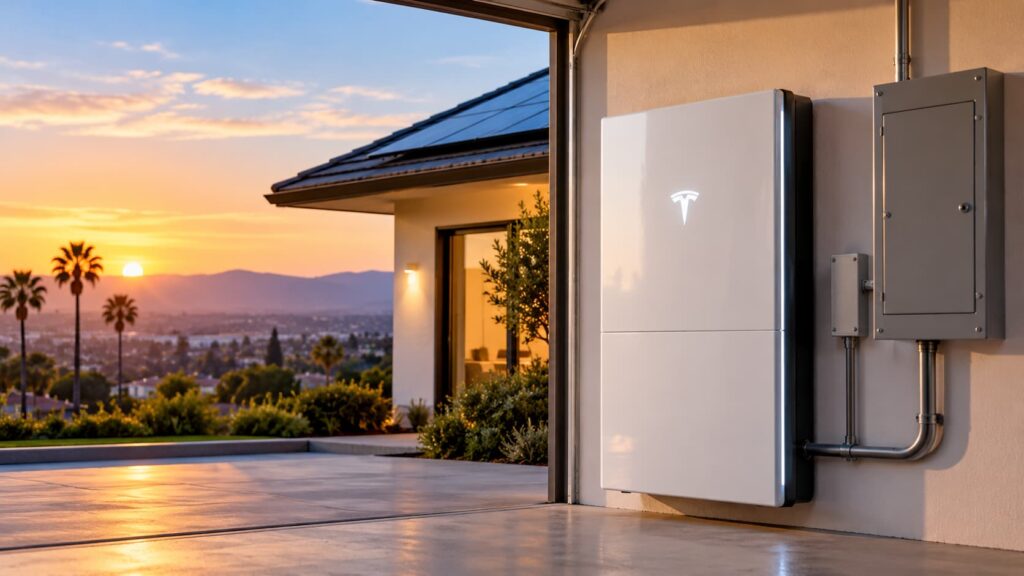
Quick answer: A home battery backup in California costs about $13,000 to $19,000 installed for one battery on a critical-loads panel, and about $23,000 to $44,000 for whole-home backup with 2 to 3 batteries, as of November 2026. One 13.5 kWh battery runs a fridge, lights, Wi-Fi and a gas furnace fan for about 24 to 36 hours. The federal 30% credit ended for homeowner systems installed after December 31, 2025, so plan on the full price unless you qualify for SGIP equity funding.
Most people searching for home battery backup in California are not shopping for a gadget. They just got a PSPS notice, or their power went out for 14 hours in a wind event, or their utility bill doubled between 4 and 9 p.m. That is the first thing I tell homeowners here: in this state a battery has two jobs, keeping the lights on and dodging peak rates, and you should size it for the job you care about most.
This guide covers what a home battery backup system costs in California right now, how many batteries you actually need, whether you can install one without solar, how the main models compare, and when a generator or a portable power station is the smarter buy.
Key takeaways
- One installed battery with a critical-loads panel: about $13,000 to $19,000. Whole-home backup with central AC: about $23,000 to $44,000.
- Size by daily kWh, not by house size. Most California critical-loads setups use 7 to 12 kWh a day, which one 13.5 to 15 kWh battery covers.
- You can install a battery without solar, but it only recharges from the grid, so a multi-day PSPS outage drains it for good.
- SGIP money remains only in the income-qualified equity budget, and most of it is waitlisted. The 25D federal credit ended for homeowner systems installed after December 31, 2025.
- Peak-rate savings are biggest on SDG&E, then SCE, and smallest on PG&E.
What is a home battery backup system?
A home battery backup system is a wall- or floor-mounted lithium battery, wired into your electrical panel, that switches on automatically within a fraction of a second when the grid goes down. It charges from solar panels, the grid, or both, and on normal days it can also discharge during your utility’s 4 to 9 p.m. peak window to cut your bill.
Every permanent system has three parts: the battery itself, an inverter (built into most new batteries), and a gateway or automatic transfer switch that isolates your home from the grid during an outage. That isolation is a safety requirement, and it is why a real home battery backup needs a licensed electrician, a permit and a utility notification, unlike a plug-in power station.
For the full picture on what goes into the price, see our breakdown of what a solar battery costs in California.
How much does a home battery backup cost in California in 2026?
One battery installed on a critical-loads panel costs about $13,000 to $19,000 in California as of November 2026. Whole-home backup that can run central air usually takes 2 or 3 batteries and lands around $23,000 to $44,000, depending on your main panel and the size of your AC.
Home battery backup cost in California by backup level, November 2026
| Backup level | What it runs | Typical runtime | Installed cost |
|---|---|---|---|
| 1 battery, critical loads | Fridge, lights, Wi-Fi, phones, TV, gas furnace fan, garage door | About 24 to 36 hours at 8 to 12 kWh a day | $13,000 to $19,000 |
| 2 batteries, most of the home | The above plus microwave, washer, well pump, a mini-split or window AC | About 24 hours at 20 to 25 kWh a day | $23,000 to $31,000 |
| 3 batteries, whole home | Everything, including central AC for part of the afternoon | About 24 hours at 30 to 40 kWh a day | $33,000 to $44,000 |
Source: installed ranges from our current California quotes; runtimes calculated from usable capacity on the Tesla Powerwall 3 datasheet and the FranklinWH aPower 2 datasheet.
Three things move a quote by thousands of dollars:
- A main panel upgrade. Older 100 A or 125 A panels often need an upgrade to 200 A for whole-home backup. That adds about $2,500 to $5,000.
- Permits and inspection. About $400 to $1,200 depending on the city and whether the fire department reviews the battery location.
- Distance from the panel. Long conduit runs or trenching add about $500 to $1,500.
A second battery on the same job costs less than the first, about $10,000 to $12,500, because the gateway, permit and most of the labor are already paid for.
Does the federal tax credit or SGIP still lower the price?
For most California homeowners buying a battery in 2026, no. The federal Residential Clean Energy Credit (Section 25D) ended for systems installed (placed in service) after December 31, 2025, according to the IRS, so it does not apply to a battery installed this year.
California’s Self-Generation Incentive Program (SGIP) still exists, but its general residential budget is closed. The money that remains is for income-qualified households only (at or below 80% of area median income, or enrolled in CARE, FERA or ESA), and much of it is waitlisted.
SGIP residential storage status by utility (checked October 28, 2026)
| SGIP budget | PG&E | SCE | SoCalGas | Rate |
|---|---|---|---|---|
| Small Residential Storage (general market) | Closed | Closed | Closed | $0.15 per Wh |
| Residential Solar and Storage Equity, AB 209 non-POU | Waitlisted | Waitlisted | Not offered | $1.10 per Wh |
| Residential Solar and Storage Equity, AB 209 POU | Waitlisted | Open | Not offered | $1.10 per Wh |
| San Joaquin Valley Residential | Closed | Closed | Not offered | $1.10 per Wh |
Source: SGIP Program Metrics and the CPUC SGIP page. Budgets change often: check the dashboard on the day you apply.
If you qualify for the equity budget, the math is dramatic: at $1.10 per Wh, a 13.5 kWh battery could earn up to about $14,850. That is worth applying for even with a waitlist. Just do not count it in your budget until you have a reservation confirmation in writing. Our plain-English guide to the Self-Generation Incentive Program walks through eligibility.
How many batteries do I need to back up my house?
Most California homes need one battery for critical loads and two to three batteries for whole-home backup with central air. Size by the kWh you need per day of outage, not by square footage: a 2,500 sq ft home with gas heat and no AC can use less than a 1,400 sq ft home with an EV and a pool pump.
Start with your daily usage. If you do not know it, our guide to how many kWh per day is normal shows typical California numbers by home size. Then cut it down to what you would actually run during an outage.
Daily outage load for a typical California critical-loads panel
| Load | Typical use per day |
|---|---|
| Refrigerator | About 1.5 kWh |
| LED lights, TV, electronics | About 2 to 3 kWh |
| Gas furnace blower (winter) | About 2 kWh |
| Wi-Fi, phones, laptops | About 0.5 kWh |
| Well pump or sump pump (if you have one) | About 1 to 2 kWh |
| Total | About 6 to 9 kWh |
Source: appliance draws from manufacturer ratings and the U.S. Department of Energy appliance energy calculator; totals are our sizing defaults.
Two numbers decide the size:
- Capacity (kWh) sets how long you last. Divide your outage load by the battery’s usable kWh.
- Power (kW) sets what you can run at the same moment. A 3-ton central AC can pull 3 to 4 kW while running and much more for a second at startup. That startup surge is why we check your AC’s nameplate before promising whole-home backup.
The takeaway: one 13.5 to 15 kWh battery is enough for most California critical-loads setups, and you only need a second or third battery when central AC or an EV is part of the plan. For appliance-by-appliance runtimes, see how long a solar battery can power a house.
Can I get a home battery backup without solar?
Yes. Most batteries we install, including the Tesla Powerwall 3 and FranklinWH aPower 2, can be installed without solar panels and charged from the grid. The tradeoff is that a battery-only system cannot recharge during an outage, so once it is empty, it stays empty until the grid comes back.
That makes battery-only a good fit when:
- Your outages are short, a few hours to one day, and you mostly want the lights and the fridge to ride through.
- Your roof cannot take solar (shade, orientation, an HOA, or a roof that needs replacing soon).
- You are on a time-of-use plan with a wide gap between peak and off-peak rates, so charging at night and discharging from 4 to 9 p.m. pays you back.
It is a weaker fit if you live in a PG&E or SCE fire-risk area where PSPS shutoffs can last two or three days. In that case, solar is what keeps the battery going: even a 6 kW array in winter can put about 15 to 20 kWh back into the battery on a clear winter day.
If you are adding a battery to an existing solar system, ask about a meter collar adapter: on some homes it replaces a costly panel upgrade.
Tesla Powerwall 3 vs Enphase IQ Battery 5P vs FranklinWH aPower 2
The three batteries we install most in California are the Tesla Powerwall 3, the Enphase IQ Battery 5P and the FranklinWH aPower 2. Per usable kWh, the FranklinWH is usually the cheapest storage, the Powerwall 3 is the best value when you also need a solar inverter, and the Enphase 5P is the most modular.
Home battery backup comparison, California installs, November 2026
| Battery | Usable capacity | Continuous power | Installed cost (1 unit) | Warranty | Best for |
|---|---|---|---|---|---|
| Tesla Powerwall 3 | 13.5 kWh | 11.5 kW | $13,000 to $16,500 | 10 years | New solar plus battery, whole-home backup |
| FranklinWH aPower 2 | 15 kWh | 10 kW | $11,000 to $15,000 | 15 years or 60 MWh | Adding storage to existing solar, lowest cost per kWh |
| Enphase IQ Battery 5P | 5 kWh | 3.84 kW | $7,500 to $8,500 | 15 years | Enphase microinverter homes, small critical-loads setups |
Source: capacity, power and warranty from the Tesla Powerwall 3 datasheet, FranklinWH aPower 2 datasheet and Enphase IQ Battery 5P data sheet; installed ranges from our California quotes.
A few details matter more than the headline specs:
- Motor starting. Both the Powerwall 3 and the aPower 2 are rated to start loads up to 185 LRA, which covers most residential AC compressors and well pumps. We still check your nameplate.
- Expansion. Powerwall 3 supports up to 4 units. FranklinWH supports up to 15 aPower units per aGate, up to 225 kWh. Enphase stacks in 5 kWh steps. See our guide to the Powerwall 3 expansion pack if you plan to grow.
- Heat. Tesla rates the Powerwall 3 from -4°F to 122°F, with output possibly reduced above 104°F. In the Inland Empire and the Central Valley we often site batteries on a shaded wall or in the garage for that reason.
- Chemistry. The FranklinWH aPower 2 uses lithium iron phosphate (LFP), the chemistry favored for thermal stability.
For head-to-head detail, read Tesla Powerwall vs Enphase and FranklinWH vs Tesla Powerwall, or our ranking of the best solar battery for your home.
Does a home battery pay for itself in California?
With solar on a time-of-use plan, a battery can pay back in about 8 to 12 years in California, fastest on SDG&E, then SCE, slowest on PG&E. Without solar, a battery is mostly a resilience purchase: the bill savings are real but rarely cover the cost within the warranty.
The savings come from shifting stored solar into the 4 to 9 p.m. peak instead of exporting it. Under California’s net billing tariff, exported solar earns far less than the retail peak rate, which is why batteries matter so much more than they did under NEM 2.0.
Simple battery payback by utility, one battery with solar
| Utility and plan | Average 4 to 9 p.m. rate | Annual value of 3,300 kWh shifted | Simple payback on $14,500 |
|---|---|---|---|
| SDG&E TOU-DR1 | 64.7 cents | $1,886 | 7.7 years |
| SCE TOU-D-PRIME | 50.3 cents | $1,413 | 10.3 years |
| PG&E E-TOU-C | 43.9 cents | $1,201 | 12.1 years |
Source: peak rates from current tariff sheets as used in our solar battery cost guide; export value under the CPUC net billing tariff. Annual value assumes the battery shifts about 10 kWh of solar a day on 330 days a year (3,300 kWh), minus about 7.5 cents per kWh of lost export value.
Worked example. A 2,000 sq ft home in Sonoma County on PG&E gets a PSPS notice for a 24-hour shutoff. It has a 7 kW solar array and one Powerwall 3 on a critical-loads panel. The fridge (1.5 kWh), lights and electronics (3 kWh), gas furnace blower (2 kWh) and Wi-Fi and phones (0.5 kWh) total about 7 kWh for the day. The battery covers that with about half its charge left, and on a clear October day the panels refill it by mid-afternoon. On normal days, the same battery shifts about 10 kWh into PG&E’s peak window. At $14,500 installed with no incentive, that is a payback of about 12 years, plus a home that stays lit through every shutoff. If the same home were in SDG&E territory, payback would drop to under 8 years.
If your bill is the main reason you are looking, our PG&E rates guide and SCE rates guide show which plan to pair a battery with.
How does a home battery help during a PSPS shutoff?
A home battery keeps your critical loads running automatically when your utility cuts power for wildfire safety. Six California utilities can call a Public Safety Power Shutoff: PG&E, SCE, SDG&E, Liberty Utilities, Bear Valley Electric Service and PacifiCorp, according to the CPUC.
A few PSPS-specific tips from our installs in fire-risk areas:
- Turn on storm watch. Most batteries can top up to 100% automatically when a red flag warning or PSPS alert hits your area, instead of sitting at your everyday reserve.
- Keep a reserve year-round. We set a 20% to 30% backup reserve so the battery is never empty when a shutoff arrives with little notice.
- Check your address. Your utility’s PSPS address lookup and the CPUC’s post-event reports show how often your area has been shut off, which is the best guide to how big your battery should be.
- Ask about Medical Baseline. If someone in your home relies on powered medical equipment, tell your utility and tell us. It changes how we size the system.
Home battery vs generator vs portable power station
A permanent home battery is the best choice for frequent shutoffs, silent operation and daily bill savings. A gas or propane standby generator is cheaper for very long outages but cannot save you money on normal days. A portable power station is the cheapest way to keep a fridge and phones going, but it does not switch on automatically.
Backup power options for California homes
| Option | Typical cost | Switches on automatically | Lowers your bill | Best for |
|---|---|---|---|---|
| Home battery (installed) | $13,000 to $19,000 for one | Yes | Yes, on time-of-use plans | Frequent PSPS events, homes with or adding solar |
| Standby generator | Varies widely by size and fuel line | Yes | No | Rural homes with multi-day outages and gas or propane on site |
| Portable power station | About $1,600 to $8,000 for whole-home-capable kits in retail listings, October 2026 | Only with an add-on panel | Rarely | Renters, short outages, a few key appliances |
Source: home battery ranges from our California quotes; portable power station prices from retail listings checked October 28, 2026.
Generators also come with noise rules, fuel storage and, in some California air districts, limits on how often you can run them. Our side-by-side of a solar battery vs a gas generator goes deeper.
What does installing a home battery backup involve?
A typical California home battery install takes one to two days on site, but the full process from signed contract to switching it on usually runs 4 to 10 weeks because of permitting and utility approval.
- Site visit or virtual survey. We look at your panel, your usage and where the battery can legally sit.
- Design and load selection. You choose critical loads or whole-home backup.
- Permit. The city or county reviews the plans; some require a fire department sign-off.
- Install. Battery, gateway and any panel work, usually in one or two days.
- Inspection and utility approval. Then we commission the system and set your backup reserve.
Every battery we install is backed by our CA contractor license #1026168, and we handle the permit and the utility paperwork. Explore our home battery backup installation service to see how we approach it in your area, including Los Angeles County.
Frequently asked questions
About $13,000 to $19,000 installed for one battery on a critical-loads panel, and about $23,000 to $44,000 for whole-home backup with 2 to 3 batteries, as of November 2026. A panel upgrade adds about $2,500 to $5,000 when needed.
Yes. Most modern batteries can be charged from the grid alone. The catch is that they cannot recharge during an outage, so battery-only works best for outages of a day or less.
One 13.5 kWh battery runs a typical critical-loads panel (fridge, lights, Wi-Fi, furnace fan) for about 24 to 36 hours. With solar recharging it during the day, it can keep going through a multi-day shutoff.
For most California homes with frequent but short shutoffs, yes: it is silent, automatic and lowers your bill on time-of-use rates. A generator wins for very long rural outages where you have a fuel supply.
Usually two or three, depending on your central AC and whether you have an EV or pool pump. A critical-loads setup needs one.
The federal 25D credit ended for homeowner systems installed after December 31, 2025. SGIP equity funding of $1.10 per Wh is still available for income-qualified households, but most of it is waitlisted. Check the SGIP dashboard before you count on it.
Get a home battery quote
If a PSPS notice or a peak-hour bill sent you here, the fastest next step is a quote built on your actual panel and usage. Get a quote in 2 minutes, or book a virtual consultation and we will tell you honestly whether one battery, three batteries or a battery at all makes sense for your home.