
Last updated: July 15, 2026
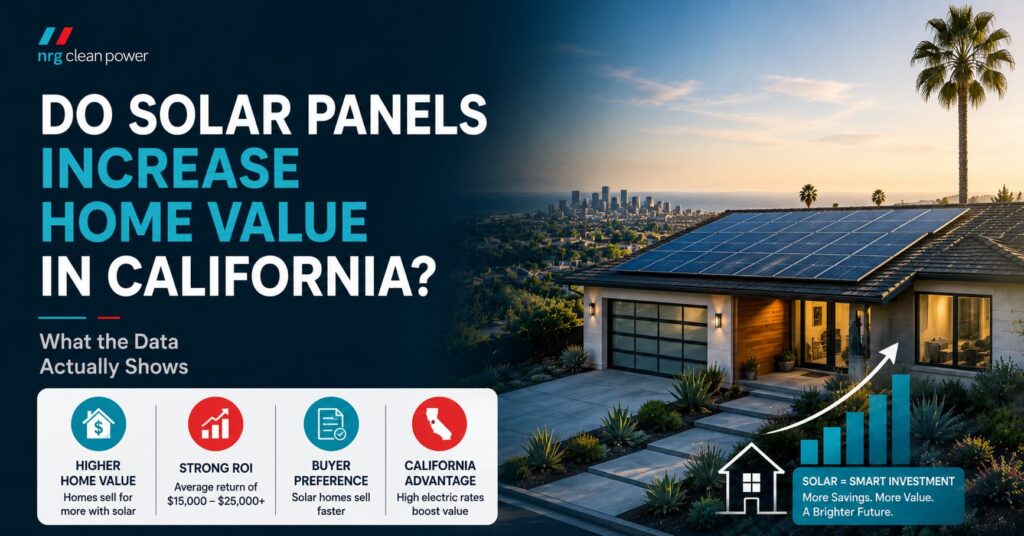
Quick answer: Yes, owned solar panels increase home value, and in California the premium is larger than the national average. A study of 5,000 California home sales found homes with owned solar sold for 5 to 10 percent more than comparable homes without solar, which on a $750,000 California home is roughly $37,500 to $75,000. The national premium runs about 4 to 7 percent. One critical catch decides whether you get any of it: the system must be owned, not leased. Leased and PPA systems add little to no appraised value and can complicate a sale.
Key takeaways
- Owned solar adds roughly 5 to 10 percent to a California home’s sale price, per a 5,000-sale California study, versus about 4 to 7 percent nationally
- On a $750,000 California home, that is approximately $37,500 to $75,000 in added value
- Ownership is the deciding factor: leased and PPA systems generally add no appraised value and can slow or complicate a sale
- Homes with solar also tend to sell faster than comparable non-solar homes
- The value premium holds even on systems over five years old, though newer systems earn slightly more
The short answer, with real numbers
The first thing I would tell any California homeowner weighing this: the resale premium here is bigger than the numbers you will see in national articles, because California has the electricity rates that make solar valuable to the next buyer. When power costs 35 cents a kWh, a paid-off system that cuts the bill is worth real money to whoever buys the house.
The most California-specific evidence comes from a SolarInsure analysis of roughly 5,000 California home sales between 2020 and 2023, comparing homes with owned solar, homes with third-party-owned solar, and comparable homes without. Homes with owned solar sold for 5 to 10 percent more than similar non-solar homes. Nationally, the picture is consistent but smaller: a 2025 SolarReviews study replicating Zillow’s methodology across 400-plus sales found a 6.9 percent average premium, about $29,000 on a median-priced US home, up from the older and widely-cited Zillow figure of 4.1 percent.
Solar home value premium, by source
| Source | Scope | Premium | Dollar value |
|---|---|---|---|
| SolarInsure (2020-2023 sales) | California, owned systems | 5% to 10% | ~$37,500 to $75,000 on a $750K CA home |
| SolarReviews (2025) | US national, owned systems | 6.9% avg | ~$29,000 on median US home |
| Zillow (2019) | US national | 4.1% | ~$9,300 at the time |
| Lawrence Berkeley National Lab | US national | ~$15,000 avg | roughly $4 per installed watt |
Premiums apply to owned systems only. Sources: SolarInsure California study; SolarReviews 2025; Zillow; Lawrence Berkeley National Laboratory. California’s higher figures track its higher electricity rates.
Why California pays a bigger premium
Direct answer: resale premium follows electricity prices and solar policy, and California leads the country on both. The 2019 Zillow data already showed the highest premiums in high-rate states. California’s residential rates now average 35.25 cents per kWh, nearly double the US average, so the bill a buyer avoids by inheriting a paid-off system is worth far more here than in a low-rate state.
There is a policy layer too. On municipal utilities like LADWP and Pasadena Water and Power that still offer retail net metering, an owned system is even more attractive to a buyer, because the export credits are worth full retail; we covered that advantage in our Granada Hills electricity cost guide. The rate environment that makes solar worth installing is the same environment that makes it worth paying extra for at resale.
The catch that decides everything: owned vs. leased
Direct answer: only owned solar reliably adds home value. This is the single most important thing to understand, and it is where homeowners get surprised.
When you own your system, outright or through a solar loan you pay off, the buyer inherits a fully owned asset with no strings. Appraisers can assign it value, and studies consistently show they do. When your system is leased or on a PPA, the buyer has to qualify for and assume your contract, or you have to buy it out before closing. Many buyers simply do not want the obligation, which shrinks your buyer pool and often leads appraisers to assign no value at all. Research on California sales found third-party-owned systems showed no measurable resale premium.
This matters more in 2026 than ever. With the federal tax credit for purchased systems gone, leases and PPAs are surging because they are the only way to capture the remaining commercial credit, as we explain in our California solar tax credit guide. That is a legitimate reason to lease, but go in knowing the resale tradeoff: the lease saves you money monthly and gives up the home-value premium. Our solar lease vs buy vs PPA guide works through the full decision.
Do solar homes sell faster?
Direct answer: yes, generally. Multiple studies find homes with owned solar spend fewer days on the market than comparable non-solar homes and attract more buyer interest. The energy savings are a concrete selling point a buyer can quantify, especially in high-rate California markets where the monthly bill is a real line in the household budget.
One honest obstacle remains on the appraisal side. The National Association of Realtors’ 2025 Sustainability Report found that a large share of agents are unsure whether local appraisers can properly value solar. The fix is documentation: keep your system’s ownership papers, production history, and warranty records, and make sure your agent presents them. A documented, owned system with a production track record is far easier to appraise at full value than a shrug and a guess.
Does system age reduce the premium?
Direct answer: barely. Research found systems over five years old still earned a 5 to 6 percent premium, while newer systems earned slightly more, in the 7 to 9 percent range. Because quality panels degrade slowly, around 0.5 percent per year as we cover in our guide to how long solar panels last, a system installed years ago is still producing most of its original output and still saving the next owner money. Buyers pay for that.
What this means if you are installing in 2026
The resale premium changes the honest math on going solar. Even without the federal tax credit, an owned California system pays back in roughly 5 to 7 years on electricity savings alone, detailed in our 5kW cost and output guide. The home-value premium is a second return layered on top: if you sell before the system’s life ends, a large share of the remaining value shows up in the sale price. For a homeowner who might move within the next 30 years, which is most homeowners, that resale bump is a financial factor that is easy to overlook and hard to ignore once you see the numbers.
The one rule that protects it: own the system. If maximizing home value is part of why you are going solar, a cash purchase or a loan you will pay off preserves the premium that a lease gives away.
FAQ
Do solar panels increase home value in California?
Yes. A study of roughly 5,000 California home sales found homes with owned solar sold for 5 to 10 percent more than comparable non-solar homes, about $37,500 to $75,000 on a $750,000 home. California’s premium exceeds the national average because of its high electricity rates.
How much value do solar panels add to a home?
Nationally, about 4 to 7 percent, or roughly $15,000 to $29,000 on a median-priced home. In California the range is 5 to 10 percent. The exact figure depends on system size, local electricity rates, and whether the system is owned.
Do leased solar panels add home value?
Generally no. Leased and PPA systems require the buyer to assume the contract or the seller to buy it out before closing, and appraisers typically assign them little or no value. Only owned systems reliably command a resale premium.
Do homes with solar sell faster?
Yes, studies find solar homes tend to spend fewer days on the market and draw more buyer interest than comparable non-solar homes, since the energy savings are a concrete, quantifiable benefit, especially in high-rate California markets.
Does an older solar system still add value?
Yes. Systems over five years old still earned roughly a 5 to 6 percent premium in the research, versus 7 to 9 percent for newer systems. Because panels degrade only about 0.5 percent per year, older systems still produce and save enough to be worth paying for.
Will solar panels increase my property taxes in California?
Not if the system is completed before January 1, 2027. California’s active solar property tax exclusion shields the added value from reassessment through that date. After the sunset, new installations may be assessed as new construction, as we detail in our California solar tax credit guide.