
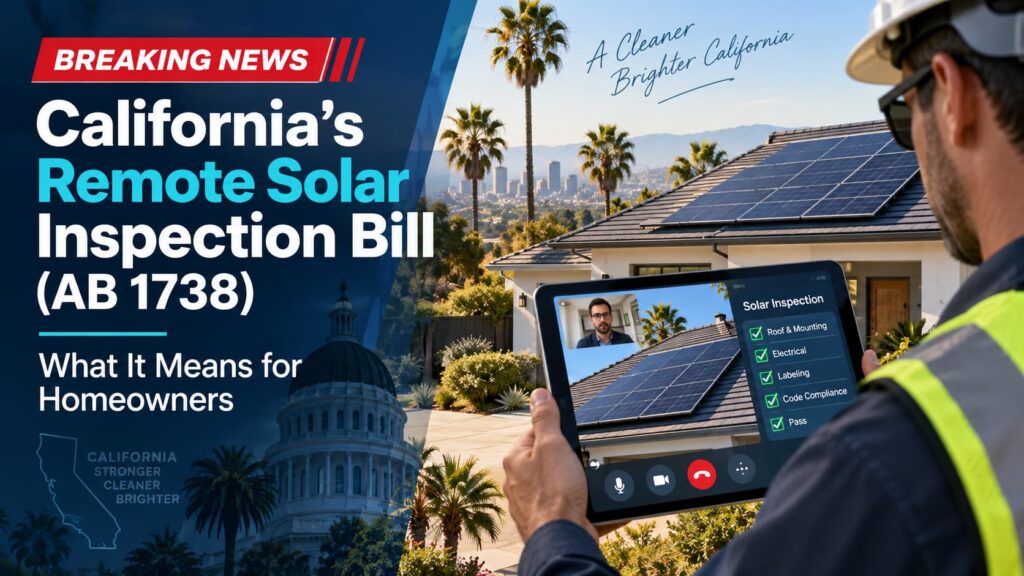
| Status as of September 16, 2026AB 1738 passed the California Legislature and was sent to Governor Newsom on August 28, 2026. He has until September 30, 2026 to sign or veto it. A companion bill for heat pumps, SB 222, is on the same deadline. We will update this page with the outcome. |
| Quick answer: AB 1738 would require most California cities and counties to let homeowners or their contractors request a remote video inspection for home solar, battery storage, heat pump water heaters, heat pump HVAC and new roofs, instead of waiting for an inspector to visit. Local agencies would have to offer the option by January 1 or July 1, 2028, and inspectors could still require an in-person visit. SPUR estimates in-person inspection delays add $600 to $1,000 to a typical project. |
Key takeaways
- California already made solar permits fast. Since SB 379, most jurisdictions must issue residential solar and paired battery permits online in real time. AB 1738 goes after the next bottleneck: the inspection.
- Covered work: rooftop solar, home batteries, heat pump water heaters, heat pump HVAC and new roofs on one- and two-family homes.
- It would not take effect for your project in 2026 or 2027. Do not delay a solar decision waiting for it.
- The savings are real but modest next to the price of a system: roughly 3% to 6% of a typical 7 kW solar project.
Here is something most homeowners do not know: in much of California, getting the solar permit is no longer the slow part. Since 2023, larger cities and counties have had to issue permits for standard home solar systems online, often the same day. What still eats time is the final inspection. An inspector has to physically come out, the crew or homeowner has to wait for a window that can stretch for hours, and until that inspection passes, the utility will not grant permission to turn the system on. AB 1738 is California’s attempt to fix that step.
What is AB 1738?
AB 1738, the Remote Virtual Inspection Act, would give California homeowners and contractors the right to request a live video inspection for specific home energy and roofing projects. The enrolled bill, authored by Assemblymember Juan Carrillo, applies to one- and two-family homes. It passed the Assembly unanimously after a 29 to 6 Senate vote, according to pv magazine USA.
What the bill would do, based on the enrolled text as summarized by CalMatters’ Digital Democracy and trade coverage:
- Require cities and counties to offer the option, including charter cities, by January 1, 2028 or July 1, 2028 depending on the jurisdiction. Canary Media reports the earlier date applies to cities over 50,000 people and counties of at least 150,000.
- Cover specific work: residential solar, battery storage, heat pump water heaters, heat pump HVAC and new roofs.
- Leave control with the inspector: the local inspector picks the video method and can require an in-person visit when a job needs a closer look. New or upgraded main electrical services do not have to be inspected remotely.
- Protect against abuse: an agency can temporarily bar a homeowner or contractor from remote inspections if they willfully misrepresent the work.
- Add reporting: cities and counties would report on remote inspections in their annual reports starting in 2028.
How much could remote inspections save on a solar project?
An estimated $600 to $1,000 per project. Research from SPUR, the Bay Area policy group that co-sponsored the bill, found contractors often wait 2 to 6 hours for an inspection that takes 5 to 15 minutes, and that the waiting, inspector travel and scheduling add that $600 to $1,000 to the cost of a single solar, battery or heat pump job. SPUR projects statewide savings of more than $500 million over three years.
To put that in perspective on a typical California solar job:
Table 1. What $600 to $1,000 in inspection costs means for a 7.2 kW solar system
| Item | Low end | High end |
|---|---|---|
| 7.2 kW system at NRG’s $2.40 to $3.25 per watt range | $17,280 | $23,400 |
| Estimated inspection-related cost (SPUR) | $600 | $1,000 |
| Share of system price | about 2.6% | about 5.8% |
| Solar + battery + new roof (separate permits, each inspected) | Savings can stack across inspections |
System pricing from our California solar cost guide. Inspection cost estimate from SPUR. Actual savings depend on your jurisdiction and how your installer prices labor.
The honest read: this is a meaningful trim, not a price revolution. The bigger payoff is time. A same-day video inspection can move a finished system to utility interconnection days sooner, and every day a finished system sits waiting is a day it is not cutting your bill.
Doesn’t California already have fast solar permits?
Yes, for the permit itself. SB 379 (2022) requires most cities and counties to run an online, automated permitting platform such as SolarAPP+ that can issue permits in real time for home solar systems up to 38.4 kW AC and for batteries paired with them. Larger jurisdictions had to comply by September 30, 2023 and smaller ones by September 30, 2024, while cities under 5,000 people and counties under 150,000 are exempt, according to the California Energy Commission. AB 1738 targets the inspection step that comes after.
Table 2. How California’s solar streamlining laws fit together
| Law | What it speeds up | Status | Applies to |
|---|---|---|---|
| SB 379 (2022) | Permit: instant online approval (SolarAPP+ or similar) | In effect since 2023/2024 | Home solar up to 38.4 kW AC and paired batteries |
| AB 1738 (2026) | Inspection: homeowner right to request a video inspection | Awaiting governor, deadline Sept 30, 2026 | Solar, batteries, heat pumps, heat pump water heaters, new roofs |
| SB 222 (2026) | Heat pump permits, fees and HOA rules | Awaiting governor, deadline Sept 30, 2026 | Heat pumps and heat pump water heaters |
Sources: CEC SB 379 program page; AB 1738 and SB 222 on California Legislative Information.
For the full permit process, fees and timelines, see our guide on how to get a solar permit in California.
When would remote inspections be available in my city?
By January 1 or July 1, 2028, if the bill is signed. Some places already offer it: at least 19 California jurisdictions have a remote option today, including Berkeley, Los Angeles County and San Diego, according to Canary Media. If you live in one of those areas, your installer may be able to book a video inspection now.
Table 3. AB 1738 timeline
| Date | What happens |
|---|---|
| August 28, 2026 | Bill sent to Governor Newsom |
| September 30, 2026 | Deadline to sign or veto |
| January 1, 2028 | Earlier compliance date (larger cities and counties, per Canary Media) |
| July 1, 2028 | Later compliance date for remaining covered jurisdictions |
| 2028 onward | Cities and counties report remote inspection use in annual reports |
What does SB 222 do for heat pumps?
SB 222, the Heat Pump Access Act, would standardize heat pump permitting statewide. As passed and reported by Canary Media, it would require cities of at least 5,000 people and counties of at least 150,000 to offer expedited or instant heat pump permits by July 1, 2028, limit a project to one permit, cap fees at $150 for a heat pump water heater and $200 for a heat pump unless a jurisdiction shows higher costs, and stop HOAs from banning or unreasonably restricting heat pumps.
It matters for solar owners because a heat pump is the load solar pairs with best under California’s current rules: it runs on electricity you can produce yourself instead of gas you buy. Estimate the running cost with our heat pump usage cost calculator.
Should I wait for AB 1738 before going solar?
No. Even if it is signed, it would not require your city to offer remote inspections until 2028, and the savings are a small share of the project. Deadlines that matter sooner:
- California’s solar property tax exclusion covers systems completed before January 1, 2027. After that, new solar may add to your assessed value. See our property tax exclusion guide.
- The federal 30% credit for purchased systems (Section 25D) already expired on December 31, 2025. Leases and PPAs can still carry the commercial credit. Our California solar financing guide runs the numbers.
- Rates keep climbing. See how fast in our report on California electric rate increases.
What should I ask my installer about inspections today?
Three questions tell you most of what you need to know:
- Does my city or county offer virtual inspections now? Some already do.
- Who needs to be home for the inspection? In-person inspections sometimes require attic or electrical panel access.
- How long from install day to permission to operate (PTO)? The inspection is one step; utility interconnection is the other. A good installer can give you a realistic range for your city.
If you are also replacing your roof, ask whether the roof and solar can be scheduled back to back. AB 1738 covers new roofs as well, and NRG handles roofing and solar under one contract, which keeps the inspections in one plan.
Frequently asked questions
Is AB 1738 law?
Not yet, as of September 16, 2026. It is awaiting Governor Newsom’s signature, with a September 30, 2026 deadline. We will update this page.
Does AB 1738 remove solar inspections?
No. Every required inspection still happens. The bill lets the homeowner or contractor request that it be done by live video, and the inspector can still insist on an in-person visit.
What projects does AB 1738 cover?
Residential solar, battery storage, heat pump water heaters, heat pump HVAC and new roofs on one- and two-family homes.
How does a remote inspection work?
The contractor or homeowner walks the inspector through the work on a live video call using a phone or tablet, following the local agency’s protocol. The inspector decides the method.
Will remote inspections get my solar turned on faster?
Often, yes, because a video inspection can be booked the same day the work is finished. You still need utility permission to operate after the inspection passes.
Does this affect plug-in (balcony) solar?
Not directly. Plug-in solar is addressed by a separate bill, SB 868. See our SB 868 plug-in solar explainer.
Ready to go solar without the runaround?
NRG Clean Power has installed solar, batteries and roofs across California for more than 30 years (CSLB license #1026168). We handle permits, inspections and utility interconnection for you, whether your city inspects in person or by video. Get a quote in 2 minutes, or explore home battery storage.