
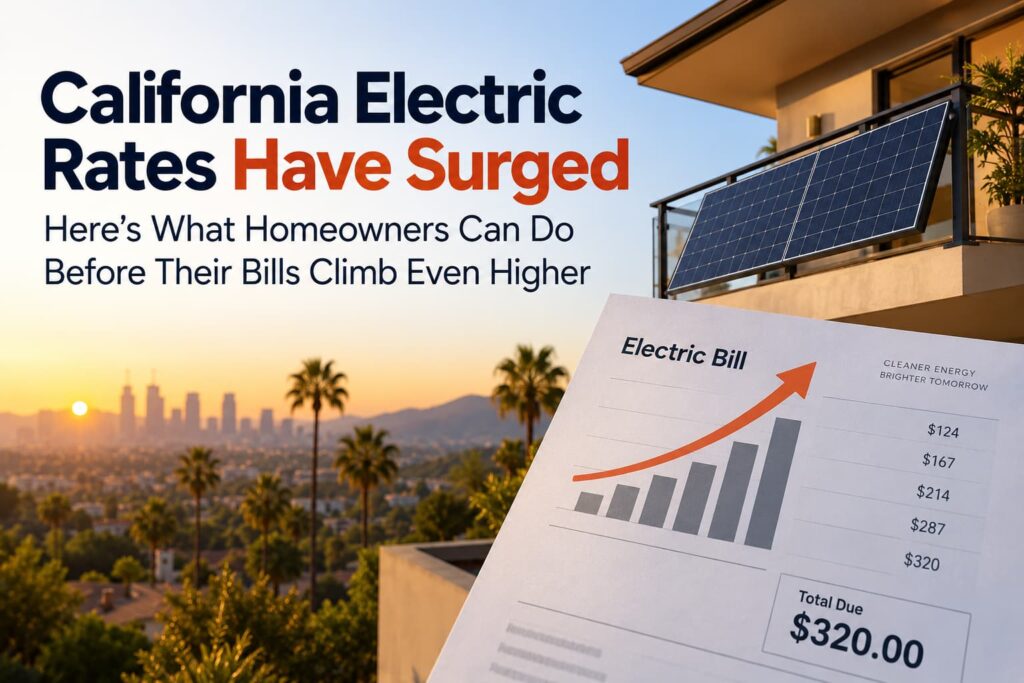
Will California Electricity Rates Go Up 10% Every Year? What the CPUC Has Actually Approved
Quick answer: The CPUC has not approved a standing 10% annual escalator, and no such decision exists. What it has approved is a series of individual revenue requirements that pushed residential rates up 69% to 101% over the past decade, roughly 5% to 7% per year compounded. As of June 1, 2026, average residential rates sit at 33.7 cents per kWh at PG&E, 34.4 cents at SCE, and 45.5 cents at SDG&E. The state’s own ratepayer advocate projects the average PG&E bill could climb 16% in 2027 and 30% by 2030.
Key takeaways
- No CPUC decision sets a 10% annual increase. Rates move case by case, through General Rate Cases and dozens of smaller advice letters.
- The real long-run number is 5% to 7% per year. That still doubles a bill in roughly 10 to 14 years.
- 2026 has actually been flat to slightly down: PG&E cut rates 3.7% on March 1, SDG&E 2.0% on June 1, SCE 0.1% on June 1. That follows a 13% jump on SCE bills in October 2025.
- SCE’s approved increases for 2026, 2027 and 2028 are already on the books at roughly 2.6% to 2.7% per year in base revenue, before wildfire and procurement costs layer on top.
- If a solar proposal models your bill at a 10% escalator, the savings number on that page is inflated. Ask for 6%.
Did the CPUC approve a 10% annual rate increase?
No. There is no CPUC decision authorizing a fixed annual escalation rate for California electricity bills, and the Commission does not work that way.
The claim usually traces back to one real event. On September 18, 2025, the CPUC approved Southern California Edison’s 2025 General Rate Case, and because the decision landed nine months into the test year, SCE had to recover the gap between what it had collected since January and what it was authorized to collect. That true-up hit October 2025 bills as an increase of roughly 13% for the average residential customer. One decision, one year, one utility.
What the CPUC actually approves is a revenue requirement: the total dollars a utility may collect. That number gets translated into cents per kWh through advice letters filed several times a year. Some of those filings raise rates. Some lower them. Bundle ten years of them together and you get the trend below.
What are California electricity rates right now?
As of June 1, 2026, the three investor-owned utilities are charging between 33.7 and 45.5 cents per kWh on average for residential service, before the California Climate Credit.
Table 1. California residential average rates and how fast they got here (June 2026)
| Utility | Avg. residential rate | 3-year change | 5-year change | 10-year change | Implied annual rate |
|---|---|---|---|---|---|
| PG&E | 33.7 cents/kWh | +8% | +39% | +69% | 5.2% |
| SCE | 34.4 cents/kWh | +4% | +56% | +101% | 6.9% |
| SDG&E | 45.5 cents/kWh | +5% | +42% | +97% | 6.7% |
Source: Public Advocates Office at the CPUC, Q2 2026 Electric Rates Report, measured January 2016 to June 2026, excluding the Climate Credit. Annual rate is the compound growth rate over that 10.4-year window.
Two things stand out. SCE residential rates have more than doubled in a decade. And SDG&E customers are paying 45.5 cents per kWh, which is not far off double the national average.
For context on the same page: California’s Consumer Price Index rose 42% since 2014 while these residential rates rose between 93% and 117%. Electricity has been outrunning inflation by better than two to one for twelve years.
Takeaway line under chart: California residential electricity rates have risen more than twice as fast as consumer prices since 2014.
Are California rates going up in 2026?
Not so far. All three utilities filed rate decreases in the first half of 2026.
- PG&E, March 1, 2026: residential average rate down 3.7%, driven by the end of recovery for two wildfire mitigation cost accounts and the new Base Services Charge.
- SDG&E, June 1, 2026: residential average rate down 2.0% after a federal decision cut $112.2 million from its transmission revenue requirement.
- SCE, June 1, 2026: residential average rate down 0.1%, as a $380.7 million wildfire self-insurance increase was offset by cuts to energy efficiency budgets and a 2023 ERRA refund.
I want to be straight about this because a lot of solar marketing is not. Rates did not go up in California in the first half of 2026. They went sideways, right after a brutal 2025. The long-run direction is still up, and the reasons are structural, but anyone telling you your bill rises 10% every single January is selling you something. If you are on Edison, the detail behind that flat year is in our breakdown of SCE rate changes in 2026.
What has the CPUC already approved for 2027 and beyond?
For SCE, the 2025 General Rate Case decision authorized base revenue increases of roughly 2.7% in 2026, 2.6% in 2027 and 2.7% in 2028 for a typical residential customer, on top of the 2025 increase. Those are approved, not proposed.
For PG&E, the picture is bigger and still open. In its 2027 General Rate Case (A.25-05-009), PG&E asked for $16.637 billion in test year 2027 revenue, an 8% increase over 2026 authorized levels, followed by 6.1% increases in each of 2028, 2029 and 2030. PG&E’s public message is that bills will stay roughly flat and that its ask is about 3.5% a year.
The Public Advocates Office disagrees, and its math is the most important number in this article. In a March 5, 2026 fact sheet, the office found that PG&E’s framing leaves out the recovery requests it plans to file outside the GRC: energization and healthcare costs, Diablo Canyon, and wildfire liability from the Dixie and Kincade fires. Counting all of it, total revenue could go from $15.4 billion in 2026 to $22.2 billion by 2030, a 44% increase, and the average PG&E customer bill could rise about 16% in 2027 and 30% by 2030.
A CPUC decision on that case is expected in May 2027.
Table 2. What is on the record for each utility
| Utility | Approved through | Approved annual increase | Pending or projected |
|---|---|---|---|
| SCE | 2028 (2025 GRC, decided Sept 18, 2025) | ~2.6% to 2.7% base revenue per year | Wildfire self-insurance and procurement layered on top annually |
| PG&E | 2026 | n/a, 2026 net change is a 3.7% decrease | 2027 GRC seeks 8% in 2027 then 6.1% per year; Cal Advocates projects +16% bill impact in 2027, +30% by 2030 |
| SDG&E | 2026 | n/a, June 2026 net change is a 2.0% decrease | Already the highest residential rate in the state at 45.5 cents/kWh |
Source: CPUC General Rate Case filings and the Public Advocates Office Q2 2026 Electric Rates Report.
Why do California rates keep climbing?
The Public Advocates Office names three drivers, in order: wildfire mitigation and wildfire liability costs, transmission and distribution investment, and legacy rooftop solar incentives.
Wildfire is the one that compounds. In January 2023, wildfire-related costs were 15% of PG&E’s total revenue requirement and 9% of SCE’s. By January 2026 they were 19% and 14%. SCE alone is now collecting $2.69 billion a year in wildfire-related revenue, and its 2026 wildfire self-insurance requirement was set at $650 million, up $380.7 million in six months.
None of that reverses. Undergrounding a mile of distribution line is a permanent capital cost that earns a regulated return for decades. That is why the honest forecast is not “10% forever” and not “flat forever” either. It is a grinding 5% to 7% with occasional double-digit years when a rate case lands.
What escalation rate should you use in a solar payback calculation?
Use 6%. Model 4% as your downside and 8% as your upside. Do not model 10%.
Here is why it matters. Take a real California household: the average non-CARE SCE customer in hot climate zone 15, using around 700 kWh a month, paid $254 a month in June 2026 according to Cal Advocates. That is $3,048 a year.
Table 3. What that $254 monthly bill becomes at four different escalation rates
| Escalation rate | Bill in year 5 | Bill in year 10 | Bill in year 25 | 25-year total spend |
|---|---|---|---|---|
| 4% | $309 | $376 | $677 | $126,900 |
| 6% (recommended) | $340 | $455 | $1,090 | $167,200 |
| 8% | $373 | $548 | $1,740 | $222,800 |
| 10% (do not use) | $409 | $659 | $2,752 | $299,800 |
Assumptions: starting bill $254 per month from the Public Advocates Office Q2 2026 report, constant usage, compounded annually, no rate design changes.
The gap between the 6% row and the 10% row is $132,600 of imaginary money. Any proposal built on the bottom row is showing you a payback period that will not happen. The 6% row is still a strong case for solar. It says a household spends $167,200 on electricity over 25 years if it does nothing.
That is the number to put next to a system quote. We built the instant quote tool to run your actual address and usage rather than a slide deck average.
What can a homeowner actually do about rising rates?
Four levers, in the order I would work through them.
1. Get on the right rate plan first. It is free. On SCE’s TOU-D-4-9PM and PG&E’s E-TOU-C, moving laundry, dishwasher and EV charging outside the 4 to 9 p.m. window changes the bill without spending a dollar. Do this before you buy anything.
2. Check CARE and FERA. CARE gives qualifying households a 30% to 35% discount, and with the new Base Services Charge structure that total discount is closer to 40%. It is worth checking, because 2.4 million California customers are behind on their energy bills right now, owing an average of $619.
3. Own your generation. Every cent per kWh you avoid buying is a cent the CPUC cannot approve an increase on. This is the whole argument for residential solar, and it gets stronger every year the utility rate base grows.
4. Add storage, because NEM 3.0 changed the math. Under NEM 3.0, exporting to the grid pays a small fraction of what you pay to buy power back. Self-consumption is where the value sits now, which means battery storage is no longer an optional add-on for most SCE and PG&E homes. It is what turns midday production into avoided 4 to 9 p.m. peak purchases.
Two deadlines that matter more than the rate forecast
The federal residential credit is already gone. Section 25D expired on December 31, 2025 under the One Big Beautiful Bill Act. If you buy a system with cash or a loan in 2026, the federal credit is zero. The commercial credit, Section 48E, survived, which is why a well-structured lease or prepaid PPA is currently the only path where federal money still reaches a California roof. We walk through the whole picture in California’s solar tax credit situation in 2026.
The property tax exclusion sunsets January 1, 2027. Under Revenue and Taxation Code Section 73, a solar system does not add to your assessed value. That exclusion becomes inoperative on January 1, 2027. The Board of Equalization has confirmed that any system completed before that date keeps the exclusion until the property changes hands. A system finished in 2027 is assessable new construction, and in a state where property tax runs about 1% of assessed value annually, that is a recurring cost rather than a one-time one. Details in our post on the California solar property tax exclusion.
Between permitting, interconnection and inspection, a typical install runs 4 to 12 weeks depending on the city. September 2026 is roughly the last comfortable window to clear that January 1 deadline.
FAQ
Did the CPUC approve a 10% annual rate increase for California? No. The CPUC approves revenue requirements for individual utilities through General Rate Cases and advice letters. There is no standing annual escalator. The 10% figure is usually a garbled version of the roughly 13% increase SCE customers saw on October 2025 bills after the 2025 GRC decision.
How much do California electricity rates go up per year? Over the last decade, residential average rates rose 5.2% per year at PG&E, 6.9% at SCE and 6.7% at SDG&E. That is the compound rate on the Public Advocates Office data through June 2026.
Are electricity rates going down in 2026? Slightly. PG&E cut residential rates 3.7% on March 1, 2026, SDG&E cut 2.0% on June 1, and SCE cut 0.1% on June 1. Those cuts follow much larger increases in 2025 and do not change the long-run trend.
Will my PG&E bill go up in 2027? Probably. PG&E’s 2027 General Rate Case requests an 8% revenue increase for 2027 and 6.1% per year through 2030. The Public Advocates Office projects the average customer bill could rise about 16% in 2027 and 30% by 2030 once cost recovery outside the GRC is included. A decision is expected in May 2027.
What escalation rate should I use when comparing solar quotes? 6% is the defensible number, with 4% and 8% as your bracket. If a salesperson models 10%, ask them to rerun it at 6%. If the payback period moves more than a couple of years, the proposal was leaning on the assumption rather than the system.
Is solar still worth it in California without the 30% tax credit? For high-usage homes on SCE, PG&E and SDG&E, usually yes, but the payback period stretched in 2026. The comparison to run is total system cost against the 25-year do-nothing spend at 6% escalation, which for a $254 monthly bill is $167,200