
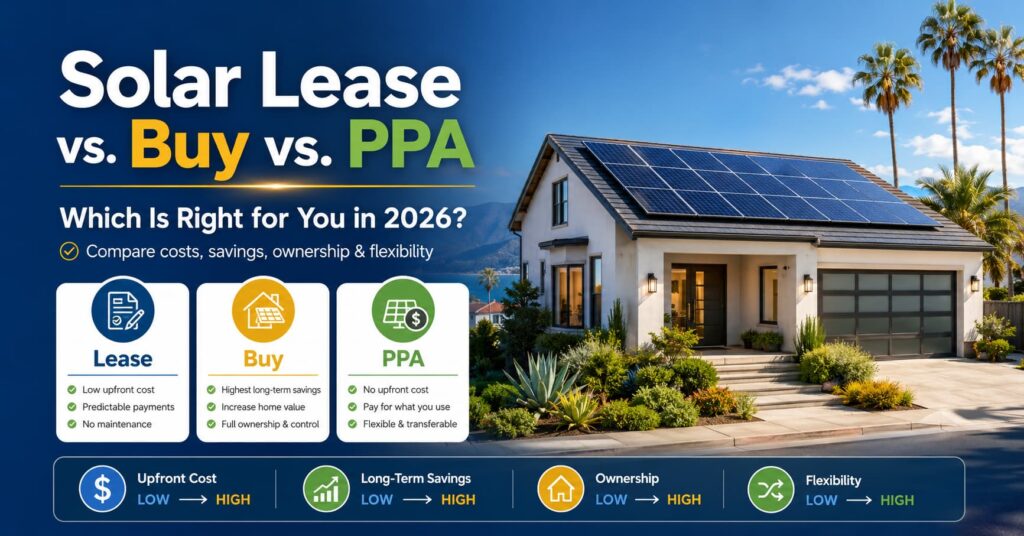
Choosing between a solar lease, buying solar panels, and a solar power purchase agreement (PPA) is one of the most important financial decisions you will make when going solar.
The panels on your roof may look the same either way, but the economics can be completely different.
If you buy solar panels with cash or a loan, you own the system and usually get the highest long-term savings. If you choose a solar lease, you pay a fixed monthly amount to use a system owned by a third party. If you choose a solar PPA, you do not pay for the panels directly. Instead, you buy the solar electricity the system produces at a contract rate.
In 2026, this decision is even more important because the federal residential solar tax credit changed dramatically. The IRS says the Residential Clean Energy Credit applied to qualified clean energy property installed from 2022 through December 31, 2025, and is not available for property placed in service after December 31, 2025.
That means the old “buy solar and claim 30% back” math no longer applies to many new homeowner-owned systems placed in service in 2026. At the same time, third-party-owned solar models, such as leases and PPAs, may still be structured around commercial clean electricity tax credits claimed by the system owner, subject to changing IRS rules, construction deadlines, ownership structure, and tax eligibility. The IRS Clean Electricity Investment Credit page says the Section 48E credit applies to qualified facilities and energy storage technology placed in service after December 31, 2024, while IRS Notice 2025-42 adds special beginning-of-construction rules for wind and solar facilities.
So, which option is best?
For many homeowners, the answer is:
- Buy solar panels if you want maximum lifetime savings, own your home long term, and can pay cash or secure a clean, transparent loan.
- Choose a solar lease if you want predictable monthly payments, little to no upfront cost, and do not want to own or maintain the system.
- Choose a solar PPA if you prefer paying only for solar energy produced, want low upfront cost, and receive a solar electricity rate that is clearly lower than your utility rate.
- Be extra careful with all three options if the contract includes escalators, hidden dealer fees, aggressive savings claims, unclear battery terms, or complicated home-sale transfer rules.
For California homeowners, this decision also needs to account for NEM 3.0, also called the Net Billing Tariff or Solar Billing Plan. Under California’s current net billing structure, solar power used directly in the home offsets retail energy costs, while exported solar is usually credited below the retail rate. The CPUC says customers can maximize savings by installing battery storage so they can use or export stored energy during higher-value hours.
Quick Comparison: Solar Lease vs. Buy vs. PPA
| Option | Who Owns the System? | How You Pay | Upfront Cost | Best For | Main Trade-Off |
|---|---|---|---|---|---|
| Cash purchase | Homeowner | One upfront payment | High | Highest lifetime savings | Requires capital upfront |
| Solar loan | Homeowner | Monthly loan payment | Low to $0 | Ownership without paying cash | Interest, dealer fees, loan terms |
| Solar lease | Solar company / third-party owner | Fixed monthly lease payment | Usually low to $0 | Predictable payment and low upfront cost | Lower lifetime savings than ownership |
| Solar PPA | Solar company / third-party owner | Per-kWh solar energy rate | Usually low to $0 | Pay for production instead of equipment | Long contract, rate escalators, transfer terms |
The 2026 Solar Financing Landscape Changed
For years, the standard solar advice was simple:
Buy the system if you can, because ownership gives you the tax credit and the strongest long-term savings.
That is still often true from a pure ownership perspective, but 2026 changed the equation.
What changed in 2026?
The biggest shift is the federal residential solar tax credit.
Before 2026, homeowners who purchased eligible solar equipment could generally qualify for a 30% Residential Clean Energy Credit, depending on their tax situation. In 2026, the IRS says the credit is not available for property placed in service after December 31, 2025.
That means:
- A homeowner buying solar in 2026 may not receive the old 30% residential credit.
- Solar loan proposals that still assume a homeowner tax-credit paydown should be reviewed very carefully.
- Cash and loan purchases may have longer payback periods than they did in 2022 to 2025.
- Leases and PPAs may look more attractive in some cases because the third-party system owner may be able to monetize commercial tax incentives and reflect that value in the customer’s monthly lease or PPA rate.
The CFPB has warned that many solar loan sales pitches historically presented the federal tax credit as if it were guaranteed, even though the credit depended on the customer’s federal tax liability. It also warned that some loan presentations deducted a presumed tax credit from the loan amount to show a “net cost,” which could hide the true cost of financing.
In 2026, that warning matters even more. If a solar quote still shows an assumed residential tax credit for a new homeowner-owned system, ask the installer to explain exactly which credit applies, who claims it, and whether the system must meet any placed-in-service or construction-start deadline.
What Does It Mean to Buy Solar Panels?
Buying solar means you own the system installed on your roof.
You can buy solar in two ways:
- Cash purchase
- Solar loan
In both cases, the homeowner owns the equipment. The system becomes part of your home improvement investment, and you receive the electricity it produces.
The FTC says homeowners considering solar generally have three options: buying a system, leasing a system, or signing an agreement to buy solar power. It also notes that the option you choose may affect tax breaks and the steps needed when selling your home.
Option 1: Buying Solar With Cash
A cash purchase is the cleanest solar ownership model.
You pay for the system upfront, own the equipment, avoid loan interest, and keep the long-term value of the energy produced by the system.
Pros of buying solar with cash
| Benefit | Why It Matters |
|---|---|
| Highest lifetime savings | No monthly lease, PPA payment, or loan interest |
| Full ownership | You control the system and benefit from its production |
| Usually easier home-sale story | No third-party lease or PPA transfer required |
| No escalator | You avoid annual payment increases common in some leases and PPAs |
| Better long-term ROI | After payback, the system can keep producing low-cost power for years |
Cons of buying solar with cash
| Drawback | Why It Matters |
|---|---|
| High upfront cost | Many homeowners do not want to spend $15,000 to $30,000+ at once |
| Tax credit changed | The old homeowner 30% residential credit is not available for property placed in service after December 31, 2025 |
| Maintenance responsibility | You own the system, so you need to understand warranties and service |
| Payback takes time | You may wait years before cumulative savings exceed the upfront cost |
EnergySage reported that as of May 2026, the average California solar panel system cost about $2.53 per watt, or $22,284 for an average 8.81 kW system before available incentives.
For more detailed pricing, read NRG Clean Power’s guide to how much solar panels cost in California and our breakdown of solar panel installation costs.
Who should buy solar with cash?
Buying solar with cash is usually best if:
- You have the cash available without straining your finances.
- You plan to stay in the home long enough to benefit from the payback.
- You want the highest lifetime savings.
- You do not want a third-party solar contract attached to the home.
- You are comfortable relying on equipment and workmanship warranties.
- You understand that 2026 residential tax-credit rules are different from the 2022 to 2025 environment.
Cash purchase example
| Item | Example |
|---|---|
| System size | 8 kW |
| Gross cost at $2.53/W | $20,240 |
| Estimated annual bill savings | $1,800 to $2,800 |
| Simple payback | About 7 to 11 years |
| Ownership term | 25+ years |
| Best case | Homeowner stays long term and utility rates keep rising |
This is a simplified example. Your real savings depend on your roof, utility, rate plan, NEM status, battery storage, usage habits, and local installation costs.
Option 2: Buying Solar With a Loan
A solar loan lets you own the system without paying the full cash price upfront.
Instead of paying the utility every month, you pay a combination of:
- A smaller utility bill
- A monthly solar loan payment
If the loan is structured well, your combined post-solar cost may be lower than your old utility bill. But loan details matter.
Pros of a solar loan
| Benefit | Why It Matters |
|---|---|
| Ownership without full upfront payment | You own the system while spreading cost over time |
| Potentially strong long-term savings | Once the loan is paid off, the system can keep producing electricity |
| No third-party lease/PPA contract | You avoid some transfer issues tied to leases and PPAs |
| May increase home value more than leased solar | Owned systems are often simpler for buyers to understand |
| Flexible loan options | Solar loans, credit union loans, HELOCs, and home improvement loans may be available |
Cons of a solar loan
| Risk | Why It Matters |
|---|---|
| Dealer fees | Some low-APR solar loans include hidden markups in the system price |
| Re-amortization risk | Some loans increase payments if a large tax-credit prepayment is not made |
| Interest cost | A low monthly payment can still cost more over 20 to 25 years |
| Complicated proposals | Sales quotes may focus on monthly payment instead of total cost |
| 2026 tax-credit confusion | Homeowners should not assume the old residential credit applies |
The CFPB reported that solar-specific loans often have stated APRs in the 1% to 7% range, but those APRs may not include fees that increase the loan principal above the cash price. It also reported that hidden solar loan fees often range from 10% to 30% of the cash price and can exceed 50%.
That is why comparing a cash price against a financed price is essential.
The most important solar loan question
Ask this before signing:
“What is the cash price of this exact system, and what is the financed price?”
If the cash price is $22,000 and the loan price is $30,000, the difference may reflect dealer fees or financing costs. A lower APR is not always better if the principal is inflated.
Who should use a solar loan?
A solar loan may be right if:
- You want to own the system.
- You do not want to pay cash upfront.
- The loan has transparent pricing.
- The total financed cost still produces good savings.
- You plan to stay in the home long enough to benefit.
- You understand the payment schedule and whether payments change later.
A solar loan may be wrong if:
- The proposal only shows “net cost” after a tax credit you may not receive.
- The loan has a large dealer fee hidden in the principal.
- The payment increases after month 18 or another trigger date.
- The monthly savings are tiny compared with the loan risk.
- You may sell the home soon and do not want to deal with payoff or assumption.
For more help, see NRG Clean Power’s guide on how to compare solar panel quotes.
What Is a Solar Lease?
A solar lease is a long-term agreement where a solar company or third-party owner installs solar panels on your roof, and you pay a fixed monthly amount to use the system.
You do not own the panels.
The third-party owner usually handles system monitoring, maintenance, and warranties. You still buy electricity from your utility when your home needs more power than the solar system produces.
The CFPB describes a solar lease as a contract where the homeowner leases solar panels for a fixed period rather than buying them outright. It says typical leases last 15 to 20 years, often require no down payment, and may include payments that increase each year by a predetermined amount.
Pros of a solar lease
| Benefit | Why It Matters |
|---|---|
| Low or no upfront cost | Easier entry point for homeowners |
| Predictable monthly payment | You know what you owe each month |
| Maintenance usually included | System owner is responsible for service terms |
| No need to monetize tax credits yourself | Third-party owner handles incentives if eligible |
| May reduce bills from day one | Works if lease payment plus remaining utility bill is lower than old bill |
Cons of a solar lease
| Drawback | Why It Matters |
|---|---|
| Lower lifetime savings | You are paying a long-term monthly fee |
| You do not own the system | The asset belongs to the lease provider |
| Escalators can reduce savings | A 2.9% or 3.5% annual increase compounds over time |
| Home-sale transfer can be more complex | Buyer may need to assume the lease |
| Buyout terms may be unclear | Early purchase options can be expensive or limited |
Solar lease example
| Item | Example |
|---|---|
| Old utility bill | $250/month |
| New lease payment | $145/month |
| Remaining utility bill | $45/month |
| Total post-solar cost | $190/month |
| First-year savings | $60/month |
| Annual escalator | 0% to 3.5%, depending on contract |
| Ownership | Third-party owner |
This example works only if the lease payment is meaningfully lower than the bill savings. A lease that saves $20 per month but locks you into 25 years of payments may not be attractive.
Fixed lease vs escalating lease
This is one of the biggest details in the contract.
| Lease Type | How It Works | What to Watch |
|---|---|---|
| Fixed payment lease | Same payment every month for the contract term | Easier to evaluate |
| Escalating lease | Payment increases annually | Savings can shrink if utility rates do not rise faster |
| Prepaid lease | You pay much or all of the lease upfront | Can be simpler, but compare with ownership |
In 2026, a lease may look better than it did in prior years for homeowners who cannot use the residential tax credit because the third-party owner may be able to claim commercial incentives if the project qualifies. But the customer should not assume that every lease automatically passes through the full value of incentives. The savings need to be visible in the monthly payment.
Who should choose a solar lease?
A solar lease may be right if:
- You want low upfront cost.
- You prefer predictable monthly payments.
- You do not want system ownership responsibilities.
- You do not have enough tax liability to use credits.
- You want maintenance handled by the provider.
- The lease payment is clearly lower than your expected utility savings.
A solar lease may be wrong if:
- You want maximum lifetime savings.
- You may sell your home soon.
- The contract has a high annual escalator.
- You want full control over batteries, upgrades, or system changes.
- The savings are small or unclear.
What Is a Solar PPA?
A solar power purchase agreement, or solar PPA, is a contract where a solar company installs and owns the system on your roof, and you buy the electricity the system produces at a set price per kilowatt-hour.
A lease is usually a payment for access to the system.
A PPA is usually a payment for solar electricity.
The CFPB explains that in a PPA, the installer sets up and maintains the rooftop solar system and provides electricity to the consumer at a predetermined per-kWh rate. The consumer pays for the electricity rather than a fixed cost for the panels.
The U.S. Treasury also warns that a PPA is a binding legal agreement and can be complex, so homeowners should review terms carefully and consult a lawyer if needed.
Pros of a solar PPA
| Benefit | Why It Matters |
|---|---|
| Low or no upfront cost | You do not buy the system |
| Pay based on production | Payments are tied to solar energy generated |
| Maintenance usually included | Third-party owner handles system responsibilities |
| Can offer immediate savings | Works if PPA rate is lower than utility rate |
| May include battery options | Some PPAs include solar-plus-storage structures |
Cons of a solar PPA
| Risk | Why It Matters |
|---|---|
| Long-term contract | Many PPAs last 20 to 25 years |
| Escalator risk | Per-kWh rate may rise annually |
| You do not own the system | Third party owns equipment and incentives |
| Home-sale transfer can be complicated | Buyer must accept or contract must be resolved |
| Production/payment mismatch | Understand whether you pay for production, consumption, or net usage |
Solar PPA example
| Item | Example |
|---|---|
| Utility rate | $0.38/kWh |
| PPA rate | $0.24/kWh |
| Solar production used/billed | 700 kWh/month |
| Solar PPA payment | $168/month |
| Utility value of same energy | $266/month |
| Estimated monthly savings | $98 before fixed charges and remaining utility usage |
| Annual escalator | 0% to 3.5%, depending on contract |
A PPA works best when the contract rate is clearly below your utility rate and remains competitive over time.
The key PPA question
Ask:
“What happens if my PPA rate becomes higher than my utility rate?”
A PPA rate may look attractive in year one, but a high escalator can change the economics over 20 to 25 years.
For example:
| Year | PPA Rate With 3% Annual Escalator |
|---|---|
| Year 1 | $0.22/kWh |
| Year 5 | $0.25/kWh |
| Year 10 | $0.29/kWh |
| Year 15 | $0.33/kWh |
| Year 20 | $0.39/kWh |
| Year 25 | $0.45/kWh |
An escalator is not automatically bad if utility rates rise faster. But it creates risk. A fixed-rate PPA is often easier to evaluate.
Who should choose a solar PPA?
A solar PPA may be right if:
- You want no or low upfront cost.
- You prefer paying for solar energy instead of owning equipment.
- The PPA rate is meaningfully lower than your utility rate.
- The escalator is low or zero.
- Maintenance and performance guarantees are strong.
- You are comfortable with a long-term contract.
A solar PPA may be wrong if:
- You want ownership.
- The PPA rate is only slightly lower than your utility rate.
- The annual escalator is high.
- You plan to sell the home soon.
- The contract does not clearly explain buyout, transfer, roof, and removal terms.
Solar Lease vs. PPA: What Is the Difference?
Solar leases and PPAs are both third-party ownership models. The solar company or financing company owns the system, not the homeowner.
The difference is how you pay.
| Feature | Solar Lease | Solar PPA |
|---|---|---|
| Payment structure | Fixed monthly payment | Per-kWh rate for solar energy |
| Payment changes with production? | Usually no | Usually yes |
| System ownership | Third party | Third party |
| Maintenance | Usually provider | Usually provider |
| Tax benefits | Usually system owner | Usually system owner |
| Best for | Predictable monthly cost | Paying based on energy output |
| Main risk | Lease escalator and transfer | PPA rate escalator and production terms |
Simple way to remember it
- Lease: “I pay to use the solar system.”
- PPA: “I pay for the solar power the system produces.”
- Buy: “I own the solar system and keep the energy value.”
Buying vs. Leasing vs. PPA: Which Saves the Most?
In most cases, buying solar panels produces the highest lifetime savings.
But in 2026, the answer is more nuanced because the homeowner residential credit is no longer available for property placed in service after December 31, 2025, while third-party-owned systems may still be able to access commercial clean energy credits if they meet eligibility rules.
Typical savings ranking
| Rank | Option | Lifetime Savings Potential | Why |
|---|---|---|---|
| 1 | Cash purchase | Highest | No financing cost, full ownership |
| 2 | Transparent loan | High | Ownership, but interest and fees reduce savings |
| 3 | Strong fixed-rate lease or PPA | Medium to high | Lower upfront cost, third-party monetization of incentives |
| 4 | Escalating lease or PPA with weak terms | Low to medium | Escalators and long terms can reduce value |
| 5 | High-fee loan | Potentially poor | Inflated principal can erase savings |
The best option is not always the one with the lowest first-month payment. The best option is the one with the best combination of:
- Lifetime savings
- Contract flexibility
- Clear pricing
- Equipment quality
- Battery strategy
- Home-sale simplicity
- Risk tolerance
California Factor: How NEM 3.0 Changes the Decision
California homeowners need to think differently than homeowners in many other states.
Under the Net Billing Tariff, also called NEM 3.0 or the Solar Billing Plan, solar power used onsite offsets the cost of imported energy. But exported solar is credited at a rate based on the value of that electricity to the grid, which is usually lower than the retail rate. The CPUC says battery storage can help customers maximize bill savings by storing energy and using or exporting it during higher-value hours.
That affects lease vs. buy vs. PPA in a big way.
Under NEM 3.0, the winning design usually includes:
- Right-sized solar, not oversized solar
- More self-consumption
- Battery storage where the economics make sense
- Smart load shifting
- Time-of-use rate awareness
- Less reliance on low-value midday exports
For more detail, see NRG Clean Power’s guide to NEM 2.0 vs. NEM 3.0.
How NEM 3.0 affects each financing option
| Option | NEM 3.0 Impact |
|---|---|
| Cash purchase | Still strong if designed for self-consumption and long-term savings |
| Solar loan | Can work well, but loan payment must be modeled with realistic export values |
| Solar lease | May work if lease payment is based on accurate NEM 3.0 savings |
| Solar PPA | PPA rate must be low enough to beat your utility import cost over time |
| Solar + battery | Often more important than before because stored energy can avoid peak rates |
If a proposal shows huge savings without explaining NEM 3.0, export rates, battery operation, and time-of-use rates, it is not detailed enough.
Should You Add a Battery?
In California, batteries are no longer just about backup power. They are often central to the savings model.
A battery can:
- Store excess midday solar
- Power the home during expensive evening hours
- Reduce grid imports
- Improve self-consumption
- Provide backup power during outages, if configured for backup
- Improve solar economics under NEM 3.0
But batteries also add cost. The question is not simply “Should I add a battery?” The better question is:
“Does the battery reduce my peak-rate grid purchases enough to justify its cost?”
Battery by financing option
| Option | Battery Consideration |
|---|---|
| Cash purchase | Higher upfront cost, but full control and long-term value |
| Loan | Payment increases, but may improve monthly bill reduction |
| Lease | Check whether battery is included and who controls dispatch |
| PPA | Check whether you pay for stored energy, produced energy, or backup capability |
If you are comparing storage options, read NRG Clean Power’s guide to the best solar batteries for home.
Lease vs. Buy vs. PPA: Best Choice by Homeowner Type
Best for maximum lifetime savings: Buy with cash
Choose cash purchase if you want the highest lifetime return and can afford the upfront cost.
Best fit:
- High electric bill
- Long-term homeowner
- Strong roof
- Good sun exposure
- Wants ownership
- Wants simple home-sale value
Best for ownership without cash upfront: Solar loan
Choose a loan if you want to own the system but preserve cash.
Best fit:
- Good credit
- Long-term homeowner
- Transparent loan terms
- No hidden dealer fees
- Monthly payment lower than utility savings
Best for predictable low upfront cost: Solar lease
Choose a lease if you want simple monthly payments and do not care about owning the system.
Best fit:
- Wants low upfront cost
- Wants maintenance included
- Prefers fixed payment
- Does not want tax-credit complexity
- Accepts third-party ownership
Best for paying by energy produced: Solar PPA
Choose a PPA if you want solar power at a lower per-kWh rate than your utility.
Best fit:
- High utility rate
- Low PPA rate
- Low or zero escalator
- Comfortable with long-term contract
- Wants low upfront cost
Best for uncertain tax-credit situation: Compare all three
In 2026, homeowners should compare ownership and third-party ownership side by side because the tax-credit environment has changed.
Ask every installer for:
- Cash purchase price
- Loan price and loan terms
- Lease payment
- PPA rate
- Escalator
- Battery option
- 25-year savings estimate
- Home-sale transfer terms
- Total cost over contract life
Real-World 2026 Comparison Example
Let’s compare three simplified options for a California homeowner.
Assumptions
| Item | Estimate |
|---|---|
| Current electric bill | $280/month |
| Annual electric cost | $3,360 |
| System size | 8 kW |
| Solar-only annual savings potential | $1,900 to $2,600 |
| Utility | California IOU under NEM 3.0 |
| Battery | Not included in base case |
Option A: Cash purchase
| Metric | Estimate |
|---|---|
| System cost | $20,000 to $24,000 |
| Monthly payment | $0 after purchase |
| Estimated utility bill after solar | $70 to $120/month |
| Estimated annual savings | $1,900 to $2,600 |
| Main advantage | Highest long-term savings |
| Main risk | High upfront cost |
Option B: Solar loan
| Metric | Estimate |
|---|---|
| Financed amount | $22,000 to $30,000, depending on loan structure |
| Monthly loan payment | $140 to $230 |
| Estimated utility bill after solar | $70 to $120/month |
| Combined monthly cost | $210 to $350 |
| Main advantage | Ownership with low upfront cost |
| Main risk | Loan fees can erase savings |
Option C: Solar lease
| Metric | Estimate |
|---|---|
| Monthly lease payment | $140 to $190 |
| Estimated utility bill after solar | $70 to $120/month |
| Combined monthly cost | $210 to $310 |
| Main advantage | Low upfront cost and maintenance included |
| Main risk | Long-term contract and escalator |
Option D: Solar PPA
| Metric | Estimate |
|---|---|
| PPA rate | $0.18 to $0.28/kWh |
| Monthly PPA payment | Varies by production |
| Estimated remaining utility bill | $60 to $130/month |
| Main advantage | Pay for solar energy, not equipment |
| Main risk | Rate escalator and long-term competitiveness |
What this example shows
The right choice depends on the spread between:
- Your old utility bill
- Your new utility bill
- Your solar payment
- Your long-term contract cost
- Your expected time in the home
A cash purchase might deliver the best 25-year economics, while a lease or PPA might deliver a lower upfront barrier and better short-term affordability.
The Home Sale Problem: What Happens If You Move?
This is one of the most overlooked parts of solar financing.
The FTC specifically advises homeowners to consider how buying, leasing, or signing a PPA might affect the ability to sell the home if they move before the end of the solar agreement.
If you own the system
Selling is usually simpler.
You can:
- Sell the home with the system included.
- Pay off the solar loan at closing.
- Ask the buyer to assume the loan, if allowed.
- Market the home as having owned solar.
If you lease the system
You usually need to:
- Transfer the lease to the buyer,
- Buy out the lease,
- Prepay remaining payments, or
- Follow the contract’s home-sale process.
If you have a PPA
You usually need to:
- Transfer the PPA to the buyer,
- Buy out the agreement,
- Negotiate with the solar provider, or
- Resolve the contract before closing.
Questions to ask before signing
- What happens if I sell the home?
- Can the buyer assume the agreement?
- What credit requirements apply to the buyer?
- Is there a buyout option?
- How is the buyout price calculated?
- Can the system be removed?
- Who pays for removal and roof repairs?
- What happens if the buyer refuses to assume the contract?
If you may sell within 5 to 7 years, ownership or a short-payback structure may be more attractive than a 25-year lease or PPA.
Contract Red Flags to Watch For
Solar financing can be excellent when structured honestly. It can also be confusing when the proposal hides the real cost.
The FTC warns consumers not to deal with companies that pressure them into quick decisions, tell them to sign without time for review, or ask for cash payments.
The CFPB has also highlighted risks around misleading tax-credit claims, hidden loan markups, and uncertain financial-benefit promises.
Red flags in solar loans
- “Your tax credit will definitely cover this payment.”
- No separate cash price and financed price.
- Very low APR but much higher principal.
- Payment increases after 18 months unless you make a large prepayment.
- Dealer fees are not clearly disclosed.
- Contract says savings are not guaranteed, but salesperson promises a $0 bill.
Red flags in solar leases
- High annual escalator.
- Vague maintenance terms.
- No clear production guarantee.
- Complicated buyout language.
- No clear home-sale transfer process.
- Lease payment leaves little real monthly savings.
Red flags in solar PPAs
- PPA rate too close to your utility rate.
- Escalator above expected savings margin.
- Unclear whether you pay for all production or only used energy.
- No clear battery dispatch rules.
- Long contract with expensive exit terms.
- Unclear end-of-term ownership or removal options.
Questions to Ask Before Choosing Lease, Buy, or PPA
Use this checklist before signing any solar agreement.
Price and savings questions
- What is the cash price?
- What is the financed price?
- What is the total cost over 20 or 25 years?
- What is my estimated year-one savings?
- What is my estimated lifetime savings?
- Are savings guaranteed or only estimated?
- What utility rate assumptions are being used?
- Does the model include NEM 3.0 export rates?
Tax and incentive questions
- Who owns the system for tax purposes?
- Who claims any tax credit or incentive?
- Does the homeowner receive any tax benefit?
- Is the proposal assuming a residential credit that is still available?
- Are commercial credits reflected in the lease or PPA pricing?
- What happens if incentives change?
Contract questions
- What is the contract length?
- Is there an annual escalator?
- What is the buyout option?
- What happens at the end of the term?
- Who handles maintenance?
- Who monitors production?
- What happens if the system underperforms?
- What happens if I need roof repairs?
- What happens if I sell the home?
Battery questions
- Is a battery included?
- Who owns the battery?
- Who controls battery operation?
- Does the battery provide backup power?
- Are backup loads clearly defined?
- Is the battery used for bill savings, backup, or both?
- What is the battery warranty?
Decision Matrix: Which Solar Financing Option Is Right for You?
| Your Situation | Best Option to Consider |
|---|---|
| You want maximum lifetime savings | Cash purchase |
| You want ownership but not upfront cost | Solar loan |
| You want the lowest upfront barrier | Lease or PPA |
| You cannot use homeowner tax credits | Lease or PPA may be worth comparing |
| You plan to sell soon | Cash purchase or carefully reviewed loan |
| You want simple maintenance | Lease or PPA |
| You dislike long contracts | Cash purchase or shorter-term loan |
| You want backup power | Solar + battery, any structure |
| You are in California under NEM 3.0 | Compare solar + battery across all options |
| You want full system control | Buy |
| You want predictable monthly payments | Fixed lease |
| You want to pay based on production | PPA |
Solar Lease vs. Buy vs. PPA in California
California homeowners should pay special attention to four things:
1. Utility rates are high
High electricity rates make solar more valuable because every kilowatt-hour you avoid buying from the grid is worth more.
For more background, see NRG Clean Power’s guide to the average electric bill in California.
2. NEM 3.0 rewards self-consumption
Under the Net Billing Tariff, exported energy is usually credited below the retail rate, while onsite solar use offsets energy costs.
That makes batteries and load shifting more important.
3. Batteries can change the winner
A solar-only lease may save less than a solar-plus-battery PPA if the battery avoids expensive evening peak rates.
A cash purchase may still win over 25 years, but the short-term monthly comparison may look different.
4. Contract design matters more than ever
In a high-rate state, a bad contract can still look good in year one. Always compare the full 20- or 25-year cost.
Final Recommendation: Lease, Buy, or PPA?
There is no universal winner.
But here is the clearest way to decide in 2026:
Buy solar panels if:
- You want the highest long-term savings.
- You plan to stay in your home.
- You can pay cash or get a transparent loan.
- You want to own the equipment.
- You want the simplest long-term asset story.
Choose a solar loan if:
- You want ownership without paying cash.
- You understand the full financed cost.
- The loan has no hidden dealer-fee surprise.
- The monthly payment is still lower than your expected savings.
- You are not relying on an outdated tax-credit assumption.
Choose a solar lease if:
- You want low upfront cost.
- You want predictable monthly payments.
- You do not care about owning the system.
- You want maintenance included.
- The payment is clearly lower than your bill savings.
- The escalator is low or zero.
Choose a solar PPA if:
- You want to pay for solar electricity, not equipment.
- The PPA rate is meaningfully lower than your utility rate.
- The escalator is low or zero.
- You understand the long-term contract.
- You are comfortable transferring or buying out the agreement if you sell.
For California homeowners in 2026:
The best proposal is usually the one that models:
- NEM 3.0 correctly
- Battery storage honestly
- Time-of-use rates accurately
- Export credits conservatively
- Total contract cost clearly
- Home-sale terms plainly
- 25-year savings realistically
Before signing, compare multiple options and review the quote carefully. Start with NRG Clean Power’s guides to solar financing in California, solar ROI, and how to compare solar panel quotes.
FAQs: Solar Lease vs. Buy vs. PPA
Is it better to lease or buy solar panels in 2026?
Buying usually produces higher lifetime savings, especially if you pay cash or use a transparent loan. Leasing can be better for homeowners who want low upfront cost, included maintenance, and predictable payments. In 2026, the end of the homeowner residential solar tax credit for new placed-in-service systems makes it more important to compare ownership against third-party-owned lease and PPA offers.
What is the difference between a solar lease and a PPA?
With a solar lease, you usually pay a fixed monthly amount to use the system. With a solar PPA, you pay a set price per kilowatt-hour for the solar electricity produced. In both cases, a third party usually owns the system.
Do I own the panels with a solar lease?
No. In most solar leases, the solar company or third-party financing company owns the panels. You pay for the right to use the system.
Do I own the panels with a solar PPA?
No. In most PPAs, the third-party owner owns the system, and you buy the electricity it produces.
Do solar leases and PPAs include maintenance?
Usually, yes. One major appeal of leases and PPAs is that the system owner typically handles maintenance, monitoring, and warranty coordination. But you should confirm the exact terms in the contract.
Can I sell my home with a solar lease or PPA?
Yes, but it can be more complicated. The buyer may need to assume the agreement, or you may need to buy out the contract. Always read the transfer and buyout terms before signing.
Is a solar loan better than a lease?
A solar loan is better if you want ownership and the loan terms are transparent. A lease may be better if you want low upfront cost, included maintenance, and no ownership responsibility. Be careful with solar loans that show low APRs but hide dealer fees in the principal.
Are solar PPAs a bad idea?
Not always. A PPA can be a good option if the per-kWh rate is clearly lower than your utility rate, the escalator is low, and the contract terms are fair. A PPA can be a bad deal if the rate rises too quickly or the long-term savings are weak.
What is the biggest mistake homeowners make when comparing solar financing?
The biggest mistake is comparing only the first monthly payment. You need to compare total 20- or 25-year cost, escalators, utility-rate assumptions, tax-credit assumptions, battery terms, and home-sale transfer rules.
Is solar still worth it in California under NEM 3.0?
Yes, but the system must be designed correctly. Under NEM 3.0, solar energy used directly in the home is generally more valuable than exported solar. Batteries can improve savings by storing solar energy for higher-value hours.
Should I add a battery if I lease or use a PPA?
Maybe. A battery can improve savings under time-of-use rates and NEM 3.0, but you need to understand who owns the battery, who controls it, whether it provides backup power, and how it affects your monthly payment or PPA rate.
Bottom Line
In 2026, the best solar financing choice depends on your goals.
If you want maximum lifetime savings, buying solar panels is usually the strongest option.
If you want ownership without a large upfront payment, a solar loan can work, but only if the pricing is transparent.
If you want low upfront cost and simple maintenance, a solar lease may make sense.
If you want to pay for solar electricity instead of equipment, a PPA may be the right fit.
For California homeowners, the smartest move is to compare all three options with realistic NEM 3.0 assumptions and a battery scenario. The right contract should lower your energy costs, make sense over the full term, and still look good if you sell the home later.