
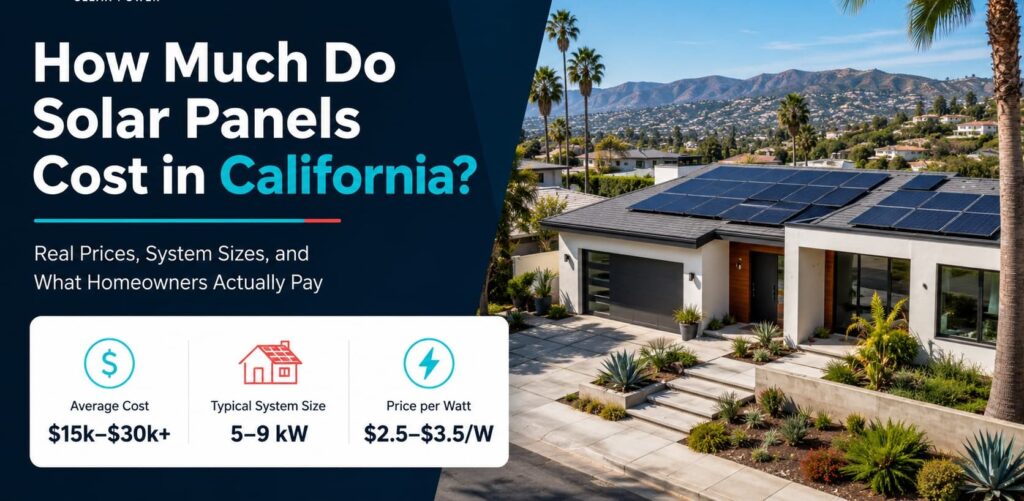
Quick answer: Solar panels in California cost about $2.40 to $3.25 per watt installed in November 2026. A 5 kW system runs about $12,000 to $16,250 and a 10 kW system about $24,000 to $32,500. Those are real out-of-pocket prices: the 30% federal Section 25D credit ended for systems installed after December 31, 2025, so no federal credit applies to a 2026 cash or loan purchase.
The sticker price of solar in California barely moved this year. What you actually pay went up by almost a third, because the federal credit is gone. Every quote we write in 2026 is a true net price, which makes the per-watt number, the battery decision and your utility matter more than they have in a decade.
Key takeaways
- California solar costs about $2.40 to $3.25 per watt installed in 2026, below the national median.
- The Section 25D credit is gone for purchased systems installed after December 31, 2025. Leases and PPAs can still carry a commercial credit.
- The panels are only about 10% to 16% of the price. Labor, electronics, permits and overhead make up the rest.
- A battery adds about $2.10 per watt to a cash system, according to Lawrence Berkeley National Lab.
- Payback on SCE and PG&E now runs about 9 to 11 years, and the property tax exclusion for new solar ends January 1, 2027.
Current cost of solar panels in California
Solar panels for your home cost about $12,000 to $16,250 for a 5 kW system and $24,000 to $32,500 for a 10 kW system in California as of November 2026. Every row uses the same $2.40 to $3.25 per watt range with no federal credit, and includes equipment, labor, permitting and interconnection.
Solar panel installation cost in California by system size (November 2026, no federal credit)
| System size | Installed cost range | Typical annual output | Best fit |
|---|---|---|---|
| 5 kW | $12,000 to $16,250 | about 7,500 kWh | Smaller or efficient home |
| 6 kW | $14,400 to $19,500 | about 9,000 kWh | Average home, moderate AC |
| 7 kW | $16,800 to $22,750 | about 10,500 kWh | Larger home |
| 8 kW | $19,200 to $26,000 | about 12,000 kWh | Daily AC, some electric load |
| 10 kW | $24,000 to $32,500 | about 15,000 kWh | Big home, pool or EV |
| 12 kW | $28,800 to $39,000 | about 18,000 kWh | Very large or all-electric home |
Source: NRG Clean Power price range applied to system size. Output assumes about 1,500 kWh per kW per year for a south-facing California roof. Credit status per IRS FAQs on Public Law 119-21.
To find your row, divide annual usage by about 1,500. A home using 12,000 kWh a year lands near 8 kW. Under NEM 3.0 we often size a little below full offset, because surplus midday exports earn only a few cents. Our guide on how to size a solar system walks through it. And if a 2026 purchase quote shows a price “after the 30% tax credit,” it is out of date.
What solar costs per watt in 2026
Solar in California costs about $2.40 to $3.25 per watt installed in 2026. The most-cited marketplace figure for the state is $2.52 per watt for an average 8.42 kW system, about $21,192 before incentives (EnergySage, October 30, 2026).
Lawrence Berkeley National Laboratory’s U.S. Distributed Solar and Storage Data: 2026 Update calls California “a relatively low-cost state for residential PV.” Nationally, LBNL found host-owned residential prices fell $0.50 per watt in real terms in 2025, to a median of $3.60, with cash-purchased systems at about $3.00.
California’s $2.40 to $3.25 range sits mostly below the national cash median of $3.00 and well below the all-buyer median of $3.60.
Per-watt pricing is the only fair way to compare quotes of different sizes. For roof-area math, see our solar panel cost per square foot breakdown.
How much do the solar panels themselves cost?
Solar modules cost about $0.28 to $0.46 per watt at US wholesale, so the panels on an 8 kW system are roughly $2,200 to $3,700, or about 10% to 16% of a typical $2.80 per watt installed price. Anza’s Q3 2025 US pricing report put the median module at $0.28 per watt, with modules using US-made cells at $0.46. Intertek CEA expects US module prices to keep rising through 2027 on tariff and sourcing rules.
Solar module cost vs installed cost per watt (California, 2026)
| Item | Cost per watt | 8 kW system | Share of $2.80/W installed price |
|---|---|---|---|
| Imported mainstream module (TOPCon, PERC) | $0.28 | about $2,200 | 10% |
| Module with US-made cells | $0.46 | about $3,700 | 16% |
| Full installed system | $2.40 to $3.25 | $19,200 to $26,000 | 100% |
Source: Anza US module pricing report (Q3 2025, wholesale medians); installed range per NRG Clean Power.
The other 84% to 90% pays for inverters, racking, wiring, a licensed crew for 1 to 3 days, engineering, permits, interconnection, monitoring, warranties and the installer’s overhead. That is why a “cheap panel” pitch rarely means a cheap system. A $0.05 per watt panel discount saves about $400 on 8 kW. A main panel that needs no upgrade and a lean sales process save thousands.
What happened to the 30% tax credit?
The 30% federal credit for homeowners who buy solar ended on December 31, 2025. Under Section 25D, the IRS says “the credit will not be allowed for any expenditures made after December 31, 2025,” and an expenditure counts as made when installation is completed, not when you pay (IRS FS-2025-05 FAQs). A December 2025 deposit on a system finished in January 2026 does not qualify. A system completed in 2025 can still be claimed on a 2025 return.
Is there still a solar tax credit in 2026?
Yes, but only through third-party ownership. When a leasing company or PPA provider owns the panels, it can claim the commercial Section 48E credit and pass part of the value back in a lower payment. Under the One Big Beautiful Bill Act, 48E projects that begin construction after July 4, 2026 must be in service by the end of 2027. A prepaid solar lease is the closest thing to the old deal: one upfront payment, no monthly bill, credit priced in by the owner.
The tradeoff is ownership. You do not own the equipment, and a buyer of your home has to take over the contract. Our post on federal solar tax credit changes tracks every update. California has no state income tax credit for residential solar.
Cost breakdown: where the money goes
On a 6 kW California system at $2.80 per watt ($16,800), about 36% goes to equipment and 22% to installation labor. The other 42% is overhead, sales, marketing and installer profit, based on EnergySage’s October 2026 installer survey.
Cost breakdown of a 6 kW solar system in California (2026)
| Component | Share of total | Approximate cost on $16,800 |
|---|---|---|
| Equipment (panels, inverters, racking, wiring) | 36% | $6,050 |
| Installation labor | 22% | $3,700 |
| Installer net profit | 17% | $2,860 |
| Overhead (design, permits, insurance, office) | 11% | $1,850 |
| Sales | 7% | $1,180 |
| Marketing | 6% | $1,010 |
Source: EnergySage 23rd Home Electrification Marketplace Report installer survey (October 2026), applied by NRG Clean Power to a 6 kW system at $2.80/W.
Sales and marketing are the lines a buyer can actually push down. Door-to-door and call-center models carry the heaviest commission loads in the industry, which is why we quote online and back it with a best price guarantee. One cost to confirm before you sign: if your main panel cannot accept solar backfeed, an upgrade typically adds $2,500 to $4,500.
What drives the price of solar in California?
Five variables explain most of the gap between a $2.40 and a $3.25 per watt quote: system size, roof, main panel, equipment and permitting.
- System size. Fixed costs spread over more watts, though LBNL notes these economies of scale have narrowed for 2025 installs.
- Roof. Composition shingle is cheapest. Tile adds labor. A roof with under 10 years left should be replaced first; we handle roofing in the same project when needed.
- Main panel. About $2,500 to $4,500 when an upgrade is required, common on older 100 A homes.
- Equipment. Microinverters and premium modules cost more but help on shaded or multi-plane roofs.
- Permits. California caps residential solar permit fees at $450 for systems up to 15 kW, plus $15 per kW above that, under Government Code section 66015, unless a city adopts findings justifying more. See our California solar permit guide for timelines.
How much does solar plus a battery cost?
Adding a battery raises the price of a cash solar system by about $2.10 per watt: LBNL’s 2026 Update found paired PV plus storage had median prices $2.10 per watt higher than stand-alone PV. On 8 kW, that is about $16,800 more, or roughly $36,000 to $42,800 combined.
LBNL found 37% of US residential solar installs included storage in 2025, up from 25% in 2024, with California driving most of the increase. The reason is NEM 3.0: a stored kWh used at 6 p.m. is worth 7 to 9 times an exported one on SCE.
Solar battery cost in California by capacity (2026)
| Battery capacity | Example setup | Installed cost at $1,130/kWh | SGIP general market ($150/kWh) | Net cost |
|---|---|---|---|---|
| 10 kWh | Two Enphase IQ Battery 5P | about $11,300 | $1,500 | about $9,800 |
| 13.5 kWh | One Tesla Powerwall 3 | about $15,300 | $2,025 | about $13,200 |
| 27 kWh | Two Tesla Powerwall 3 | about $30,500 | $4,050 | about $26,500 |
Source: EnergySage national median battery price of $1,130/kWh (1H 2026); SGIP rates per CPUC. SGIP steps change, so confirm the open step before you sign.
Our full solar battery cost in California guide compares models, and our backup solar batteries page covers what we install.
What incentives California still offers in 2026
California’s remaining incentives are the SGIP battery rebate ($150 to $1,100 per kWh depending on budget), the property tax exclusion for systems completed before January 1, 2027, the ACC Plus export adder, and the federal 48E credit through leases and PPAs.
California solar incentives still available (November 2026)
| Incentive | What it does | Status |
|---|---|---|
| Federal 48E (lease or PPA) | Owner claims the credit and prices it into your payment | Construction begun after July 4, 2026 must be in service by end of 2027 |
| SGIP battery rebate | $150/kWh general market; $1,000/kWh equity resiliency; $1,100/kWh equity | Budgets and steps change |
| Property tax exclusion | Solar’s added value is not reassessed | Systems completed before January 1, 2027 |
| ACC Plus export adder (PG&E, SCE) | Slightly higher export credits for 9 years | Eligible customers applying before end of 2027 |
Source: CPUC Net Energy Metering and Net Billing; CPUC SGIP; California Board of Equalization; SB 710 (Chapter 328, Statutes of 2025).
The deadline that matters now is the property tax exclusion. SB 710, signed October 3, 2025, kept the January 1, 2027 sunset. If you sign this month, ask whether your system can be completed by December 31. Our California solar incentives guide covers each program.
NEM 3.0 and why your utility matters
Under NEM 3.0, PG&E, SCE and SDG&E credit exports at hourly values from the CPUC’s Avoided Cost Calculator, averaging roughly 4 to 5 cents per kWh, while charging about 34 to 46 cents. The CPUC confirms net billing customers keep that structure for 9 years from interconnection. So in IOU territory, size solar to your daytime use and treat a battery as the main upgrade. Our explainer on why NEM 3.0 is now final lists export values by utility.
Municipal utilities differ. LADWP still offers net energy metering, which shortens payback in Los Angeles city limits. SMUD now credits surplus solar at a flat 9.6 cents per kWh under its Solar and Storage Rate, effective June 1, 2026: better than IOU averages, but no longer full retail.
Long-term savings and payback
Without the federal credit, a purchased solar-only system on SCE or PG&E pays back in about 9 to 11 years, and quality panels last 25 to 30 years or more. We used to quote 5 to 7 years. That assumed the 30% credit, and we will not use it on a 2026 purchase.
Average residential rates were 33.7 cents per kWh for SCE, 34.4 cents for PG&E and 45.5 cents for SDG&E in June 2026, according to the CPUC Public Advocates Office Q2 2026 rates report, up 4% to 8% over 3 years.
How long does solar take to pay off in California? A worked example
Home: 1,000 kWh a month on SCE’s TOU-D-4-9PM plan, where off-peak and super off-peak energy runs 32 to 36 cents and the 4 to 9 p.m. window 44 to 59 cents. System: 8 kW at $2.80 per watt, $22,400, about 12,000 kWh a year.
Solar only:
- 40% of production (4,800 kWh) is used as it is made, at about 33 cents: $1,584.
- 60% (7,200 kWh) is exported at about 4.6 cents plus a 2 cent ACC Plus adder: $475.
- Year 1 savings $2,059. Payback: $22,400 ÷ $2,059 = 10.9 years, or 9.6 years if rates rise 3% a year.
Solar plus a 13.5 kWh battery:
- Same direct use: $1,584.
- The battery stores 4,330 kWh of midday solar and delivers 3,900 kWh (90% efficiency) in the evening, at about 50 cents averaged across seasons: $1,950.
- Remaining 2,870 kWh exported: $189.
- Year 1 savings $3,723 on $39,200 ($22,400 plus the $16,800 battery premium). Payback: 10.5 years, or 9.3 years with 3% rate growth.
Solar payback in California under NEM 3.0 (8 kW, $2.80/W, no federal credit)
| Scenario | Upfront cost | Year 1 savings | Simple payback | With 3% rate growth |
|---|---|---|---|---|
| SCE, solar only | $22,400 | $2,059 | 10.9 years | 9.6 years |
| SCE, solar + 13.5 kWh battery | $39,200 | $3,723 | 10.5 years | 9.3 years |
| PG&E, solar only | $22,400 | $2,004 | 11.2 years | 9.8 years |
Source: NRG Clean Power calculation using SCE TOU-D-4-9PM rates, CPUC Public Advocates Office Q2 2026 averages (PG&E row: 34.4 cents for direct use, about 4.9 cents for exports) and the LBNL 2026 battery premium.
Buy at $2.40 per watt instead of $2.80 and solar-only payback drops by more than a year. A battery home also qualifies for SCE’s TOU-D-PRIME plan, with off-peak rates of 24 to 30 cents. After payback you get 15 to 20 more years of savings, plus home value covered in our post on whether solar panels increase property value. More scenarios are in our solar panel payback period guide.
Regional cost differences across California
Installed prices vary about 10% to 15% across California, but your utility moves payback more than your zip code. Los Angeles and the Bay Area run higher on labor and tile roofs. The Central Valley and Inland Empire price lower and produce more per kW. The same system on LADWP net metering and on SCE’s net billing tariff can see paybacks years apart. Browse our California service areas for local pricing and rate guides.
Tips to get the best value in 2026
Compare 3 to 5 quotes on price per watt, with the same scope written into each.
- Compare price per watt, not monthly payment.
- Confirm permits, interconnection, monitoring and workmanship warranty are included.
- Get any main panel upgrade priced in writing.
- Reject any 2026 purchase quote that subtracts a 30% federal credit.
- If you cannot buy, compare a lease, prepaid lease or PPA against a solar loan.
- Ask whether you can be completed before January 1, 2027 for the property tax exclusion.
- Verify the license on the CSLB website. NRG Clean Power holds California license #1026168 and has installed statewide for more than 30 years.
FAQ
About $2.40 to $3.25 per watt installed: roughly $12,000 to $16,250 for 5 kW and $24,000 to $32,500 for 10 kW. These are out-of-pocket prices, since the federal credit ended for purchased systems installed after December 31, 2025.
About $24,000 to $32,500 installed in November 2026, with no federal credit. It produces roughly 15,000 kWh a year, enough for a large home with a pool or EV.
Not for purchased systems. Section 25D ended for systems installed after December 31, 2025, and California has no state solar tax credit. In 2026, only leases and PPAs capture federal credit value, through Section 48E.
The per-watt price is slightly lower, but your net cost is higher. LBNL found residential prices fell $0.50 per watt in real terms in 2025, while losing the credit added about $6,700 to a typical $22,400 system. Module prices are expected to rise through 2027, so waiting rarely pays.
For most homes on SCE, PG&E or SDG&E, yes. Payback runs about 9 to 11 years on systems that last 25 to 30 years, against rates of 34 to 46 cents per kWh. The case is weakest for low-usage homes and heavily shaded roofs.
About $2.10 per watt of solar on a cash system, per LBNL, or about $15,300 for a 13.5 kWh battery at the national median of $1,130 per kWh. SGIP cuts $150 per kWh in the general market and $1,000 or more for eligible equity and fire-zone households.
Up front, usually yes, because the leasing company can claim the 48E credit and you cannot. Over 25 years, buying with cash still delivers the most total savings for most homeowners.
About 9 to 11 years for a purchased solar-only system on SCE or PG&E in 2026, based on our worked example. It is faster on LADWP net metering, on higher-rate SDG&E, and at the low end of the price range.
No. California’s incentives are SGIP battery rebates, the property tax exclusion for systems completed before January 1, 2027, and utility-specific programs.
$2.40 to $3.25 per watt in 2026. The most-cited California marketplace average is $2.52 per watt, below LBNL’s national cash median of about $3.00.
Probably not by much. Module prices are forecast to rise through 2027, and modules are only 10% to 16% of your price. Waiting a year usually costs more in lost bill savings than it saves.
See what solar costs for your roof
Every number on this page is a range. Your real price depends on your roof, your panel and your utility. We will give you a transparent per-watt quote with no hidden fees and a payback built on your actual rate plan. Get a quote in 2 minutes, or book a virtual consultation. Solar, The Smart Way.