
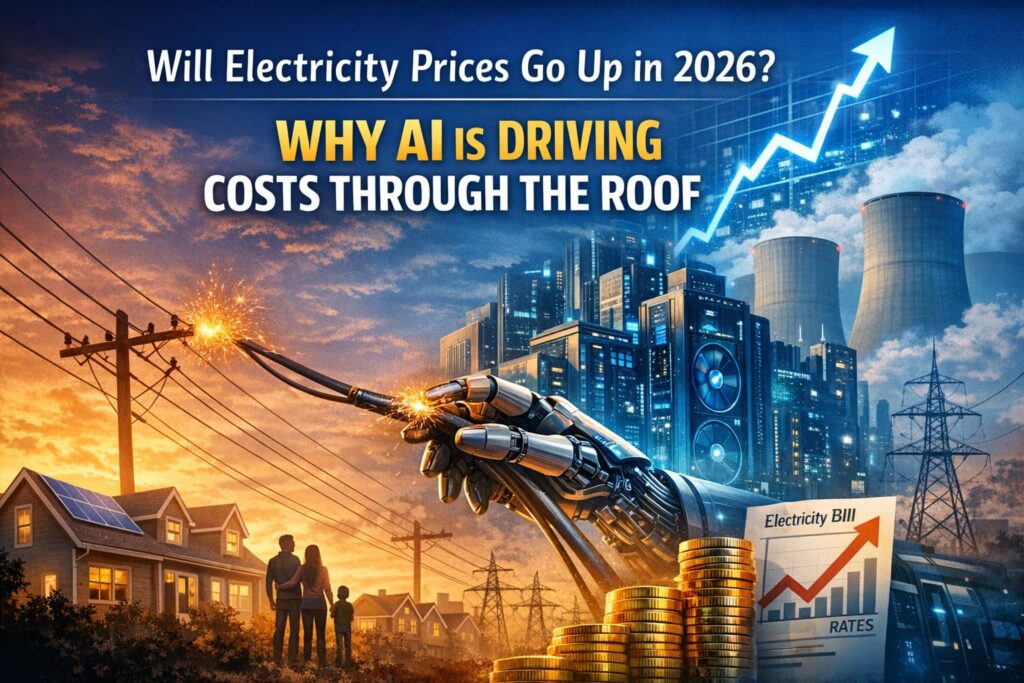
Electricity prices are rising across the U.S., and 2026 is very likely to bring further increases. Utilities continue filing rate changes to recover the costs of grid upgrades, reliability investments, climate and wildfire risk, and new demand.
One of the fastest-growing drivers is AI and data centers. AI runs on energy-intensive computing infrastructure that often operates 24/7. Over the next decade, AI-driven electricity demand could become one of the most significant structural pressures on electric rates.
This guide covers:
- Why are electricity prices are going up in 2026
- Why California is uniquely exposed to rate increases
- How AI demand translates into higher prices
- What the next 10 years may look like
- Practical steps homeowners can take (including solar and storage)
Key takeaways
- Yes, electricity prices are expected to rise in 2026 in many markets due to ongoing utility rate cases and grid investment.
- California rate pressure is often stronger because of wildfire mitigation, infrastructure hardening, and high system costs.
- AI data centers increase electricity demand with large, steady 24/7 load, which can tighten supply and raise costs.
- When demand grows faster than new generation and transmission can be built, rates and volatility tend to rise.
- For homeowners, higher rates typically make solar and batteries more valuable by reducing exposure to utility pricing.
Why are electricity prices going up in 2026?
Electricity rates rise when utility costs rise. The most common drivers going into 2026 include:
1) Grid modernization and reliability upgrades
Utilities are spending heavily on:
- Upgrading aging transmission and distribution equipment
- Substation capacity and transformer replacements
- Grid automation and monitoring
- Integrating renewables, storage, and distributed energy resources
2) Wildfire mitigation and climate risk costs
In wildfire-prone regions, utilities face rising costs for:
- Vegetation management
- Line hardening and undergrounding
- System monitoring and shutoff protocols
- Insurance premiums and risk-related financing
3) Electrification is increasing baseline demand
EV charging, heat pumps, and building electrification are increasing overall electricity usage, even as appliances get more efficient.
4) Fuel and capacity volatility
Many grids still rely on dispatchable resources (often natural gas) to meet peak demand and maintain reliability. When fuel or capacity costs rise, rates can follow.
California in 2026: why the state often sees larger increases
California is not “just another electricity market.” Rates are shaped by a specific mix of factors that tends to push bills higher over time.
The biggest California-specific drivers
- Wildfire risk and mitigation spending (hardening, undergrounding, monitoring)
- High cost of delivering power (terrain, density, system complexity)
- Aggressive grid transition (integrating renewables + storage while maintaining reliability)
- Time-of-use pricing exposure (more costs concentrated into peak windows)
- Capital-heavy infrastructure programs that are recovered over long periods
Internal links (NRG Clean Power)
California electricity pricing “pressure points” (what pushes rates up)
| Cost driver | What it means | Why it matters in California |
|---|---|---|
| Wildfire mitigation | Hardening, undergrounding, monitoring | Large multi-year programs can materially raise delivery costs |
| Transmission + distribution upgrades | Replacing aging assets, adding capacity | High capex programs are often recovered through rates |
| Reliability resources | Capacity to meet peaks and evening ramp | Firm capacity gets expensive when the grid is tight |
| Time-of-use structures | Higher peak prices, more volatility | Bills can jump if usage shifts into peak windows |
| Policy + compliance costs | Grid transition programs | Adds incremental costs and complexity |
The AI factor: why data centers can push rates higher
AI introduces a new category of demand: large, steady, high-density load. Unlike residential usage, AI load is often continuous and less price-sensitive.
How much electricity can an AI data center use?
Large data centers (especially AI-focused) can draw power at the scale of:
- 100–500 MW for major facilities (and sometimes more across campuses)
- 24/7 continuous demand with minimal seasonal drop
- High cooling and power-quality requirements
How AI demand turns into higher electricity prices
1) Demand grows faster than supply
When electricity demand rises faster than new generation can be added, systems become tighter. Tight systems can lead to:
- Higher wholesale prices during peak periods
- More expensive capacity procurement
- More frequent congestion events
2) Transmission constraints create congestion costs
Data centers cluster near fiber, land, and tax incentives, concentrating load. If transmission can’t deliver power efficiently, congestion costs rise.
3) Grid upgrades are capital intensive
Serving large new loads typically requires:
- Substation upgrades
- New feeders, transformers, and interconnection work
- Transmission expansions
Depending on regulation, some of these costs can flow into broader rates.
Why AI demand is different from “normal” electricity growth
| Attribute | Typical residential growth | AI data center growth |
|---|---|---|
| Load shape | Peaks in mornings/evenings | Often 24/7 steady load |
| Location | Distributed | Clustered, very high density |
| Elasticity | Some ability to reduce usage | Low; workloads are constant |
| Grid impact | Gradual | Can require large upgrades fast |
What happens to electricity prices over the next 10 years?
Electricity pricing is regional, but AI-driven demand creates a common pattern: near-term upward pressure while new generation and transmission are built.
Table: 2026–2035 outlook (high-level)
| Time period | What’s likely to happen | What it means for homeowners |
|---|---|---|
| 2026–2028 | Continued rate cases + grid investment + data center growth | Bills trend up; TOU volatility increases |
| 2028–2032 | Faster buildout of solar + storage + grid upgrades | Some stabilization possible, but rates often still climb |
| 2032–2035 | Depends on whether supply + transmission catch up | Best case: stabilization; worst case: sustained increases |
What this means for California homeowners
California already has some of the highest residential electricity rates in the country, and time-of-use structures can make peak-hours electricity especially expensive.
Rising rates generally increase the value of:
- Solar (each kWh offsets a more expensive grid kWh)
- Batteries (reduce exposure to peak rates and add backup resilience)
- Load shifting (moving EV charging and appliances to off-peak hours)
Common homeowner actions that reduce exposure to rising rates
| Strategy | What it does | Best for |
|---|---|---|
| Solar panels | Reduce grid kWh purchase | High daytime usage, long-term savings |
| Battery storage | Shift usage away from peak rates; backup power | TOU plans, outages, evening usage |
| EV charging schedule | Move charging to off-peak | EV owners with TOU pricing |
| Heat pump optimization | Reduce peak usage and improve efficiency | Homes electrifying heating/cooling |
| Smart thermostat + controls | Automated load shifting | Households with variable schedules |
Quick solar value lens (simple framework)
This helps frame why solar often becomes more attractive as rates rise.
| Utility rate trend | Effect on bill | Effect on solar value |
|---|---|---|
| Rates rise slowly | Bill increases modestly | Solar savings grow gradually |
| Rates rise faster than inflation | Bill jumps more noticeably | Solar savings grow faster |
| Peak rates surge under TOU | High evening/peak costs | Solar + battery value increases |
Can AI also help reduce electricity costs?
Yes. AI can improve grid efficiency through:
- Better load forecasting
- Smarter battery dispatch and grid balancing
- Faster detection of faults
- Optimized building energy management
However, the near-term impact of AI is likely net upward pressure because demand growth is happening quickly and infrastructure takes time to build.
Bottom line: will electricity prices go up in 2026?
Yes.
Traditional drivers like grid upgrades, wildfire mitigation, and insurance remain important. But AI-driven electricity demand is becoming one of the most significant structural forces shaping rates — and California is one of the most exposed states due to its cost structure and grid risk profile.
For homeowners, reducing dependence on utility pricing is increasingly valuable when rates rise and TOU volatility increases.
Disclaimer
Electricity rates and projections vary by utility territory and are subject to regulatory approvals. This article is for informational purposes only; for official rate information and filings, refer to your utility and state regulator.