
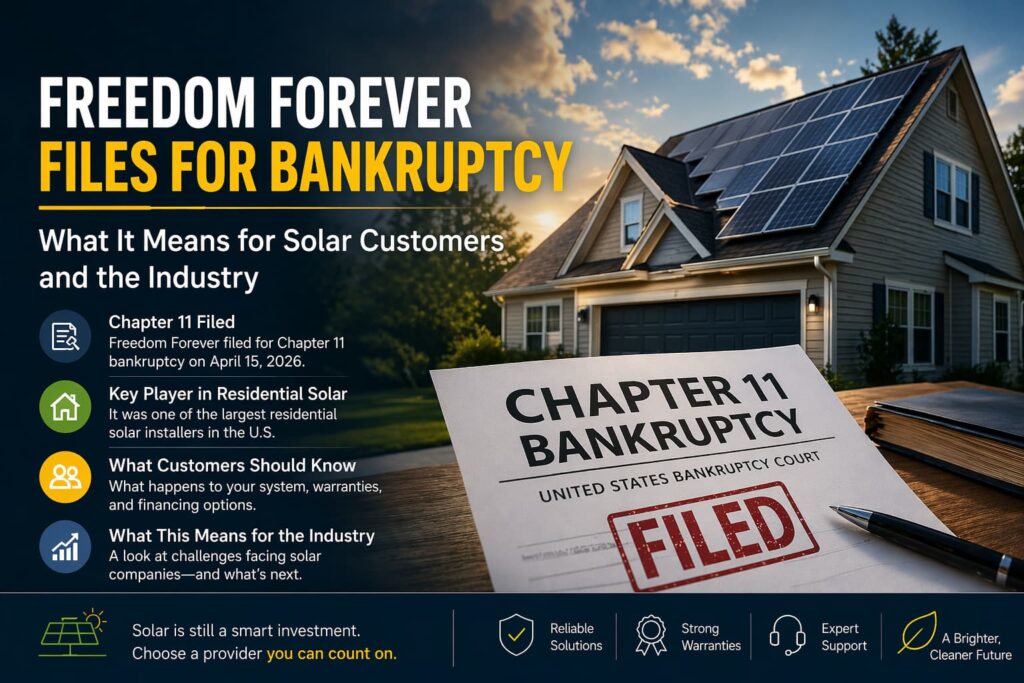
Freedom Forever, one of the largest residential solar installers in the United States, filed for Chapter 11 bankruptcy in April 2026. While the headline may sound alarming, the real takeaway for homeowners is deeper: the solar market is maturing, and choosing the right installer has never been more important.
This guide breaks down what actually happened, what it means in practical terms, and how smart homeowners can protect themselves and make better solar decisions going forward.
What Happened: The Facts
- Freedom Forever filed for Chapter 11 bankruptcy protection in Delaware
- Estimated debt: $500M to $1B
- Estimated assets: $100M to $500M
- Previously ranked among the largest U.S. residential solar installers (top 2–5 in 2025)
- Earlier in 2026: exited 10+ state markets and reduced workforce by ~20%
What Chapter 11 Actually Means
Chapter 11 is not a shutdown. It is a restructuring process that allows the company to:
- Continue operating
- Renegotiate debts
- Attempt to stabilize financially
However, it often leads to:
- Slower project timelines
- Reduced service capacity
- Vendor and subcontractor disruptions
Why This Is Happening Across Solar (2025–2026 Trends)
Freedom Forever is not an isolated case. The entire residential solar market has been under pressure due to structural changes.
Key Industry Pressures
| Factor | Impact on Solar Companies |
|---|---|
| High interest rates | Increased cost of solar loans and leases, reducing demand |
| Customer acquisition costs | Sales-driven models became expensive to sustain |
| Policy changes (e.g. NEM 3.0 in CA) | Lower export compensation reduced ROI for some homeowners |
| Financing tightening | Fewer aggressive lending options available |
| Over-expansion | Companies scaled too fast in low-margin environments |
What This Means in Plain English
Some solar companies grew fast during the low-interest, high-demand years (2020–2022). In 2026, the market is rewarding:
- Operational efficiency
- Strong balance sheets
- Real service infrastructure (not just sales)
Important: Solar Itself Is NOT the Problem
This is critical.
Solar remains one of the strongest long-term financial and energy decisions for homeowners, especially in high-electricity-cost states like California.
2026 Solar Reality
- Electricity rates continue to rise (often 5–12% annually in CA markets)
- Solar still provides 20–30 year energy cost control
- Battery adoption is increasing due to outages and grid instability
👉 The risk is not solar.
👉 The risk is choosing the wrong installer.
What Current Freedom Forever Customers Should Do (Action Plan)
If you are a customer, stay calm but act smart.
Step-by-Step Checklist
1. Secure Your Documentation
- Contract agreement
- Financing terms
- Warranty coverage (equipment + workmanship)
- Permit approvals
2. Document System Status
- Installed vs not installed
- PTO (Permission to Operate) status
- Monitoring screenshots
3. Understand Your Warranties
| Warranty Type | Who Covers It | Risk Level |
|---|---|---|
| Panel warranty (25 yrs typical) | Manufacturer | Low risk |
| Inverter warranty | Manufacturer | Low risk |
| Workmanship warranty | Installer | Higher risk |
4. Contact Your Financing Provider
Your loan or lease likely remains active regardless of installer status.
5. Track Performance
Monitor production regularly to catch issues early.
The Bigger Lesson: How to Choose a Solar Company in 2026
This is where homeowners can turn a negative headline into a smart decision.
The 5 Critical Checks (Most Important Section)
1. Financial Stability
Ask:
- How long has the company been operating?
- Are they profitable or heavily debt-funded?
- Do they rely on aggressive financing models?
2. Installation Model
- In-house installers vs subcontractors
- Local crews vs outsourced national networks
👉 Companies with local teams tend to provide better long-term service.
3. Service Infrastructure
Ask directly:
- Who handles service calls?
- What is the average response time?
- Do you have a local support team?
4. Warranty Clarity
A strong solar company should clearly separate:
- Equipment warranty (manufacturer)
- Workmanship warranty (installer)
If this is unclear → red flag.
5. Reputation and Track Record
Look for:
- Real customer reviews (not just ads)
- BBB ratings and complaints
- Longevity in your specific state
California-Specific Insight
California homeowners need to be especially careful in 2026 because:
- NEM 3.0 changed the economics of solar exports
- Batteries are now a key part of maximizing savings
- Electricity rates are among the highest in the U.S.
👉 This means your installer must:
- Design systems properly (not oversell production)
- Understand storage integration
- Provide long-term service support
Where the Market Is Going
The solar industry is not shrinking. It is evolving.
What Strong Companies Are Doing in 2026
- Focusing on quality installs over volume sales
- Integrating battery storage as standard
- Building real service operations
- Offering transparent, realistic savings models
Bottom Line (Key Takeaway)
Freedom Forever’s bankruptcy is not the end of residential solar. It is a wake-up call.
For homeowners, the message is simple:
✔ Solar is still a smart long-term investment
✔ Electricity prices are still rising
✔ Energy independence is still valuable
But success depends on one thing:
👉 Choosing the right solar partner
Final Thought
At NRG Clean Power, we believe solar should be built on:
- Transparency
- Long-term service
- Financial stability
- Real customer support
In a changing market, homeowners who take the time to research, ask the right questions, and choose a trusted installer will still see the full benefits of solar for decades to come.
Quick FAQ
Is my solar system affected if my installer files for bankruptcy?
Not necessarily. Equipment warranties usually remain valid through manufacturers, but workmanship and service may be impacted.
Should I still go solar in 2026?
Yes. In most markets, especially California, solar remains financially beneficial. The key is choosing the right company.
What is the biggest risk when going solar today?
Not the technology, but the installer. Financial stability and service quality matter more than ever