
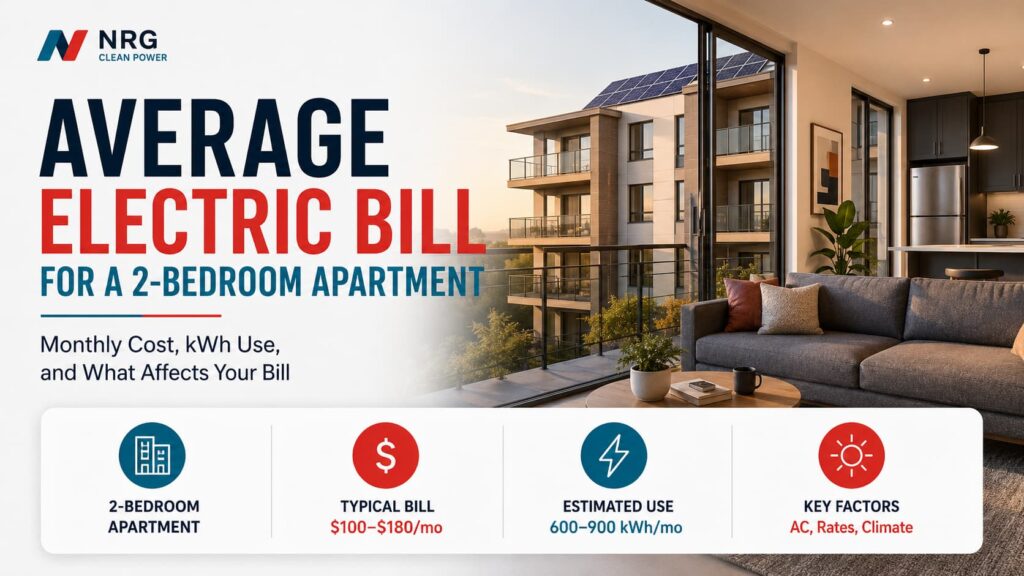
Quick answer: The average electric bill for a 2-bedroom apartment is about $117 to $179 per month, based on 650 to 1,000 kWh of usage at the 2026 national average rate of 17.91 cents per kWh (EIA, March 2026). That is roughly 20 to 30 percent more than a 1-bedroom. In California, the same apartment costs far more, because state residential rates average 35.25 cents per kWh, nearly double the national figure. A California 2-bedroom using 800 kWh runs about $280 a month, and higher in an inland summer. Your utility matters more than almost anything else.
Key takeaways
- National average for a 2-bedroom: about $117 to $179 per month at 650 to 1,000 kWh of usage
- California 2-bedroom: roughly $230 to $350 per month, because state rates average 35.25 cents per kWh versus 17.91 nationally
- A 2-bedroom uses 20 to 30 percent more power than a 1-bedroom, thanks to more space, occupants, and appliances
- Your utility decides a lot: the same unit costs far less on LADWP or SMUD than on PG&E, SCE, or SDG&E
- Air conditioning is the biggest swing factor, especially inland where summer AC lands during peak-rate hours
What a 2-bedroom apartment actually uses
Your electric bill is usage times rate, plus fixed charges, and both halves matter. A typical 2-bedroom apartment uses 650 to 1,000 kWh per month, roughly 20 to 30 percent more than a 1-bedroom. The extra bedroom, often a second bathroom, more living space, and usually more people all add load. Run central AC daily through a hot summer or add an EV charger, and usage climbs past 1,100 kWh.
Apartments still beat houses on efficiency. Even a 2-bedroom uses far less than a single-family home because of its smaller footprint and shared walls, which insulate. That is why a 2-bedroom bill sits near the national household average rather than above it.
National 2-bedroom apartment electric bill by usage, at the 2026 average rate
| Monthly usage | Bill at 17.91 ¢/kWh (US avg) | Typical situation |
|---|---|---|
| 600 kWh | ~$107 | Efficient unit, mild climate, gas heat |
| 750 kWh | ~$134 | Average 2-bedroom, moderate use |
| 850 kWh | ~$152 | Regular AC or a second occupant |
| 1,000 kWh | ~$179 | Warm climate, daily AC |
| 1,150 kWh | ~$206 | Electric heat or heavy summer cooling |
Rate: EIA Electric Power Monthly national residential average, 17.91 cents per kWh, March 2026 (EIA). Add fixed monthly charges, which vary by utility.
Why California costs so much more
Direct answer: California’s residential electricity averages 35.25 cents per kWh, nearly double the national 17.91 cents (EIA, April 2026). Same apartment, same usage, close to twice the bill. A 2-bedroom using 800 kWh that costs about $143 nationally costs roughly $280 in California.
2-bedroom apartment bill, California vs national, by usage
| Monthly usage | US average (17.91¢) | California (35.25¢) | Difference |
|---|---|---|---|
| 650 kWh | ~$116 | ~$229 | +$113 |
| 800 kWh | ~$143 | ~$282 | +$139 |
| 1,000 kWh | ~$179 | ~$353 | +$174 |
| 1,150 kWh | ~$206 | ~$405 | +$199 |
California figures at the state average residential rate; your actual rate depends on your utility and plan. Note how the gap widens with usage: the more power you use in California, the more that rate difference costs you.
Your utility matters more than your ZIP code
Direct answer: within California, which utility serves your building can swing the bill by 10 cents or more per kWh. California is not one electricity market; it is a patchwork of investor-owned and municipal utilities with very different prices.
Approximate California residential rates by utility, mid-2026
| Utility | Serves | Approx. residential rate | 800 kWh 2-bedroom bill |
|---|---|---|---|
| SMUD | Sacramento | ~20 to 24 ¢/kWh | ~$175 to $195 |
| LADWP | City of Los Angeles | ~24 to 26 ¢/kWh | ~$200 to $210 |
| SCE | Much of Southern CA | ~36+ ¢/kWh | ~$290+ |
| PG&E | Northern & Central CA | ~40+ ¢/kWh | ~$320+ |
| SDG&E | San Diego area | ~40+ ¢/kWh | ~$320+ |
Rates are approximate and change quarterly; confirm on your utility’s current tariff page. Municipal utilities (SMUD, LADWP, Pasadena) generally run cheaper than the investor-owned utilities (PG&E, SCE, SDG&E). We break down specific cities in our Granada Hills and Pasadena rate guides.
The lesson for renters: a 2-bedroom in Los Angeles on LADWP can cost $100 or more less per month than an identical unit an hour away on PG&E or SDG&E, for the exact same usage. When apartment hunting with utilities not included, the serving utility is a real monthly cost worth asking about before you sign the lease.
What drives a high 2-bedroom bill
Direct answer: air conditioning, electric heat, and electric water heating are the big movers, and a 2-bedroom often has more of all three running than a 1-bedroom. Common culprits behind a bill that feels too high: inefficient window AC units instead of central air, old appliances left by the landlord, an electric water heater serving a larger household, poor insulation and drafty windows, and space heaters in winter. In California, inland summer AC in areas like the Inland Empire and Central Valley is the single biggest swing, because that cooling load lands during the utility’s most expensive peak-rate hours, and a larger unit takes more energy to cool.
Practical ways to trim it: set the AC to 78°F instead of 72°F, since each degree saves roughly 3 to 5 percent on cooling; use a programmable thermostat if the landlord allows; run laundry and the dishwasher off-peak, generally after 8 or 9 pm in California; close off and stop cooling unused rooms; and switch any remaining old bulbs to LEDs. Our guide to how many kWh per day is normal shows where the power actually goes.
Renters and solar: worth knowing for later
Most renters cannot install solar on a unit they do not own, so this is not a pitch. But it explains why California bills are what they are: the same high rates that make your 2-bedroom sting are what make owned solar so valuable for California homeowners, with paybacks around 5 to 7 years even without the federal tax credit, as we cover in our 5kW cost and output guide. The math that works against you as a renter works for you once you own.
FAQ
What is the average electric bill for a 2-bedroom apartment?
About $117 to $179 per month nationally, based on 650 to 1,000 kWh of usage at the 2026 average rate of 17.91 cents per kWh. In California, expect roughly $230 to $350 for the same usage, because state rates run nearly double the national average.
How many kWh does a 2-bedroom apartment use?
Typically 650 to 1,000 kWh per month, about 20 to 30 percent more than a 1-bedroom. Usage climbs above 1,100 kWh with heavy air conditioning, electric heat, or EV charging, and drops toward 600 in an efficient unit with gas heat and mild weather.
Why is my 2-bedroom electric bill so high?
The usual causes are air conditioning, electric heating, an electric water heater, inefficient appliances, and poor insulation. In California, summer AC during peak-rate hours is the biggest single driver, and a larger unit takes more energy to cool. PG&E, SCE, and SDG&E service also costs more than a municipal utility.
How much is a 2-bedroom apartment electric bill in California?
Roughly $230 to $350 per month for typical usage at the state average of 35.25 cents per kWh, and higher in inland areas with heavy summer AC. Your utility matters: LADWP and SMUD run cheaper than PG&E, SCE, or SDG&E.
Is a 2-bedroom apartment much more expensive than a 1-bedroom?
Usually 20 to 30 percent more for electricity, since a 2-bedroom uses 650 to 1,000 kWh versus 500 to 750 for a 1-bedroom. More space, more occupants, and more appliances all add up. See our 1-bedroom apartment bill guide for that comparison.
Which California utility has the cheapest electricity?
Among the major providers, municipal utilities like SMUD and LADWP generally have lower residential rates than the investor-owned PG&E, SCE, and SDG&E. Your building’s location determines which one serves you; as a renter it is not something you can choose.