
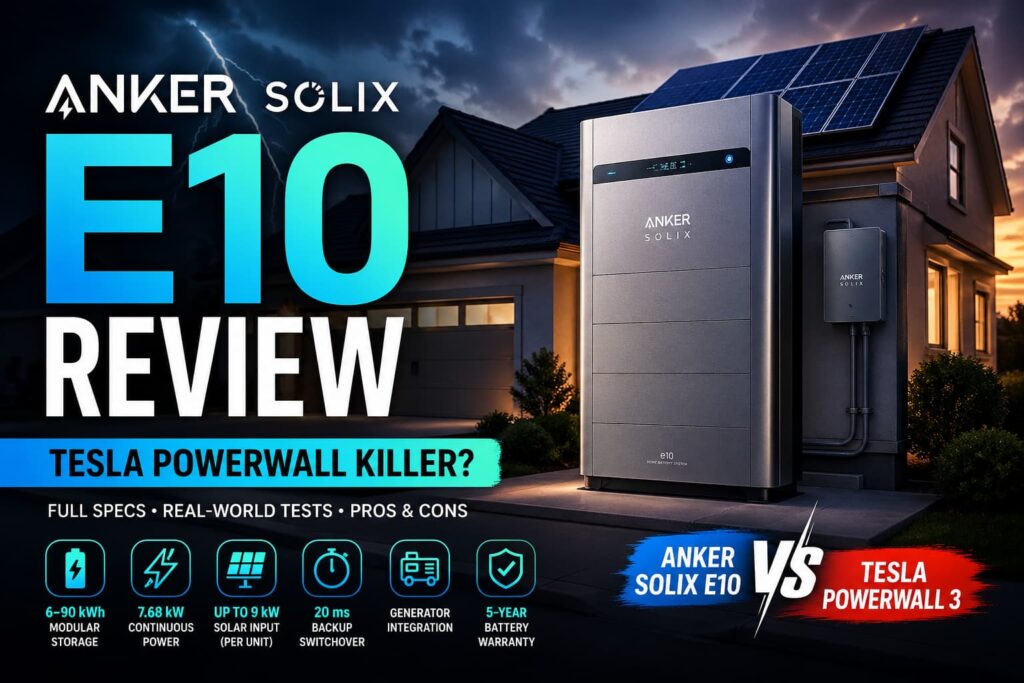
Quick Verdict
The Anker SOLIX E10 is one of the most interesting home battery launches for homeowners who want backup power, solar storage, and more control over outages.
It is not just another portable power station. The E10 is a modular whole-home backup system that can connect to solar panels, the grid, a home electrical panel, and Anker’s Smart Generator ecosystem.
But is it really a Tesla Powerwall killer?
The honest answer is: not for every homeowner.
The Anker SOLIX E10 looks strongest for people who want:
- A lower starting hardware price
- Modular battery expansion
- Long-outage backup planning
- Generator integration
- High surge power for heavy appliances
- A system that can start small and grow over time
The Tesla Powerwall 3 still looks stronger for people who want:
- A more established solar battery ecosystem
- A 10-year battery warranty
- Higher continuous power per unit
- A larger base battery
- A proven installer network
- A cleaner solar-first design
So the better way to think about it is this:
The Anker SOLIX E10 is not a universal Powerwall killer. It is a serious Powerwall alternative, especially for outage-focused homeowners who care about flexible backup power more than brand maturity.
What Is the Anker SOLIX E10?
The Anker SOLIX E10 is a smart hybrid whole-home backup system built around a power module, stackable B6000 battery modules, and either a Smart Inlet Box or Power Dock.
Anker markets the system as a home backup solution that can scale from 6 kWh to 90 kWh of storage, support up to 9 kW of solar input per E10, and expand up to 27 kW of solar input when three E10 units are used together. The system can also provide 7.68 kW of continuous output, 10 kW turbo output for up to 90 minutes in the right configuration, and fast backup transition when paired with the Power Dock. (Anker SOLIX)
That puts the E10 in a different category from a small backup battery. It is designed to compete in the same homeowner conversation as Tesla Powerwall, EcoFlow Delta Pro Ultra, FranklinWH, Enphase, Generac, and other residential energy storage systems.
Anker SOLIX E10 Specs at a Glance
| Feature | Anker SOLIX E10 |
|---|---|
| Starting hardware price | $4,299 promotional price for Power Module + 1 battery |
| Battery capacity | 6 kWh to 90 kWh |
| Battery module | B6000 battery module |
| Max storage per E10 unit | Up to 30 kWh |
| Max storage with three E10 units | Up to 90 kWh |
| Continuous output | 7.68 kW |
| Turbo output | 10 kW for up to 90 minutes with two batteries |
| Solar input per E10 | Up to 9 kW |
| Solar input with three E10 units | Up to 27 kW |
| Backup transfer time | 20 ms or less with Power Dock |
| Large-load support | Anker says it can start up to a 5-ton central AC in the right configuration |
| Outdoor rating | E10 is NEMA 4 / IP66 rated |
| Smart Inlet Box / Power Dock rating | NEMA 3R |
| Battery retention claim | 80% capacity after 4,000 cycles |
| Battery and power module warranty | 5 years |
| Smart Inlet Box / Power Dock warranty | 10 years |
| Smart Generator warranty | 3 years |
| Grid export | Anker says the E10 and Power Dock do not feed electricity back to the grid |
Anker’s official product page lists current promotional pricing at $4,299 for the E10 Power Module plus one battery, $6,298.99 for the Power Module plus two batteries, $6,599 for the two-battery Manual Backup Kit with Smart Inlet Box, and $7,799 for the two-battery Automatic Backup Kit with Power Dock. (Anker SOLIX)
Why the E10 Is Being Compared to Tesla Powerwall
Tesla Powerwall became the best-known home battery because it solved a very real homeowner problem: store solar power, use it later, and keep the home running during an outage.
The Anker SOLIX E10 is going after the same emotional and practical need, but from a different angle.
Tesla’s system is more solar-first. Anker’s system feels more backup-first.
That matters because many homeowners are not just asking, “How do I store solar power?”
They are asking:
- Can I keep my refrigerator running during an outage?
- Can I run my lights, Wi-Fi, garage door, and medical devices?
- Can I start my central AC?
- Can I survive a multi-day blackout?
- Can I add more batteries later?
- Can I combine battery backup with a generator?
- Can I avoid buying a massive system on day one?
This is where the E10 gets interesting. It is modular, expandable, and designed around a mix of battery, solar, grid, and generator backup.
Anker SOLIX E10 vs Tesla Powerwall 3
| Category | Anker SOLIX E10 | Tesla Powerwall 3 | Better Fit |
|---|---|---|---|
| Base battery size | About 6 kWh | 13.5 kWh | Tesla |
| Starting hardware price | Lower entry point | Higher typical installed cost | Anker |
| Continuous output | 7.68 kW | 11.5 kW | Tesla |
| Short-duration boost | 10 kW turbo output for up to 90 minutes with two batteries | Strong continuous and motor-start output | Depends |
| Solar input | Up to 9 kW per E10 | Up to 20 kW DC solar input per Powerwall 3 | Tesla |
| Storage scalability | Up to 90 kWh | Tesla’s current Powerwall 3 architecture can scale very high, including example configurations with Powerwall 3 Expansion units | Tie, depending on design |
| Expansion style | Smaller battery increments | Larger 13.5 kWh increments | Anker for modularity |
| Warranty | 5 years on E10 battery and power module | 10 years | Tesla |
| Generator integration | Stronger native generator angle | Not the main value proposition | Anker |
| Installer ecosystem | Newer | More mature | Tesla |
| Best use case | Flexible outage backup | Solar-first home battery | Depends |
Tesla lists the Powerwall 3 with 13.5 kWh of energy capacity, 11.5 kW of continuous on-grid and backup power, 185 LRA motor-start capability, 97.5% solar-to-grid efficiency, and a 10-year warranty. Tesla’s current datasheet also shows Powerwall 3 Expansion configurations and maximum system examples, so the older claim that Powerwall 3 simply maxes out at 54 kWh should not be used as a blanket comparison anymore. (Tesla Energy Library)
The cleaner comparison is this:
Anker has an advantage in smaller expansion steps and backup flexibility. Tesla has an advantage in maturity, warranty, continuous output, and solar-first integration.
Where the Anker SOLIX E10 Beats the Powerwall
1. Lower Entry Price
The E10’s most obvious advantage is its lower starting price.
Anker currently lists the E10 Power Module plus one battery at $4,299 as a promotional price. That is not the full installed cost, but it gives homeowners a much lower hardware entry point than many traditional home battery installations. (Anker SOLIX)
This is important because battery storage often feels financially out of reach. A homeowner may not want to start with a large, fully installed, multi-battery system. The E10 gives them a way to start smaller.
That said, homeowners should not compare the $4,299 E10 hardware price directly against a fully installed Powerwall quote. Real-world installed costs can include:
- Electrical labor
- Permits
- Load calculations
- Backup panel work
- Power Dock or Smart Inlet Box
- Additional batteries
- Solar wiring
- Utility requirements
- Local code requirements
The E10 may be cheaper to start, but final pricing depends heavily on system design.
2. Modular Battery Expansion
This may be the E10’s biggest practical advantage.
A Tesla Powerwall 3 gives you 13.5 kWh per battery. That is simple, but expansion happens in larger jumps.
The Anker SOLIX E10 is built around roughly 6 kWh battery modules. Anker markets the system as starting at 6 kWh and scaling up to 30 kWh per E10 unit, or 90 kWh with three E10 units. (Anker SOLIX)
That makes the E10 more flexible for homeowners who want to build in phases.
For example:
| Homeowner Goal | Possible E10 Direction |
|---|---|
| Backup fridge, lights, Wi-Fi, and outlets | Start with one battery |
| Add more runtime for longer outages | Add a second or third battery |
| Support larger loads | Add more batteries and proper electrical integration |
| Whole-home backup | Use Power Dock and multiple battery modules |
| Large resilience setup | Expand toward multiple E10 units |
This smaller-step expansion is a real advantage for homeowners who want backup power now but do not want to overbuy on day one.
3. Strong Long-Outage Strategy
A home battery is only as useful as the energy available inside it.
For short outages, almost any properly sized battery can help. For multi-day outages, the strategy becomes more complicated.
This is where the E10 is compelling. It is designed to combine:
- Stored battery power
- Solar charging
- Grid charging
- Generator backup
- Whole-home or partial-home backup configurations
Anker’s E10 ecosystem includes compatibility with its Smart Generator 5500, which is part of the company’s broader backup strategy. (Anker SOLIX)
That matters in places where outages are not just a one-hour inconvenience.
The E10 may be especially attractive for homeowners dealing with:
- Wildfire-related shutoffs
- Storm outages
- Rural grid instability
- Older utility infrastructure
- Hurricane or winter storm risk
- Homes with medical or work-from-home backup needs
- Homeowners who already planned to buy a generator
A battery-only system is clean and quiet. A battery plus solar plus generator can be more resilient during extended outages.
4. High Surge Power for Large Appliances
A big issue with home batteries is not just how much energy they store. It is whether they can start large appliances.
Central air conditioners, well pumps, sump pumps, refrigerators, freezers, and other motor-driven loads can require a large startup surge.
Anker claims the E10 can support high surge power and start up to a 5-ton central AC in the right configuration. Anker’s product materials also reference up to 37.2 kW surge capability per unit and higher surge capability with dual E10 setups. (Anker SOLIX)
For homeowners, this is a major selling point.
A battery that can run lights but cannot start important home loads may not feel like true backup power. The E10’s surge-focused design makes it more interesting for people who want practical backup, not just a small emergency circuit.
5. Fast Backup Transition
When paired with the Power Dock, the E10 is designed for fast automatic backup transition.
Anker lists a backup switchover time of 20 milliseconds or less with the Power Dock. (Anker SOLIX)
That kind of transition is important for homeowners who want a more seamless experience during outages. It can help keep essential circuits running without the homeowner manually switching equipment on.
There is still a difference between “automatic backup” and a fully designed whole-home backup system. The exact experience depends on how the system is installed, what loads are backed up, and whether the home uses the Power Dock or Smart Inlet Box.
Where Tesla Powerwall 3 Still Wins
1. Larger Base Battery
The Powerwall 3 has a 13.5 kWh battery. The E10 starts at about 6 kWh.
That means one Powerwall 3 stores more energy than the entry E10 configuration.
For a homeowner who wants a simple solar battery setup without thinking through many battery-module combinations, Tesla’s larger base unit is easier to understand.
2. Higher Continuous Power Per Unit
Tesla Powerwall 3 is rated at 11.5 kW continuous power. The Anker SOLIX E10 is rated at 7.68 kW continuous output, with turbo output available in certain configurations. (Anker SOLIX)
That distinction matters.
The E10 looks strong for surge and backup flexibility. Powerwall 3 looks stronger for continuous output per unit.
For homes with large constant loads, this can affect system design.
3. Longer Battery Warranty
This is one of the most important differences.
Anker lists a 5-year standard warranty for the E10 power module and battery module. The Smart Inlet Box and Power Dock have a 10-year standard warranty, and the Smart Generator has a 3-year warranty. (Anker SOLIX)
Tesla Powerwall 3 has a 10-year warranty. (Tesla Energy Library)
For a permanently installed home battery, warranty length matters. Batteries are long-term investments. A 5-year battery warranty is a real weakness when compared with Tesla and other established residential storage brands.
This does not mean the E10 is unreliable. It means homeowners should price that warranty difference into the decision.
4. More Mature Ecosystem
Tesla has years of experience in residential batteries, a large installed base, and a familiar app-driven ecosystem.
The E10 is newer in the whole-home battery category. That creates questions homeowners should ask before buying:
- How many local installers are trained on the E10?
- How easily can replacement parts be sourced?
- How will support work after year five?
- How well does it integrate with existing solar systems?
- How familiar are local inspectors with the system?
- How does the system behave after years of daily cycling?
Anker is a major consumer electronics brand, and the SOLIX line has become more serious. But Tesla still has the more mature home battery ecosystem.
California Homeowners: Why the E10 Is Interesting, but Not Perfect
For California homeowners, battery storage has become much more important under the state’s Solar Billing Plan, also known as Net Billing.
The California Public Utilities Commission explains that the older NEM tariffs are closed to new enrollments, and that Net Billing changes the way customers are credited for exported energy. Under the newer structure, batteries can help homeowners use more of their own solar power instead of sending it to the grid at lower export values. (CPUC)
That is why batteries have become a bigger part of California solar design.
However, the E10 has one major California-specific limitation:
Anker says the E10 and Power Dock do not feed electricity back to the grid. (Anker SOLIX)
That means the E10 should be framed as a backup and self-consumption battery, not a battery built for export arbitrage.
In plain English:
- It may help you store solar power and use it later.
- It may help you avoid buying expensive electricity during peak evening hours.
- It may provide strong outage backup.
- But it is not designed to export stored electricity back to the grid.
For California homeowners, that distinction is important. A solar battery strategy under Net Billing is not just about having storage. It is about how the battery interacts with the home, solar system, utility rate, interconnection rules, and export strategy.
Before choosing the E10 in California, homeowners should ask an installer:
- Will this system work with my current solar inverter?
- Will it support my utility rate strategy?
- Will it reduce evening grid imports?
- Which loads will be backed up?
- Will this be a partial-home or whole-home backup design?
- Does the system require a Power Dock?
- Can this system export energy, or is it self-consumption only?
- How does it compare with Tesla, Enphase, FranklinWH, or SolarEdge for my specific home?
Federal Tax Credit Warning for 2026 Buyers
This is a major point for homeowners shopping in 2026.
The IRS currently states that the Residential Clean Energy Credit equals 30% of the cost of qualified clean energy property installed from 2022 through December 31, 2025. The IRS also says the credit is not available for property placed in service after December 31, 2025. Battery storage technology qualified beginning in 2023 if it had a capacity of at least 3 kWh. (IRS)
That means homeowners should not automatically assume a new E10 battery installed in 2026 qualifies for the old 30% federal tax credit.
This is especially important because many older solar battery articles still talk about the federal tax credit as if it is guaranteed.
Before buying, homeowners should confirm:
- Current federal tax credit eligibility
- State incentives
- Utility battery programs
- Local rebates
- Battery-specific program rules
- Whether the system must be installed with solar
- Whether the system must meet certain technical requirements
Always confirm tax details with a qualified tax professional.
Real-World Backup Runtime: What Can the E10 Actually Run?
Battery runtime depends on two things:
- How much storage you have
- How much power your home is using
A small battery system can run essential loads for a long time if the home is conservative. The same battery can drain quickly if it is running HVAC, electric cooking, pool equipment, or other heavy loads.
Here is a simple way to think about it.
| E10 Battery Size | Best Use Case | Practical Expectation |
|---|---|---|
| 6 kWh | Essentials backup | Fridge, lights, Wi-Fi, outlets, small devices |
| 12 kWh | Longer essentials backup | Better overnight coverage and more comfort loads |
| 18 to 30 kWh | Larger backup setup | More appliances, longer runtime, possible HVAC support depending on design |
| 60 to 90 kWh | Serious resilience system | Multi-day potential with load management, solar, and possibly generator support |
A maxed-out 90 kWh E10 system sounds enormous, and it is. For context, the U.S. Energy Information Administration’s 2024 residential electricity data shows average household consumption at about 863 kWh per month, or roughly 28.8 kWh per day. That means 90 kWh is roughly equal to about three average days of electricity before real-world losses, weather, HVAC usage, and load management are considered. (EIA)
But averages can be misleading.
A California home with mild weather, efficient appliances, and good solar production may stretch storage much longer. A large home running central AC, pool pumps, and electric heating may drain batteries much faster.
The best backup systems are designed around specific loads, not generic averages.
Example Backup Scenarios
Scenario 1: Essential Loads Backup
A homeowner wants to run:
- Refrigerator
- Freezer
- Wi-Fi
- Lights
- Phone charging
- Garage door
- A few outlets
This is where the E10 can make a lot of sense, even in a smaller configuration. The homeowner may not need full whole-home backup. They need resilience.
Scenario 2: Work-From-Home Backup
A homeowner wants to keep:
- Internet
- Computer equipment
- Lighting
- Refrigerator
- Outlets
- Possibly a mini-split or small AC zone
This is a strong use case for a modular battery. The homeowner can design around the circuits that matter most.
Scenario 3: Whole-Home Backup
A homeowner wants to support:
- HVAC
- Kitchen appliances
- Laundry
- Lighting
- Refrigeration
- Internet
- Garage
- Most normal home circuits
This requires a larger system, professional design, and careful load management. The E10 can scale toward this use case, but the final design matters more than the product name.
Scenario 4: Long-Outage Resilience
A homeowner wants backup for wildfire shutoffs, storms, or rural grid problems.
This is where the E10’s solar plus battery plus generator angle becomes compelling. A large battery can help. Solar can recharge during the day. A generator can provide another layer of protection if weather or outage duration becomes a problem.
Safety, Certifications, and Installation
Home batteries are not simple plug-in gadgets. They connect to electrical systems, solar arrays, load panels, transfer equipment, and sometimes generators.
Anker markets the E10 as a UL 9540 and UL 9540A certified system, and the product page references certification documentation. (Anker SOLIX)
That matters because energy storage systems must meet safety, fire, and electrical code expectations.
Homeowners should still work with qualified professionals for:
- Load calculations
- Permitting
- Utility requirements
- Electrical panel review
- Backup circuit design
- Solar integration
- Generator integration
- Local inspection
- Fire code compliance
Even if a system is marketed as simpler or more flexible, whole-home backup should be designed carefully.
Pros and Cons of the Anker SOLIX E10
Pros
- Lower starting hardware price than many traditional home battery systems
- Modular battery expansion from 6 kWh to 90 kWh
- Smaller expansion steps than Powerwall
- Strong backup-first design
- Solar input support
- Generator integration
- Fast backup transition with Power Dock
- High surge capability for large appliances
- Can support central AC startup in the right configuration
- Outdoor-rated E10 unit
- Good fit for outage-prone homes
- Strong option for homeowners who do not want to enter Tesla’s ecosystem
Cons
- 5-year warranty on the battery and power module is short compared with Tesla Powerwall 3
- Base battery capacity is much smaller than one Powerwall 3
- Newer whole-home battery ecosystem
- Not designed to feed electricity back to the grid
- Installed cost can rise quickly with Power Dock, additional batteries, electrical work, and permits
- Not every solar installer will be familiar with the E10 yet
- California homeowners need to be careful because it is better framed as self-consumption and backup, not export optimization
- Long-term field performance is not as proven as Tesla’s
Who Should Consider the Anker SOLIX E10?
The Anker SOLIX E10 may be a good fit if you:
- Want a flexible home backup system
- Want to start smaller and expand later
- Care more about outage protection than brand name
- Want generator integration
- Need high surge power for large appliances
- Want backup for central AC, pumps, or heavy loads
- Want a modular alternative to Tesla Powerwall
- Are building a resilience strategy around battery, solar, and generator power
- Prefer a lower initial hardware entry point
- Want to avoid buying a large battery system all at once
Who Should Choose Tesla Powerwall 3 Instead?
Tesla Powerwall 3 may be the better choice if you:
- Want a more established solar battery product
- Want a 10-year battery warranty
- Want a larger base battery
- Want higher continuous output per unit
- Are installing new solar and storage together
- Prefer Tesla’s app and energy ecosystem
- Want a simpler one-brand solar-storage experience
- Have a local installer who strongly prefers Tesla
- Want a product with more long-term residential battery history
Is the Anker SOLIX E10 Good for Solar?
Yes, but with an important limitation.
The E10 can support solar input and can be part of a solar-plus-storage setup. Anker lists up to 9 kW of solar input per E10 and up to 27 kW when three units are used together. (Anker SOLIX)
However, because Anker says the E10 and Power Dock do not export electricity back to the grid, it should not be treated exactly like every other grid-interactive solar battery.
For many homeowners, that may be fine. If the goal is to store solar power and use it at home later, the E10 may still make sense.
But if the goal is to optimize export credits, participate in certain utility programs, or design around advanced grid services, the E10 needs a closer review.
Is the Anker SOLIX E10 Better Than a Generator?
The E10 is not simply better or worse than a generator. It solves a different problem.
| Category | Anker SOLIX E10 | Traditional Generator |
|---|---|---|
| Noise | Quiet | Loud |
| Fuel | Battery, solar, grid, generator support | Gasoline, propane, natural gas, diesel |
| Indoor air risk | No combustion at battery | Must be operated safely outdoors |
| Daily solar use | Yes, depending on setup | No |
| Long outage support | Stronger with solar and generator integration | Strong if fuel is available |
| Maintenance | Battery system is lower maintenance | Generator needs more maintenance |
| Instant backup | Yes with Power Dock | Depends on setup |
| Best use | Clean backup and solar storage | Long outage fuel-based backup |
The most resilient strategy may not be battery or generator. It may be battery plus solar plus generator.
That is one of the E10’s most interesting angles.
Is the Anker SOLIX E10 Worth It?
The E10 looks worth considering if you want a flexible backup system and you like the idea of starting smaller.
Its biggest strengths are:
- Modularity
- Price flexibility
- Backup design
- Surge capability
- Generator integration
- Scalability
Its biggest weaknesses are:
- Shorter battery warranty
- Newer ecosystem
- No grid export
- Smaller base capacity
- Less proven residential track record
For many homeowners, the decision will come down to what problem they are trying to solve.
If the goal is solar self-consumption and whole-home backup with a mature ecosystem, Tesla Powerwall 3 may still be the safer choice.
If the goal is flexible outage protection with modular growth and generator-ready backup, the Anker SOLIX E10 is one of the most compelling new options on the market.
Final Verdict: Is the Anker SOLIX E10 a Tesla Powerwall Killer?
The Anker SOLIX E10 is not a simple Tesla Powerwall replacement. It is a different kind of home battery system.
Tesla Powerwall 3 is still stronger as a polished, solar-first, widely adopted home battery with a longer warranty and higher continuous output per unit.
But the Anker SOLIX E10 is more flexible in several ways. It allows homeowners to start smaller, expand in smaller battery increments, add more storage over time, support high-surge loads, and build a more outage-focused system with solar and generator backup.
So is it a Powerwall killer?
For solar-first homeowners, probably not yet.
For outage-first homeowners who want modular storage, generator integration, and flexible backup power, the Anker SOLIX E10 may be one of the strongest Tesla Powerwall alternatives available.
Review Score
| Category | Score |
|---|---|
| Backup power capability | 9/10 |
| Solar integration | 7.5/10 |
| Value | 8.5/10 |
| Scalability | 9/10 |
| Warranty | 6/10 |
| Installer ecosystem | 7/10 |
| Overall | 8.2/10 |
Bottom Line
The Anker SOLIX E10 is not just a cheaper Powerwall. It is a more modular, backup-focused alternative.
It may not beat Tesla on warranty, ecosystem maturity, or solar-first polish. But it gives homeowners something Tesla does not emphasize as strongly: a highly flexible path to build a battery backup system around real outage needs.
For homeowners worried about blackouts, rising electricity rates, and long-term energy resilience, the Anker SOLIX E10 deserves serious attention.