
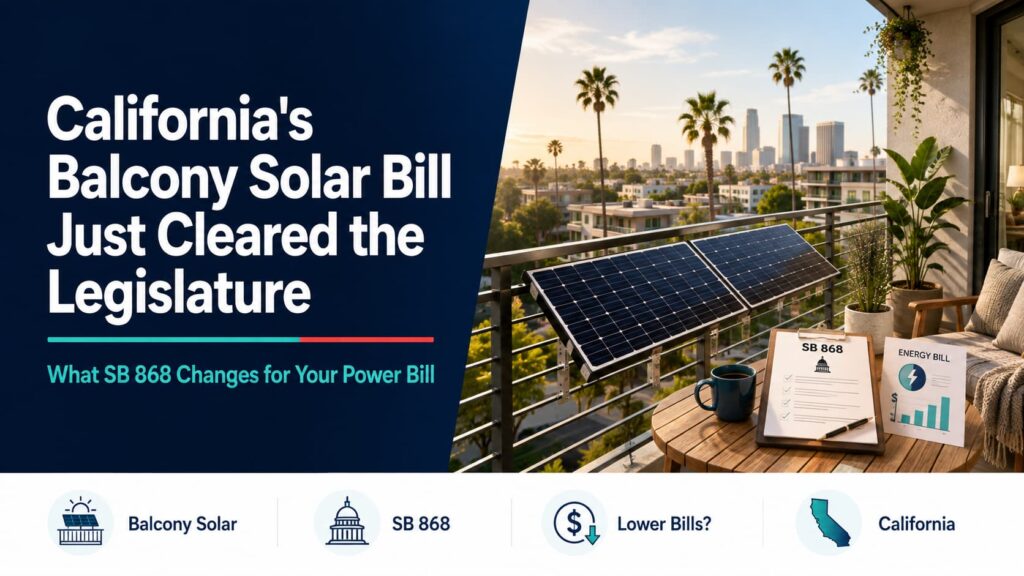
TL;DR: The California Assembly passed SB 868, the Plug and Play Solar Act, 73 to 0 on August 25, 2026. After a final Senate concurrence vote it goes to Governor Newsom, who has until September 30, 2026 to sign or veto. If it becomes law, homeowners and renters can plug a solar system of up to 1,200 watts AC into a standard outlet with no utility approval, no interconnection application, and no utility fees. A 1,200 W plug-in system in Los Angeles produces roughly 1,900 kWh a year on a tilted mount, and it only pays you back on the power you consume the moment it is made, because the bill creates no export compensation of its own.
Key takeaways
- SB 868 exempts plug-in solar devices up to 1,200 watts AC per dwelling from utility interconnection requirements through January 1, 2030.
- Utilities cannot charge you a fee or make you wait for approval. They can only ask you to fill out a simple online registration form.
- Devices must be certified as plug-in PV by UL or an equivalent testing lab, meet the National and California Electrical Codes, and stop backfeeding during an outage.
- The first UL 3700 microinverter in the US, the Hoymiles HiFlow Pro, launched in July 2026 at 360 W per unit. Product availability is the real bottleneck, not the law.
- Balcony solar is a bill trimmer, not a bill killer. A full rooftop system with a battery still covers 100% or more of a California home’s usage.
What is SB 868 and where does it stand right now?
SB 868 is the Plug and Play Solar Act, authored by Senator Scott Wiener. The Senate passed it 35 to 1 on May 19, 2026. It cleared the Assembly Utilities and Energy Committee 18 to 0 on June 10, passed Assembly Appropriations 11 to 0 in August, and the full Assembly approved it 73 to 0 on August 25, 2026.
One procedural step remains. Because the Assembly amended the bill on August 20, the Senate has to concur in those amendments before the bill is transmitted to the Governor. That vote is expected before the Legislature’s deadline.
The dates that matter, from the 2026 legislative calendar: the Legislature’s last day to pass bills is August 31, 2026, and the Governor’s last day to sign or veto bills in his possession on or after September 1 is September 30, 2026. If he signs, the exemption runs through January 1, 2030.
I have watched a lot of solar bills die in Appropriations. This one moved on near-unanimous votes in both houses, which is unusual for anything the investor-owned utilities push back on.
What does SB 868 actually let you do?
It lets you buy a small solar system, plug it into a standard 120 V outlet, and start offsetting your own usage without asking SCE, PG&E, or SDG&E for permission. Here is the line-by-line version, from the bill text on leginfo and the Assembly Utilities and Energy Committee analysis.
Table 1: What SB 868 does and does not change for California homeowners
| Item | Under SB 868 | Today, without the law |
|---|---|---|
| Utility interconnection application | Not required for qualifying devices | Required for any grid-tied solar |
| Utility fees for the device | Prohibited | Varies by utility |
| Utility approval before you plug in | Not required | Permission to Operate required |
| Registration | Utility may require a simple online form: address, make, model, size | Full application packet |
| Size cap | 1,200 W AC per dwelling | No plug-in pathway |
| Safety certification | Certified as plug-in PV by UL or an equivalent nationally recognized testing lab, National and California Electrical Codes, anti-backfeed during outages | UL 1741 equipment, licensed install |
| Export compensation | The bill creates none | Net billing credits under NEM 3.0 |
| Local building and fire permits | Unaffected. The bill binds utilities, not city building departments | Required |
| Sunset | Exemption runs through January 1, 2030 | n/a |
Source: SB 868 as amended August 20, 2026 and the bill history on California Legislative Information.
One provision almost nobody is reporting: starting January 1, 2030, it becomes illegal to sell a plug-in photovoltaic device in California that does not meet the bill’s definition. The bill is not just an exemption. It is a product standard with teeth. Both the 2030 sunset and the 2030 sales restriction were added in the August 20 amendments, not the earlier version, so ignore any summary written before that date.
Do you get paid for the extra power a balcony solar system makes?
In most cases, no. Assume the power you do not use in the moment is worth nothing to you, and treat anything better as a bonus.
Here is the mechanism. Grid-tied solar earns export credits because it is interconnected under the net billing tariff the CPUC adopted in December 2022, commonly called NEM 3.0. SB 868 works by taking plug-in devices out of the interconnection process, and the bill itself is silent on metering, credits, and compensation. If you are a renter or condo owner with no solar tariff on your account, there is no mechanism to pay you for exports.
The one exception, flagged in the Senate Energy, Utilities and Communications analysis, is a customer who already has a rooftop system on NEM or the net billing tariff. On that account, a plug-in device’s output shows up as reduced imports or increased exports on an existing bidirectional meter, so it can add to what the tariff already pays.
For everyone else this is the tradeoff that makes plug-and-play possible, and it is why a small battery in the kit matters more than an extra panel.
How much will a balcony solar system actually save in California?
Roughly $230 to $560 a year for a 1,200 W system in Southern California. The spread is that wide because two variables dominate: how you mount the panels and how much of the power you use in real time.
Here is the full calculation. Take a Los Angeles renter or condo owner on Southern California Edison using 750 kWh a month, a high-usage household. Per our average electric bill in California guide, that customer paid about $283 a month as of June 1, 2026, which works out to an all-in 37.7 cents per kWh. To stay conservative I model at 33 cents per kWh, close to the California residential average in mid-2026. EIA’s California profile put the state at 27.04 cents for full-year 2024, and rates have climbed every year since.
Step 1. Production. Los Angeles delivers roughly 1,600 kWh per kW of installed capacity per year in real-world conditions. That means:
| Mounting | Annual output, 1,200 W system |
|---|---|
| Tilted on a patio stand or angled rail bracket | ~1,900 kWh |
| Flat or near-horizontal | ~1,700 kWh |
| Vertical, flush against a balcony railing | ~1,150 kWh |
Step 2. Self-consumption. Without storage, a household typically uses 50% to 70% of midday production on site. Call it 60%. On the tilted mount, that is 1,140 kWh.
Step 3. Value. 1,140 kWh x $0.33 = $376 a year. The other 760 kWh is exported for nothing.
Step 4. With a small battery. Kits that bundle 1 to 2 kWh of storage push self-consumption toward 90%. 1,710 kWh x $0.33 = $564 a year.
Step 5. The railing case. Vertical against a rail at 60% self-consumption: 690 kWh x $0.33 = $228 a year. Tilt is worth more than an extra panel.
Step 6. Payback. At a kit price of $700 to $1,600, payback lands between roughly 2 and 6 years for most setups. There is no federal tax credit to apply here, which brings us to the next point.
For scale, the Environmental Working Group estimates a smaller 400 W balcony system offsets about 14% of a typical apartment’s electricity use and saves around $250 a year.
Does the federal solar tax credit apply to plug-in solar?
No. The Section 25D residential clean energy credit expired on December 31, 2025. Any 2026 pricing you see that still subtracts 30% is stale. That applies to rooftop systems and plug-in kits alike. Third-party ownership, meaning a lease or PPA, is the one remaining path where a federal credit still flows through on the commercial side, and we walk through that honestly in our California solar cost guide.
Can you actually buy a legal balcony solar system in California yet?
Barely, and that is the story behind the story. When the Assembly Utilities and Energy Committee analyzed SB 868 in June 2026, its finding was blunt: “no commercially available balcony solar system has achieved that certification to date; meaning, the law effectively freezes adoption of these kits until manufacturers respond to the newly created market and achieve UL safety certification.”
UL published UL 3700, the outline of investigation for interactive plug-in PV equipment, in mid-December 2025. The Hoymiles HiFlow Pro, announced July 15, 2026, is the first US microinverter the trade press has described as UL 3700 certified, at 360 W per unit. Hoymiles’ own release calls it UL 3700 compliant, and reaching the 1,200 W cap means running four units in parallel on separate outlets, not daisy-chained into one.
So the legal pathway is arriving months ahead of the shelf stock. If the Governor signs in September, expect a thin catalog through the end of 2026 and a real product wave in 2027. Be skeptical of any kit sold today that does not name UL 3700 on the spec sheet. The same committee analysis relayed UL’s finding that overload current from these systems “can pose a risk of fire or shock through damaged conductors, insulation, and/or equipment connected to the circuit,” which is exactly what the certification exists to control.
Balcony solar or rooftop solar: which one fits your home?
Balcony solar fits apartments, condos, and rentals where a roof install is not on the table. Rooftop solar with a battery fits anyone who owns their roof and wants the bill gone rather than trimmed.
Table 2: 1.2 kW plug-in system vs 7 kW rooftop system with battery, Los Angeles, SCE customer at 9,000 kWh per year
| 1.2 kW plug-in (SB 868) | 7 kW rooftop + 13.5 kWh battery | |
|---|---|---|
| Annual production | ~1,900 kWh tilted, ~1,150 kWh on a vertical rail | ~10,500 kWh |
| Share of a 9,000 kWh household | 13% to 21% | 100%+ |
| Upfront cost | $700 to $1,600 | $2.40 to $3.25 per watt, roughly $17,000 to $23,000 before storage |
| Federal tax credit | None (25D expired 12/31/2025) | None for cash purchase (25D expired) |
| Export credits | None created by the bill | Yes, under NEM 3.0 net billing |
| Backup power in an outage | No, anti-backfeed shuts it down | Yes, with battery |
| Utility interconnection | Exempt under SB 868 | Required |
| Local building permit | Unaffected by the bill, check your city | Required |
| Estimated annual savings | $228 to $564 | $2,400 to $3,000 |
| Takes it with you when you move | Yes | No |
Sources: SB 868 as amended August 20, 2026; NRG Clean Power California install pricing, cash price before incentives. See our solar battery cost breakdown and California payback period guide.
[CHART: horizontal bar chart, title “Annual kWh offset: plug-in vs rooftop solar for a 9,000 kWh California home”, x-axis kWh per year 0 to 12,000, y-axis four bars: “Household usage 9,000 kWh”, “1.2 kW plug-in, vertical rail 1,150 kWh”, “1.2 kW plug-in, tilted 1,900 kWh”, “7 kW rooftop system 10,500 kWh”, source: NRG Clean Power modeling at 1,600 kWh per kW per year for Los Angeles]
Takeaway: a maxed-out plug-in system covers about a fifth of what a high-usage California home burns in a year, while a standard rooftop array covers all of it and then some.
What SB 868 does not do
Read this part before you order anything.
- It does not override your landlord. A rental agreement that bars fixtures on the balcony still bars them.
- It does not override your HOA. California’s Solar Rights Act protections are written around roof-mounted systems, not plug-in devices on a shared-wall balcony.
- It does not waive local fire and building codes. City rules on balcony obstructions and egress still apply, and those vary between Los Angeles, San Diego, and San Jose.
- It does not give you backup power. Anti-backfeed protection is mandatory, so the system shuts down in an outage. If you want power when the grid goes down, you need a home battery.
- It does not apply to systems above 1,200 W AC per dwelling. Above that line, you are back in the normal interconnection and permitting process.
Frequently asked questions
Is balcony solar legal in California right now? Not yet in the plug-and-play sense. The Assembly passed SB 868 on August 25, 2026, a Senate concurrence vote sends it to the Governor, and he has until September 30, 2026 to sign or veto. Until it takes effect, plug-in solar connected to a utility-served building still falls under normal interconnection rules.
How big can a plug-in solar system be under SB 868? 1,200 watts of aggregated AC output per dwelling unit, connected and disconnected through a standard receptacle, certified as plug-in PV by UL or an equivalent nationally recognized testing laboratory, with a feature that isolates it from the building during an outage.
Will my utility charge me for a balcony solar system? No. SB 868 prohibits utilities from imposing fees or charges tied to the device or the electricity it feeds into your building. They can require a simple online registration listing address, make, model, and size, but they cannot require approval.
Do I get bill credits for extra power? Usually not. SB 868 creates no compensation mechanism, and a device exempt from interconnection is not placed on the net billing tariff. If you have no solar tariff on your account, assume only the power you consume while it is being produced saves you money, which is why kits with a small battery deliver noticeably better returns. The exception is a home that already has interconnected rooftop solar, where the extra output registers on the existing bidirectional meter.
Does balcony solar work during a power outage? No. The bill requires anti-backfeed protection, so the device stops producing when the grid goes down. Outage protection requires a properly interconnected battery system.
Is balcony solar worth it if I own my home? If you own your roof, the math is not close. A 7 kW rooftop system offsets roughly five to nine times the energy of a plug-in kit and earns export credits the kit does not. Balcony solar earns its place for renters, condo owners with no roof rights, and homeowners with heavy shading.
Where NRG lands on this
We install rooftop solar and batteries, so treat this as a biased source and check the math yourself. We also think SB 868 is good policy. About 44% of California households are renters, versus 35% in the rest of the country, according to Census data compiled by PPIC, and until now, none of them had a legal path to producing their own power. A $376-a-year bill cut is real money for a household paying $283 a month to SCE.
But do not let a balcony kit talk you out of the bigger decision if you own your roof. In Los Angeles and across our service territory, the homeowners who actually stop paying SCE and PG&E are the ones with a properly sized array and storage, not four panels on a railing.
If you want to see what a full system costs on your specific roof and rate plan, get a quote in 2 minutes or book a virtual consultation. No door knock, no pressure.