
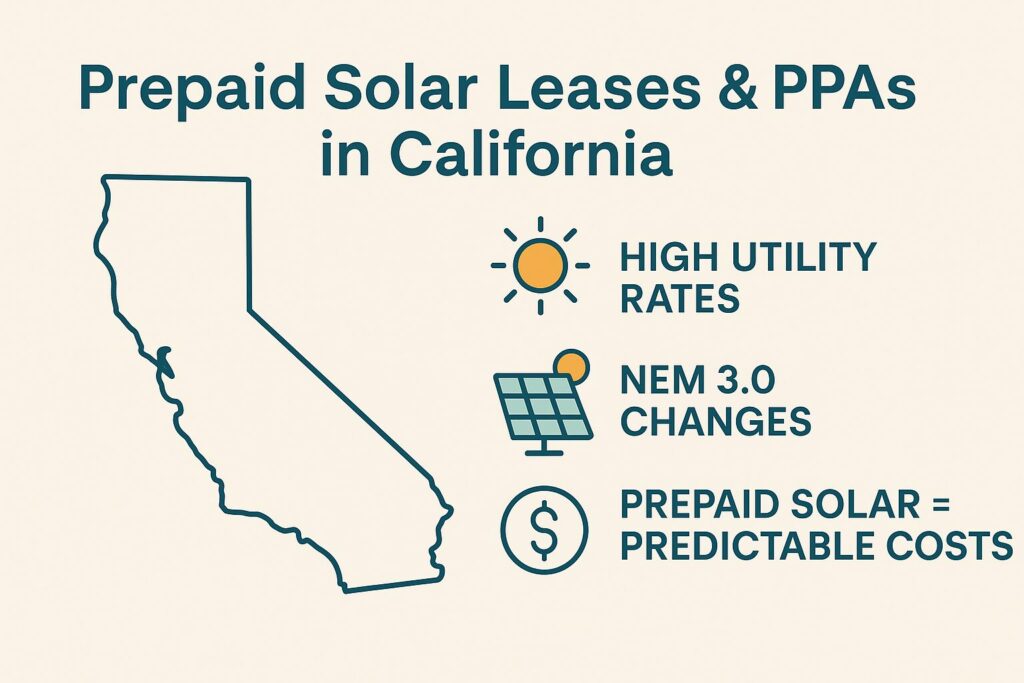
California homeowners face some of the highest electricity rates in the United States. Residents served by PG and E, SCE, and SDG and E often pay more than 35 to 45 cents per kilowatt hour once delivery fees and taxes are included. These increases are outpacing inflation and creating long-term financial pressure for households trying to manage monthly bills.
At the same time, NEM 3.0 has changed how rooftop solar works in the state. Under the new policy, excess solar energy sent back to the grid earns far lower credits than under NEM 2.0. This reduces the value of exporting electricity and makes self-consumption and predictable energy costs much more important.
Because of this, many homeowners do not want large solar loans or twenty-five-year leases with escalators. Prepaid solar leases and prepaid PPAs have emerged as a different option that reduces long-term payments and uses third-party tax incentives to lower the overall system cost.
What Is a Prepaid Solar Lease or PPA?
A prepaid solar lease or prepaid solar PPA is a financing structure where a third party owns the solar system during the initial term, usually around six years, and the homeowner pays most of the system’s value upfront. The third party claims the federal solar tax credit and often depreciation benefits. These incentives help reduce the effective cost of the system.
Prepaid Solar Lease
The homeowner pre pays for the right to use the solar equipment. The third party owns the system and handles installation, monitoring, and maintenance. After the required hold period, ownership usually transfers to the homeowner.
Prepaid Solar PPA
Instead of paying for the equipment, the homeowner pre pays for the expected energy production of the system. The third party still owns and maintains it during the term.
Key Characteristics
- A third party owns the system initially.
- The homeowner makes a large upfront payment.
- The third party claims the tax credit.
- Maintenance is included during the initial term.
- Ownership generally transfers after about six years.
Homeowners comparing different structures may also want to review this guide on Solar Lease vs PPA:
https://nrgcleanpower.com/learning-center/solar-lease-vs-ppa/
How Prepaid Solar Leases and PPAs Work Step by Step
- System design
The provider designs a solar system tailored to the home’s usage, roof layout, and shading. - Third party ownership
A financing partner or investor agrees to own and operate the system for the first several years. - Prepayment by homeowner
The homeowner pays a large upfront amount, often similar to about seventy percent of the system cost. This may be financed through a loan or paid in cash. - Tax incentives captured by the investor
The third party claims the federal tax credit and depreciation benefits. These savings help reduce the overall cost of the prepaid agreement. - Maintenance and monitoring
The provider maintains and repairs the system throughout the initial term. The homeowner benefits from solar electricity with little or no monthly solar payment. - Ownership transfer
Once the tax hold period ends, usually after six years, ownership transfers to the homeowner or another defined option becomes available.
Prepaid Lease vs Prepaid PPA vs Traditional Options
Comparison Table
| Option | Upfront Cost | Monthly Payments | Initial Owner | Tax Benefits | Maintenance | End of Term Ownership |
|---|---|---|---|---|---|---|
| Traditional Lease | Low to moderate | Yes | Third party | Third party | Included | Buyout or remove system |
| Standard PPA | Low | Yes | Third party | Third party | Included | Buyout option |
| Solar Loan | Low to high | Yes | Homeowner | Homeowner | Homeowner | Homeowner |
| Cash Purchase | High | None | Homeowner | Homeowner | Homeowner | Homeowner |
| Prepaid Lease | High | None | Third party | Third party | Included | Ownership transfer |
| Prepaid PPA | High | None | Third party | Third party | Included | Ownership transfer |
California Specific Cost Comparison
| Option | Typical 25 Year Cost | Cost Predictability | Notes |
|---|---|---|---|
| Cash Purchase | Lowest | Very high | Best for homeowners with strong tax appetite |
| Solar Loan | Moderate | High | APR and term affect total cost |
| Prepaid Lease | Moderate | Very high | No monthly solar payment |
| Prepaid PPA | Moderate | Very high | Includes production guarantees |
| Standard PPA | Higher | Moderate | Payments usually escalate |
For California pricing context, see:
https://nrgcleanpower.com/learning-center/how-much-do-solar-panels-cost-in-california/
Pros and Cons of Prepaid Solar for Homeowners
Pros
- Lower effective system cost because the third party monetizes tax incentives.
- No monthly solar bill after the prepaid amount is made.
- Third party maintenance and monitoring during the initial term.
- Clearer home sale process once ownership transfers.
- Strong protection from rising utility rates.
Cons
- Larger upfront cost compared with a zero down lease or PPA.
- Limited equipment selection based on provider requirements.
- More complex contract structure.
- Potential questions from lenders unless explained clearly.
Special California Factors: High Rates, NEM 3.0, and Policy
California’s steep electricity rates make long term cost stability very valuable. With utility rates increasing nearly every year, locking in the cost of solar provides predictable energy expenses for decades.
NEM 3.0 reduces the financial value of exporting solar energy. Homeowners benefit more when they consume their own solar power or use a structure like prepaid solar that offers predictable pricing regardless of export credit levels.
To understand long term savings, use our California Solar ROI Calculator:
https://nrgcleanpower.com/learning-center/solar-roi-calculator/
Key Risks and Questions to Ask Before Signing
A prepaid agreement can be an excellent fit, but homeowners should review the details carefully. Key questions include:
- What is the full contract length and what happens after the initial term?
- When and how does ownership transfer?
- Are there production guarantees or minimum output levels?
- Are there any escalators or hidden fees?
- What is included and excluded in maintenance?
- What happens if the provider or investor goes out of business?
- Does my lender or HELOC explicitly approve the prepaid structure?
- What happens if I sell my home during the term?
Where HDM’s Prepaid Solar PPA Fits In
HDM offers a prepaid solar PPA designed specifically for California homeowners who want predictable long term savings with no monthly solar bill. The structure uses a single upfront or financed payment, includes full maintenance during the initial term, and provides a clear ownership transfer option after the hold period.
To see how this model compares with traditional financing, read HDM’s Prepaid Solar PPA vs Traditional Solar Leases for California homeowners:
[INSERT HDM ARTICLE URL HERE]
Who Is and Is Not a Good Fit
Good Fit
- Homeowners planning to stay in their home at least six to ten years.
- Households that cannot fully use the solar tax credit themselves.
- Anyone who prefers predictable, fixed solar costs with no monthly payment.
- Homeowners who like a maintenance included model.
Not Ideal
- People expecting to move within a few years.
- Homeowners who want full ownership and control from day one.
- Households with strong tax liability that can use the full credit.
Prepaid vs Loan Solar Cost Calculator
Prepaid vs Loan Solar Cost Calculator
Break-Even Estimates for a Typical California Home
| Scenario | Total 25 Year Cost | Cost per kWh | Break Even vs Utility | Notes |
|---|---|---|---|---|
| Utility Only | $90,000 | 40 cents | Baseline | Based on 9,000 kWh per year |
| Solar Loan | $36,000 to $45,000 | 16 to 20 cents | Year 6 to 8 | Depends on APR and term |
| Prepaid Solar | ~$28,000 | 12 to 14 cents | Year 4 to 5 | No monthly solar bill |
| Cash Purchase | $20,000 to $24,000 | 9 to 12 cents | Year 3 to 4 | Break-Even vs Utility |
Frequently Asked Questions About Prepaid Solar
Is a prepaid solar lease or PPA legal in California?
Yes. These structures are commonly used in residential solar. What matters is that the homeowner fully understands the contract terms and transfer provisions.
Can I add a battery to a prepaid system?
In many cases yes. Some providers include batteries in the prepaid agreement, while others require a separate purchase or financing structure.
What happens if my system underperforms?
Most prepaid PPAs include performance guarantees. If production is lower than expected, the provider may provide compensation or corrective action.
What if I sell my home during the prepaid term?
Buyers can typically assume the agreement or ownership may transfer early. The exact process depends on the contract.
How is prepaid different from buying a system with cash?
A cash purchase gives immediate ownership and full tax incentives. Prepaid shifts incentives to a third party, creating a lower effective cost for homeowners without strong tax appetite.