
Knowing what a “normal” monthly electricity usage looks like helps you:
- Spot unusually high bills
- Choose the right utility rate plan
- Size solar panels and batteries correctly
- Track the impact of new appliances, EV charging, or HVAC upgrades
This guide is a research-backed, homeowner-friendly breakdown of average kWh per month, what changes your usage, and how to estimate your own “normal.”
Quick note: “Normal” depends on climate, home size, heating fuel, and how many people live in the home. Use the benchmarks below as a starting point, then compare to your own bills.
What does kWh per month mean?
A kilowatt-hour (kWh) is a unit of energy. It measures how much electricity you use over time.
- 1 kWh = using 1,000 watts for 1 hour
- Examples:
- A 1,500W space heater running for 2 hours uses about 3 kWh
- A refrigerator might use 1–3 kWh/day depending on size, age, and efficiency
Quick conversion: kWh per day to kWh per month
If you already track daily usage, monthly kWh is roughly:
- kWh/day × 30 = kWh/month
So:
- 10 kWh/day ≈ 300 kWh/month
- 20 kWh/day ≈ 600 kWh/month
- 30 kWh/day ≈ 900 kWh/month
Related reading: How many kWh per day is normal?
https://nrgcleanpower.com/learning-center/how-many-kwh-per-day-is-normal/
What is the average monthly consumption in kWh for a house?
There’s no single “normal,” but most U.S. households fall within a broad band.
Typical monthly electricity usage ranges
For many homes, a reasonable starting point is:
- Small apartment / efficient home: 300–600 kWh/month
- Average home: 600–1,000 kWh/month
- Large home / high A/C use / EV charging: 1,000–2,000+ kWh/month
The fastest way to identify your baseline is to look at your last 12 months of bills and find:
- Your average monthly kWh
- Your highest-use month (often summer)
- Your lowest-use month (often spring/fall)
What’s average monthly kWh usage in the U.S.?
EIA benchmark (U.S. average)
EIA data typically shows average U.S. residential electricity consumption around 10,000–11,000 kWh per year, which is about:
- 830–920 kWh per month on average
This is a national average. Hot climates, electric heating, and bigger homes often exceed it.
What’s normal monthly kWh usage in California?
California typically has lower electricity usage than many states because:
- Coastal climates reduce heating/cooling needs
- Many homes use natural gas for space and water heating
- Energy efficiency standards are relatively strict
But California households often pay more per kWh, so even moderate usage can mean a high bill.
Related reading:
- Average electric bill in California
https://nrgcleanpower.com/learning-center/average-electric-bill-in-california/
What affects “normal” kWh per month?
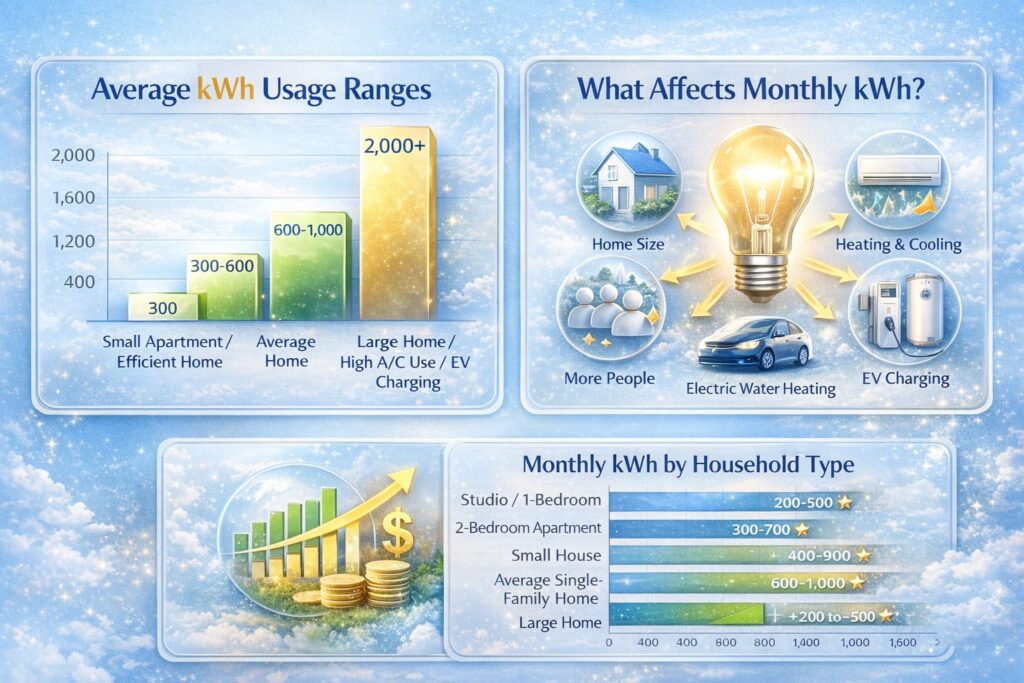
Your monthly kWh depends more on lifestyle and equipment than people realize. Here are the biggest drivers.
1) Home size
As a rough guide, bigger homes tend to use more electricity, especially for cooling.
- 600–1,000 sq ft: often 300–700 kWh/month
- 1,000–2,000 sq ft: often 600–1,200 kWh/month
- 2,000+ sq ft: often 1,000–2,000+ kWh/month
These are directional ranges. HVAC type and climate matter more than square footage alone.
2) Heating and cooling (HVAC)
HVAC is often the #1 electricity load.
- Central A/C can add hundreds of kWh per month in summer
- Heat pumps can increase winter usage (but may lower total energy costs vs resistance heating)
- Space heaters can spike monthly kWh fast
3) Number of people in the household
More people typically means:
- More laundry
- More cooking
- More showers and hot water use (if electric)
- More electronics
4) Electric water heating
If your water heater is electric, expect higher baseline usage.
- Traditional tank water heaters: often a larger monthly draw
- Heat pump water heaters: much more efficient
5) EV charging
EVs can significantly change what “normal” looks like.
As a rough estimate:
- 1,000 miles/month at ~0.30 kWh/mile ≈ 300 kWh/month
So adding an EV can increase a home’s electricity use by 200–500+ kWh/month depending on driving and efficiency.
What does your monthly kWh say about your bill?
Your bill is driven by:
- kWh usage
- your rate plan (tiered or time-of-use)
- peak vs off-peak behavior
- fixed charges and delivery fees
Quick bill estimate
Use:
- Monthly cost ≈ kWh/month × your blended $/kWh
Example:
- 800 kWh/month × $0.35/kWh ≈ $280/month
If you’re in California, price per kWh can vary a lot by utility and season.
Related reading:
- PG&E rate increase
https://nrgcleanpower.com/learning-center/pge-rate-increase/ - Preparing for LADWP utility rate increase
https://nrgcleanpower.com/learning-center/preparing-for-ladwp-utility-rate-increase/
What’s a “high” kWh per month?
Many households consider usage “high” when it’s consistently above:
- 1,200–1,500 kWh/month without an obvious reason
Common causes:
- Heavy A/C use or poor insulation
- Electric resistance heating
- Old refrigerator/freezer or multiple fridges
- Pool pump running long hours
- EV charging plus high daytime peak usage
- Hidden loads (dehumidifiers, server equipment, old well pumps)
Quick self-check
If your kWh spikes suddenly, look for:
- A new appliance or HVAC change
- A schedule change (more people at home)
- A seasonal shift (heat wave)
- A rate plan change (TOU moving usage into peak hours)
How to find your “normal” kWh per month (fast)
Do this in 10 minutes:
- Pull your last 12 electric bills (utility portal or paper statements)
- Write down kWh used each month
- Identify:
- Average month
- Highest month
- Lowest month
- Note major drivers:
- Summer A/C months
- Winter heating months
- EV charging start date
Create your baseline range
A practical personal definition of “normal” is:
- Your average monthly kWh ± 20%
So if you average 750 kWh/month, a normal band might be:
- 600–900 kWh/month
Monthly kWh by household type
| Household type | Typical kWh/month range | Notes |
|---|---|---|
| Studio / 1-bedroom | 200–500 | Often no central A/C |
| 2-bedroom apartment | 300–700 | Wide range depending on A/C |
| Small house | 400–900 | Climate and heating type matter |
| Average single-family home | 600–1,000 | Common national baseline |
| Large home | 1,000–2,000+ | Especially with A/C |
| Home + EV | +200 to +500 | Adds to your baseline |
FAQs: Normal kWh per month
Is 500 kWh per month normal?
Yes, it can be normal for:
- Apartments
- Smaller homes
- Mild climates
- Homes with gas heating and water heating
Is 1,000 kWh per month normal?
Yes, it’s within a common range for:
- Average U.S. households
- Homes with air conditioning
- Larger households
Is 2,000 kWh per month normal?
It can be, especially if you have:
- Large square footage
- High A/C use
- Electric heating
- EV charging
- Pool pump
If 2,000 kWh/month is new for you, it’s worth checking for HVAC issues or schedule changes.
Solar sizing from your monthly kWh
If you’re exploring solar, your monthly kWh usage is the fastest way to estimate how large your solar system needs to be.
Step 1: Convert monthly kWh to annual kWh
Most solar proposals and production estimates are expressed annually.
- Annual kWh ≈ (Your monthly kWh) × 12
Example:
- 800 kWh/month × 12 = 9,600 kWh/year
Step 2: Use a simple “system size” estimate
A practical homeowner shortcut is:
- Solar system size (kW) ≈ Annual kWh ÷ 1,400 (good starting point for many CA homes)
Why 1,400? In many parts of California, 1 kW of solar can produce roughly 1,300–1,700 kWh per year depending on roof direction, shading, tilt, and location.
Quick examples (California rough sizing)
| Monthly usage (kWh) | Annual usage (kWh) | Estimated solar size (kW) | Approx panels (400W each) |
|---|---|---|---|
| 600 | 7,200 | ~5.1 kW | ~13 panels |
| 800 | 9,600 | ~6.9 kW | ~18 panels |
| 1,000 | 12,000 | ~8.6 kW | ~22 panels |
| 1,500 | 18,000 | ~12.9 kW | ~33 panels |
These are rough estimates. A precise design depends on your roof, shading, azimuth, and your utility rate plan.
Step 3: Choose your target “offset” (50%, 80%, or 100%)
Not everyone needs 100% offset. Many homeowners choose:
- 50–70% offset to reduce peak costs without major electrical upgrades
- 80–90% offset to balance savings and system cost
- 100%+ offset if you expect load growth (EV, heat pump, ADU)
To adjust your size:
- Adjusted size = Estimated size × Target offset
Example:
- 6.9 kW estimate × 80% = 5.5 kW target
Step 4: Understand why TOU rates matter
In much of California, your savings depend on when you use energy, not just how much.
- If most usage happens during late afternoon/evening peak, solar-only may not offset your highest-priced hours.
- A battery can shift solar energy into peak hours (varies by utility and rate plan).
Use these internal links naturally in this section:
- https://nrgcleanpower.com/learning-center/how-many-kwh-per-day-is-normal/
- https://nrgcleanpower.com/learning-center/average-electric-bill-in-california/
- https://nrgcleanpower.com/learning-center/pge-rate-increase/
- https://nrgcleanpower.com/learning-center/preparing-for-ladwp-utility-rate-increase/
Step 5: Account for “load growth” (future usage)
If any of these are planned in the next 12–24 months, your “normal” monthly kWh may rise:
- Adding an EV (often +200 to +500 kWh/month)
- Switching to a heat pump for heating/cooling
- Adding a heat pump water heater
- Building an ADU or finishing a garage
Pro tip: If you expect load growth, size solar for your future usage, not last year’s.
FAQs: How Many kWh per Month Is Normal?
How many kWh per month is normal for a 1-bedroom apartment?
Many 1-bedroom apartments fall around 200–500 kWh per month, but air conditioning, electric water heating, and laundry frequency can push that higher.
How many kWh per month is normal for a house?
A common range for many single-family homes is 600–1,000 kWh per month. Larger homes, hot climates, or heavy A/C use can exceed 1,200+ kWh per month.
Is 500 kWh per month normal?
Yes. 500 kWh per month can be normal for smaller homes, apartments, mild climates, and homes with gas heating and gas water heating.
Is 1,000 kWh per month normal?
Yes. Around 1,000 kWh per month is within a typical range for many U.S. households, especially if you run air conditioning seasonally or have multiple occupants.
Is 2,000 kWh per month normal?
It can be, especially for large homes, strong A/C demand, electric resistance heating, pool pumps, or EV charging. If 2,000 kWh per month is new, check for HVAC issues or behavior changes.
What is a “high” kWh per month?
Many homeowners consider usage consistently above 1,200–1,500 kWh per month to be high without a clear reason. A/C, insulation gaps, electric heating, pool pumps, and older appliances are common causes.
How do I calculate my “normal” monthly kWh?
Review your last 12 bills, list each month’s kWh, then take your average. A practical normal range is your average ± 20% to account for seasonal swings.
How do I convert kWh per day to kWh per month?
Multiply your daily kWh by 30. For example, 20 kWh per day is roughly 600 kWh per month.
How many kWh per month does an EV add?
Many EVs add roughly 200–500+ kWh per month depending on miles driven and efficiency. A common shortcut is miles per month × 0.30 kWh per mile.
How many solar panels do I need based on monthly kWh?
A rough approach is to convert monthly kWh to annual kWh (× 12), then estimate system size. In many parts of California, 1 kW of solar can produce roughly 1,300–1,700 kWh per year, depending on roof orientation and shading.