
PG&E customers have seen major bill changes since 2023, and 2026 brings another big shift.
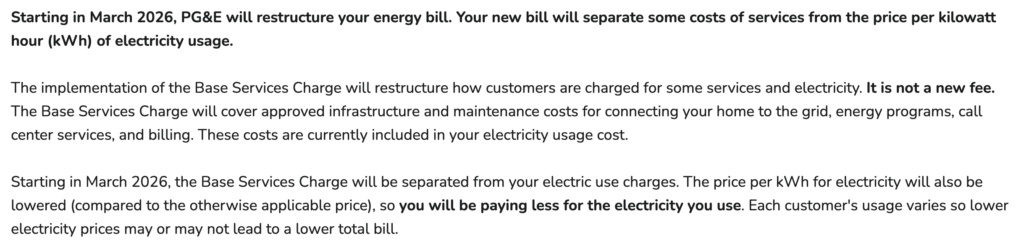
The key story for 2026 is not just a single price hike. It is a bill redesign that adds a new fixed monthly charge called the Base Services Charge starting March 2026, while lowering the per kWh electricity price by an estimated $0.05 to $0.07 per kWh on average.
This guide explains what is changing, includes real reference numbers from 2024 and 2025, and shows how to reduce your exposure to ongoing rate volatility.
Quick takeaways
- PG&E is implementing a new Base Services Charge starting March 2026.
- Typical Base Services Charge levels:
- Most customers: about $24 per month
- CARE customers: about $6 per month
- FERA customers: about $12 per month
- Regulators indicate the change is paired with a reduction of roughly $0.05 to $0.07 per kWh in the usage rate (average residential impact).
- Your bill impact depends heavily on monthly usage.
- Lower usage customers may see the fixed charge more clearly.
- Medium and higher usage customers can offset more of the fixed charge through the lower per kWh rate.
What happened before 2026 (numbers from 2024 and 2025)
Homeowners often ask for concrete reference points. Here are the most widely cited PG&E bill impact figures from the last two years.
January 1, 2024: major bill impact (PG&E published estimates)
| Customer type | Avg bill before | Avg bill after | Change | Percent |
|---|---|---|---|---|
| Residential electric (non CARE) | $190.84 | $222.36 | +$31.52 | +16.5% |
| Residential electric (CARE) | $121.87 | $141.35 | +$19.47 | +16.0% |
2024 to 2025: smaller adjustments and bill relief periods (PG&E updates)
| Date | PG&E described change | What it means |
|---|---|---|
| July 2024 | Bill decrease (reported as about 9.4% for typical residential electric) | Some customers saw a meaningful drop compared to earlier 2024 levels |
| January 2025 | Small decrease (reported as about 0.4%) | Minor bill relief at the start of 2025 |
| March 1, 2025 | Residential electric rate increase (reported as about 1.5%) | A modest increase compared to the rates in effect at the time |
These updates show why customer bills can feel unpredictable. Multiple items on the bill can change at different times, and the bill can move even if usage is stable.
What is changing in 2026?
At the same time, the per kWh usage rate is expected to drop. The intent is to shift a portion of costs away from the usage price and into a fixed monthly structure:
PG&E Base Services Charge (starting March 2026)
| Customer category | Estimated Base Services Charge |
|---|---|
| Most residential customers | About $24 per month |
| CARE customers | About $6 per month |
| FERA customers | About $12 per month |
Expected per kWh reduction
Regulator summaries commonly describe an average residential usage rate reduction of about $0.05 to $0.07 per kWh.
Important: the exact impact depends on your rate plan and how you use electricity across the day (time of use periods).
Will my PG&E bill go up in 2026?
It depends on your monthly usage.
A simple way to think about it:
- The Base Services Charge adds a fixed amount.
- The lower per kWh rate reduces the bill based on how much electricity you use.
Break even estimate table
This table shows roughly how many kWh per month it takes for the usage rate reduction to offset a $24 monthly fixed charge.
| If the usage rate drops by | Break even monthly usage (approx) | How to read it |
|---|---|---|
| $0.05 per kWh | 480 kWh per month | 480 x $0.05 = $24 |
| $0.06 per kWh | 400 kWh per month | 400 x $0.06 = $24 |
| $0.07 per kWh | 343 kWh per month | 343 x $0.07 = $24 |
If your monthly usage is well below these break even levels, the fixed charge can represent a larger share of your bill. If your usage is above these levels, the lower per kWh price can offset more of the fixed amount.
This is a simplified illustration and not a billing quote.
Why PG&E rates and bills change so often
Most people think there is one single rate. In reality, your bill includes multiple cost components that can be updated on different schedules.
Common drivers discussed in California utility proceedings include:
- Wildfire mitigation and grid hardening work
- Transmission and distribution infrastructure upgrades
- Public purpose programs and other non energy charges
- Procurement and market costs for energy supply
Different drivers and regulatory updates can show up as separate changes over the year.
What to do now to lower your PG&E bill in 2026
Even if you cannot control PG&E pricing, you can control how exposed your household is to high on peak rates and volatility.
1) Make sure your rate plan matches your lifestyle
- If you can shift usage to off peak hours, you may reduce costs.
- If most of your usage happens late afternoon and evening, you may be paying the highest prices.
2) Focus on the biggest loads first
The fastest way to reduce kWh is usually targeting the loads that dominate usage:
- Heating and cooling (HVAC)
- Electric water heating
- EV charging
- Pool pumps and hot tubs
- Older refrigerators or freezers (especially second units in garages)
3) Use real load shifting tactics
- Charge EVs during off peak windows
- Run laundry and dishwashers off peak
- Pre cool the home before peak hours
- Use smart thermostats and schedules
4) Check eligibility for CARE or FERA
If you qualify, these programs can reduce bills and align with a lower Base Services Charge level in 2026.
5) Solar and batteries: what changed after NEM 3.0
If you are considering solar in PG&E territory, the current export credit structure means the best value often comes from:
- Using more solar energy at home (self consumption)
- Adding battery storage to shift solar energy into the evening
- Right sizing the system to your usage pattern instead of oversizing for exports
FAQ: PG&E rate increase 2026
When does the Base Services Charge start?
PG&E states the Base Services Charge begins March 2026.
Is this a new fee?
PG&E describes it as a restructuring of charges: more costs are moved into a fixed monthly line item, and the per kWh usage rate is lowered.
Will everyone pay the same fixed charge?
No. The fixed charge differs for CARE and FERA customers.
Why is my bill high even when my usage is not?
Electric bills include multiple charges beyond kWh usage, and some components can rise even if your household consumption stays similar.
Bottom line
PG&E’s 2026 change is a major shift in how residential bills are structured. Starting in March 2026, most customers will see a new Base Services Charge (about $24 per month), paired with lower per kWh usage prices.
The smartest move for most households is to reduce peak hour usage, optimize EV and appliance schedules, and consider efficiency upgrades and solar designs that prioritize self consumption.