
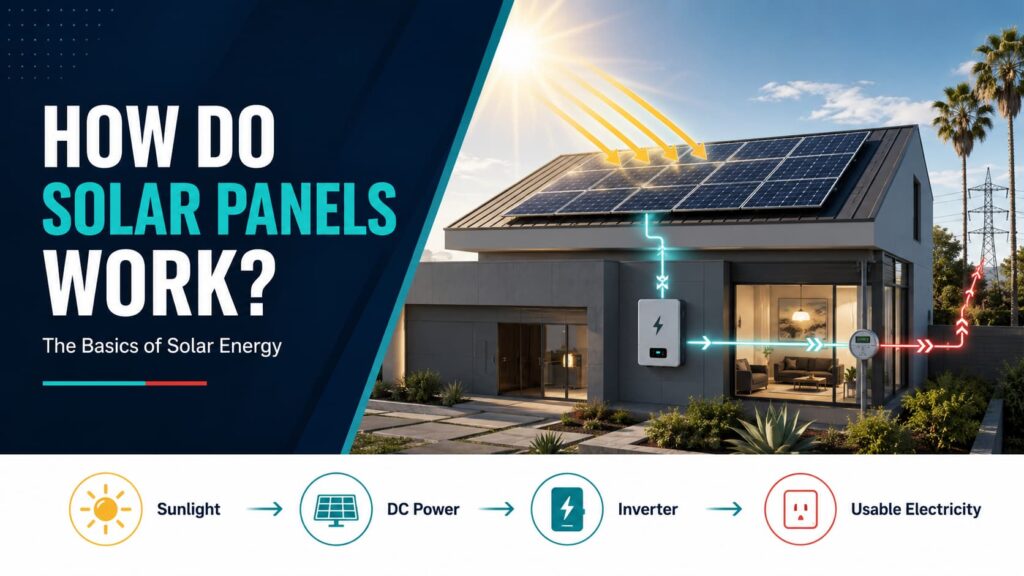
Here is what surprises most California homeowners on install day: the physics is the boring part. Panels have no moving parts, nothing to service, and the way they make electricity has not fundamentally changed in 50 years. What has changed is everything after the panel. Under NEM 3.0, when your system makes a kilowatt-hour now matters more than how many it makes, and that changes how we design systems in 2026. I will explain how the hardware works in plain English, then the part that actually determines your savings.
Quick answer: Solar panels are made of silicon cells that release electrons when sunlight hits them, producing DC electricity. An inverter converts it to the AC power your home uses. Your home consumes that power first; any surplus exports to the grid, where your utility credits it at NEM 3.0 export rates averaging roughly 5 to 8 cents per kWh, far below the 33.7 to 45.7 cents per kWh you pay PG&E, SCE, or SDG&E for grid power in 2026. That gap is why modern California systems are designed for self-consumption, usually with a battery.
Key takeaways
- Sunlight in, DC out, inverter converts to AC, your home uses it first. No moving parts, 25-year warranties are standard.
- A well-placed 1 kW of panels produces roughly 1,500 to 1,700 kWh per year in most of California. A 7.2 kW system in Fresno makes about 11,900 kWh annually.
- Panels work on cloudy days at 10% to 25% of full output. Heat is the bigger enemy: output drops about 0.3% per degree Celsius above 25°C panel temperature.
- Under NEM 3.0, a kWh you use yourself is worth retail rate (33.7 cents PG&E average). A kWh you export is worth roughly 5 to 8 cents. Batteries exist to move your solar into the 4 p.m. to 9 p.m. window.
- Solar panels alone do not power your home in a blackout. That requires a battery or special inverter.
How do solar panels turn sunlight into electricity?
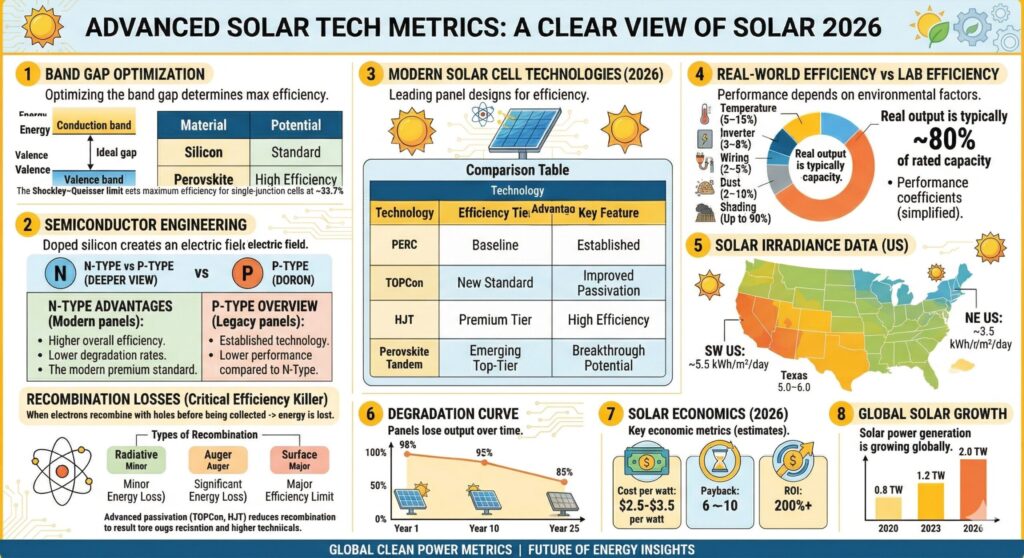
Sunlight knocks electrons loose inside silicon, and the cell’s design forces them to flow in one direction, which is an electric current. That is the photovoltaic effect, discovered in 1839 and unchanged since. Each panel wires about 108 half-cut cells together; today’s residential panels produce 400 to 470 watts each at 21% to 23% efficiency, meaning they convert about a fifth of the sunlight hitting them into electricity.
The panels on your roof produce direct current (DC). Your home runs on alternating current (AC), so every system includes an inverter to convert it. In our California installs this is either microinverters (one per panel, better for complex or partially shaded roofs) or a string inverter with optimizers. The inverter is the component that actually wears out: panels carry 25-year warranties, inverters 10 to 25 years depending on type.
What happens to the electricity your panels produce?
It follows a strict order, and this order is the whole economics of solar in California:
- Your home uses it first. Every kWh your AC, pool pump, or EV charger draws while the sun is up comes straight from the roof. That kWh replaces one you would have bought at retail: 33.7 cents average on PG&E, 34.5 cents on SCE, 45.7 cents on SDG&E as of March 2026, per the CPUC Public Advocates Office Q1 2026 rates report.
- A battery charges next, if you have one. It stores midday surplus for the 4 p.m. to 9 p.m. peak window when grid power is most expensive.
- The rest exports to the grid. Under the CPUC’s NEM 3.0 billing structure, exports are credited at the avoided-cost rate, which averages roughly 5 to 8 cents per kWh across most hours (CPUC net billing decision).
What one kWh of solar is worth in California, 2026
| Where the kWh goes | Value on PG&E | Value on SDG&E |
|---|---|---|
| Used in your home at time of production | 33.7c avg | 45.7c avg |
| Stored in a battery, used 4 to 9 p.m. | 40c to 60c (peak TOU) | 50c+ (peak TOU) |
| Exported to the grid | ~5c to 8c typical | ~5c to 8c typical |
Rates: CPUC Public Advocates Office, March 2026; export values: NEM 3.0 avoided-cost schedule, varies by hour and month. This table is why system design changed after April 2023.
Read that table twice. Under the old NEM 2.0 rules, exporting was nearly as good as using. Now a stored kWh discharged at peak is worth up to ten times an exported one. This is why we size systems to your actual hourly usage, not just your annual kWh, and why most of our 2026 installs include storage. See our solar battery cost guide for what that adds.
How much electricity do solar panels produce in California?
Plan on roughly 1,500 to 1,700 kWh per year for every kW of panels, south or southwest facing, in most of the state. Fresno and the Central Valley sit at the top of that range, coastal fog belts at the bottom. Concretely: a 7.2 kW system produces about 11,900 kWh per year in Fresno and about 10,800 in San Jose. The average California home uses around 6,500 to 7,500 kWh per year, but homes with AC and an EV routinely use double that; check yours against our how many kWh per day is normal benchmarks.
[CHART: bar chart, “Monthly output of a 7.2 kW system in Fresno, CA”, x-axis: month, y-axis: kWh, single series peaking around 1,350 kWh in June-July and bottoming near 600 kWh in December-January, source: PVWatts-modeled production for Fresno at 1,650 kWh/kW-yr. Alt text: monthly solar production curve for a 7.2 kW system in Fresno California.] Takeaway: a Fresno system produces about twice as much in June as in December, which is also when PG&E air-conditioning bills peak, so production and need line up well in the Central Valley.
Three things move these numbers:
- Heat, more than clouds. Panels are rated at 25°C (77°F) cell temperature. Output falls roughly 0.3% per degree above that, and a rooftop panel on a 105°F Fresno afternoon can run 60°C+, giving up 8% to 10% of its rating. This is why panel choice matters in the Central Valley and why we spec low temperature-coefficient models there.
- Clouds and fog. Output drops to 10% to 25% of rating under heavy overcast. Annual totals already account for this.
- Age. Quality panels degrade 0.25% to 0.5% per year and are warrantied to produce about 88% to 92% of original output at year 25. Panel efficiency details are in our solar panel efficiency guide.
Do solar panels work at night or during a blackout?
At night, no; production is zero, and your home draws from your battery or the grid. During a blackout, also no, unless you have storage or a special inverter. Standard grid-tied inverters shut down automatically when the grid fails, a UL safety requirement that protects line workers. A battery with backup capability (or an inverter with islanding) is what keeps your refrigerator and Wi-Fi on during a PSPS shutoff. If outage protection is your main goal, that is a design conversation, not a panel conversation: see our home battery backup options.
How does this translate to your bill?
A worked example, the same one we use in our financing guide. Fresno home on PG&E E-TOU-C, 750 kWh per month, $255 average bill. A 7.2 kW system produces about 11,900 kWh per year against roughly 9,000 kWh of usage. Because usage and production do not happen at the same hours, the system offsets about 70% of the bill without a battery, cutting it to roughly $77 per month, saving about $2,140 in year one. Add a battery shifting surplus into the 4-to-9 peak and the offset climbs toward 90%. At current Fresno cash pricing of $2.40 to $3.00 per watt, that is a 7-to-10-year payback on a 25-year asset, with every PG&E rate increase shortening it. Full price breakdowns are in our California solar cost guide and the payment options in our solar financing guide.
FAQ
How do solar panels work in simple terms? Sunlight frees electrons in silicon cells, creating DC electricity. An inverter converts it to AC. Your home uses it first, a battery stores the surplus if you have one, and the remainder exports to the grid for a small credit.
Do solar panels work on cloudy days? Yes, at 10% to 25% of full output under heavy overcast. Annual production estimates for your city already include cloudy weather, which is why Fresno models at about 1,650 kWh per kW per year and foggier coastal zones model lower.
How many solar panels does it take to power a house in California? A typical 7 to 8 kW system is 16 to 19 panels at today’s 430-to-460-watt panel sizes. Homes with heavy AC load or an EV often need 10 to 12 kW. The driver is your annual kWh, which is on page 2 of your utility bill.
Why is my neighbor’s export credit so small under NEM 3.0? Because the CPUC’s net billing tariff credits exports at the utility’s avoided cost, roughly 5 to 8 cents per kWh most hours, instead of the retail rate. Systems installed before April 2023 keep the older, richer NEM 2.0 export rates for 20 years from interconnection.
Do solar panels need maintenance? Almost none mechanically. Panel cleaning once or twice a year matters in the dusty Central Valley, where soiling can cost 5% to 10% of production; coastal homes need it less. Monitoring catches inverter faults, which are the most common failure.
Will solar panels power my house during a PG&E shutoff? Not by themselves. Grid-tied inverters shut off in an outage by design. Pair the system with a backup-capable battery and your essential circuits, or whole home, ride through the shutoff.